
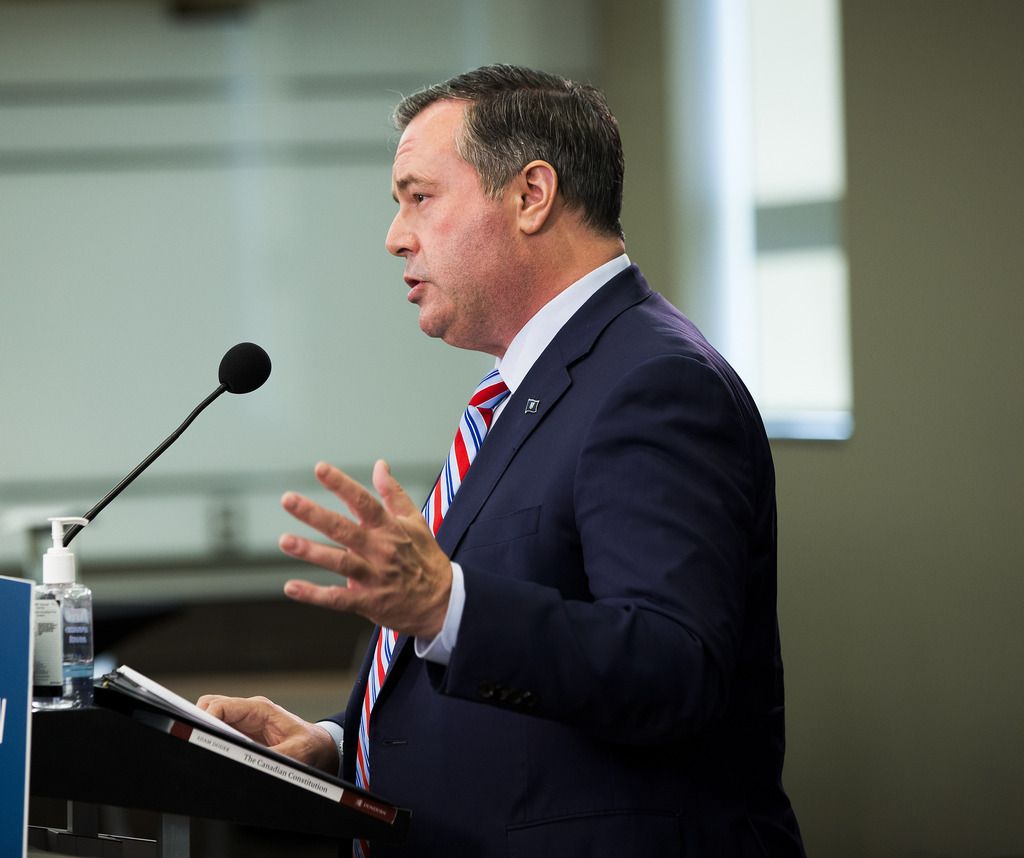
Former Alberta premier Jason Kenney and lawyer Keith Wilson clashed over separation and First Nations at a University of Alberta panel on Friday night, while all three speakers criticized aspects of the first nine questions in Alberta’s upcoming referendum. Lawyer Marie L. Gordon joined Kenney, a federalist, and Wilson, who supports separatism, at the event hosted by the University of Alberta Students’ Union. The discussion was intended to help young people at the university understand the stakes of the vote.
The panel began with the speakers challenging the first nine referendum questions, which address immigration and constitutional changes. Wilson argued that those questions would not give Alberta meaningful power to push back against Ottawa, even if a majority voted yes. He said the tenth question, on separation, was the one that could change the future for the students in the room.
“There’s only one that can change the future for the students in this room, which is question 10,” Wilson said. He later called the first nine questions “a political gimmick.”
Gordon challenged Wilson’s dismissal of the questions, although she did not endorse them. She said they should be considered for what they reveal “about the direction that this government wants to go in, and the power and control that they are seeking.” In her view, the immigration questions place blame on newcomers and temporary foreign workers for shortfalls in health care and education, while the remaining questions assign responsibility for Alberta’s economic challenges to the Senate, judges and the federal government.
“These questions are really intriguing, in terms of not only what they ask, but what they say,” Gordon said. Her point was that the wording and implications deserve attention even if the questions do not themselves give Alberta new powers.
Kenney also questioned how clearly voters would understand the questions. He said immigration policy is difficult to grasp without specialized knowledge, and that the wording could present a particular challenge to people who are not native English speakers. He warned that complexity might suppress turnout and slow voters as they work through the ballot before reaching the separation question, which he and Wilson both identified as central.
“I was the immigration minister for five years. It’s a pretty arcane, complex area that most regular folks have never had a chance to really study or penetrate,” Kenney said. “I’m a little concerned about the complexity of these, particularly for people who are not native English speakers.”
The conversation then turned to whether pursuing separation would put Alberta’s economy at risk or offer potential gains. Kenney said the province currently has strong economic momentum, with major oil and gas projects approaching. He urged people who support those projects to vote, saying, “If you support those things, I would say make sure you turn up and vote so that it puts an end to this.”
He pointed to Quebec as a warning, arguing that separation became a permanent feature of provincial politics and was followed by economic decline. Kenney said some Alberta separatists want to use a potential vote to pressure Ottawa, as they believe Quebec did, but he disputed the idea that this approach worked well. He cited the departure of hundreds of thousands of people and a collapse in Quebec’s real estate market, adding, “There’s a reason why the Bank of Montreal is in Toronto.”
Gordon referred to recent studies that she said indicate Alberta separation is setting the province on a path toward economic decline. She cited economist Trevor Tombe’s comparison with Britain’s exit from the European Union, known as Brexit. “He says that Brexit would be a cakewalk compared to what’s going to happen to landlocked Alberta as a separate country,” Gordon said.
Wilson rejected comparisons with both Quebec and Brexit. He argued Alberta would not be abandoning its trading partners and described the province as the third-biggest purchaser of Ontario goods. He said Alberta would not quickly replace Ontario with another customer. In his view, the corporate departures that affected Quebec could not be repeated in the same way because Alberta’s oil reserves cannot be moved elsewhere.
“The bottom line is you can relocate a car plant from Quebec or Ontario to New York State or Detroit, you cannot relocate what Alberta has,” Wilson said. Kenney agreed that Brexit was not the right comparison. He added, “I would have voted for Brexit as a patriotic Brit, by the way,” before saying, “I happen to think voting for option one is the patriotic position.”
The debate grew sharper when the speakers discussed First Nations. Kenney said Alberta’s resource economy relies on co-operative relationships with 47 First Nations and Métis communities. He described those ties with the energy industry as generally positive over seven decades and said separation would discard them, creating another source of economic decline.
Wilson focused on the treaties, which he said cover all the land in the province and predate Alberta’s creation. He argued that because the agreements were made with the Crown before the constitutional changes that established Alberta, they could continue under another constitutional arrangement. “The law is clear, that you can have a change in constitutional arrangement, and there’s no adverse effects on treaty rights or traditional rights,” Wilson said.
Kenney interrupted to dispute Wilson’s authority to make that claim on behalf of First Nations. “Keith, you do not speak for the First Nations,” Kenney said. “Their elected councils and chiefs do, and they unanimously disagree with you.” The exchange brought the panel’s disagreement over separation into focus, with the speakers contesting both its economic consequences and its relationship to treaty rights.
In their closing remarks, Kenney maintained that Alberta should end the separation issue now. Wilson described that position as undemocratic. Gordon closed by saying she wanted the province to move away from “toxic politcal conversations that divide all of us.” She said, “We are Canadians. We need to stand together.”
Based on reporting by Edmonton Journal.