
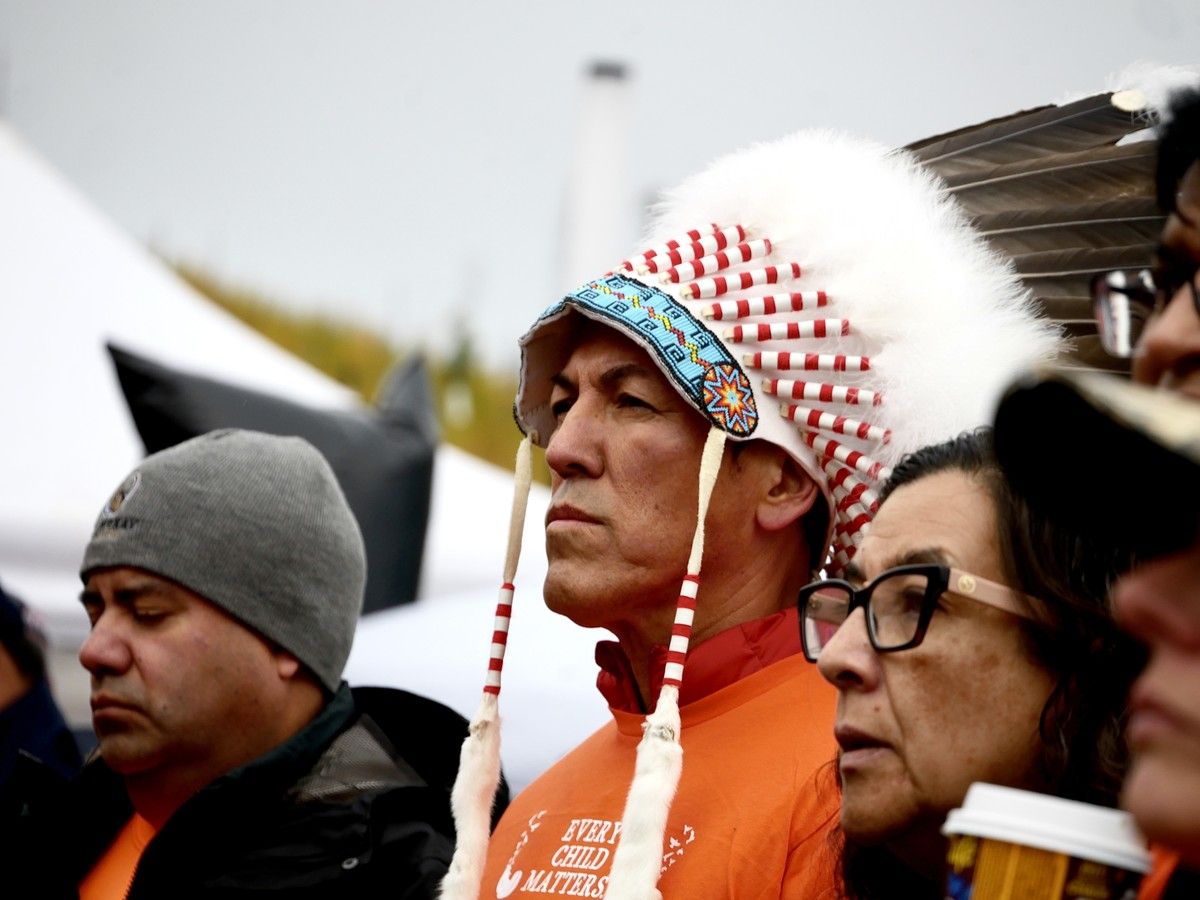
Chief Raymond Powder condemned a white nationalist group’s demonstration on Tk’emlups te Secwepemc reserve in Kamloops, British Columbia, as he addressed the National Truth and Reconciliation Gathering in Fort McMurray. He said the incident should not be taken lightly and urged people to stand with residential school survivors and oppose displays that deny the schools’ history.
Second Sons Canada staged the demonstration on Sept. 27, three days before the National Day for Truth and Reconciliation. More than a dozen men, wearing black and white face coverings, displayed a banner reading “Got bones?” above the Trans-Canada Highway. The gathering took place near the former residential school, where unmarked graves were discovered five years ago.
“When you see the white nationalists, Second Sons that were standing there on Indigenous land, that is not a pleasant view,” Powder said. He added that Indigenous Peoples, First Nations and Métis “are not only the First people, but are the First Sons of this land.”
Hundreds of residents, families and community members gathered Wednesday morning at kiyām Community Park in Fort McMurray to mark the National Day for Truth and Reconciliation, also known as Orange Shirt Day. Many wore orange T-shirts and sweaters. First Nations and Métis leaders joined them to offer encouragement and express solidarity as the Survivor’s Flag was raised; a heavy silence settled over the outdoor park.
Powder called for solidarity against displays denying residential schools and said greater accountability was needed from Indigenous communities, stakeholders, governments and educational institutions to support the whole community. He said promises had been made, but trust remained lacking.
“There have been signs of progress and moments of goodwill but there’s still a long road ahead of us,” he said. “Authentic reconciliation requires sustained effort, and a shared resolve to correct the past wrongs.”
Chief Melody Lepine of the Mikisew Cree First Nation echoed Powder’s call, emphasizing the need to honour Indigenous Peoples’ strength and resilience. She said survivors had often kept their experiences private for many years, and that sharing their accounts has helped create a way toward healing and understanding.
“Many survivors carried their experience in silence for many, many, many years. However, by speaking their truth, they have created a path towards healing and understanding,” Lepine said.
The gathering came as survivors and their families continue to live with the effects of residential schools. More than 134 federally funded residential schools operated in Canada between 1893 and 1996. The Indian Residential Schools Settlement Agreement formally recognized 25 residential school locations in Alberta.
Among them was Holy Angels Indian Residential School in Fort Chipewyan, in northeast Alberta on the western shore of Lake Athabasca. It stood on rural land west of Fort Chipewyan and operated under Catholic doctrine from 1900 until 1974. The school closed in 1974 and was demolished by 1975.
The last known residential school in Canada officially closed in 1996, 30 years before the date of the gathering’s report. The intergenerational trauma experienced by survivors’ families continues today.
The report also cited a related story about masked white nationalists bringing what it called an “odious message” to Kamloops, as well as a report that RMWB council approved a residential school memorial in Fort Chipewyan. It listed IUmanah@postmedia.com as a contact and invited readers to bookmark FortMcMurrayToday.com, EdmontonJournal.com and EdmontonSun.com, sign up for the Fort McMurray Today newsletter, and subscribe for unlimited access to The Edmonton Journal, The Edmonton Sun, the National Post and 13 other Canadian news sites.
Based on reporting by Edmonton Journal.