
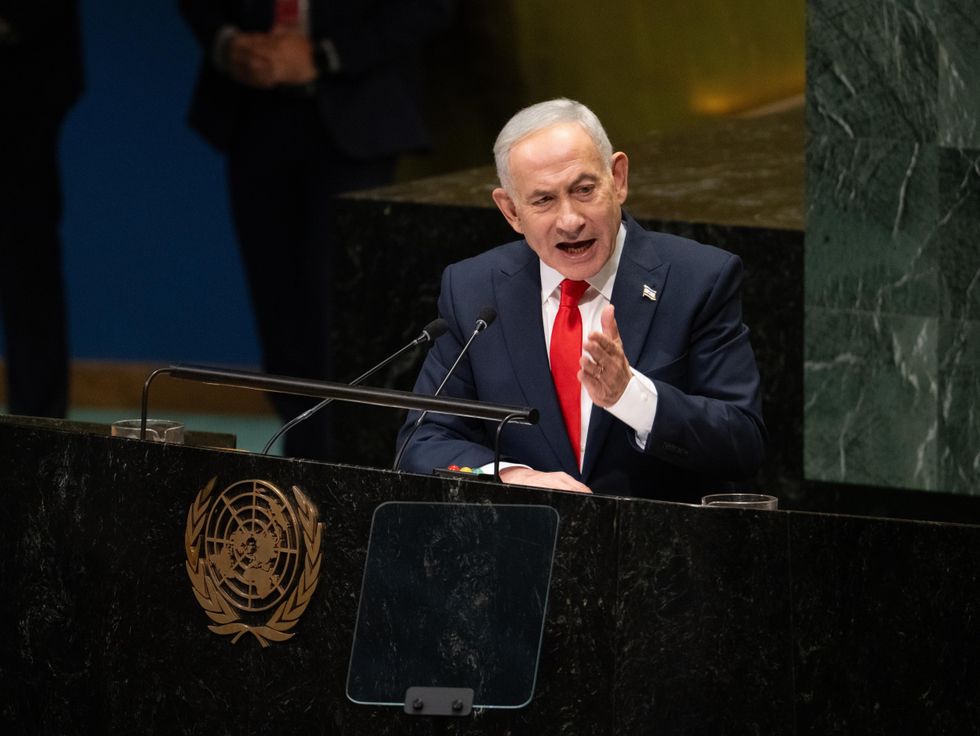
Israeli Prime Minister Benjamin Netanyahu’s criticism of Turkish President Recep Tayyip Erdoğan at the United Nations came as an Israeli airstrike near Turkey’s border brought months of political and diplomatic tension closer to a direct military confrontation. In August, Israeli warplanes struck Abu al-Duhur Airbase in northwestern Syria, about 43 miles from the Turkish border, leaving craters in its runway. As with earlier Israeli attacks around T4 and Palmyra in Homs province, the strike was conducted without advance notice to Ankara.
During a speech at the United Nations the previous week, Netanyahu called Erdoğan a “tyrant” and accused him of seeking control of Syria. “Now he wants to take over Syria,” Netanyahu said. “Well, that's not surprising because he calls for Israel's destruction almost every single day.”
The Israeli government has described its strikes as preventive measures intended to stop a larger Turkish presence in Syria before it develops. Turkey, alongside the United States, has become one of the main military and political partners of Syria’s post-Assad government. But the Abu al-Duhur attack also illustrates the risk that strikes aimed at preventing a possible future Turkish deployment could raise the chance of conflict rather than reduce it, particularly when there is no immediate military threat.
The Israeli prime minister’s office said intelligence indicated that Abu al-Duhur would become a Turkish military facility. Ankara and Damascus denied that claim. U.S. envoy Tom Barrack, who is often criticized by Israel, had dinner with Syrian Foreign Minister Asaad al-Shaibani in Istanbul on the eve of the strike. Barrack later said U.S. intelligence had found no evidence to support Israel’s claim.
Even if the Israeli intelligence assessment were accurate, whether a possible Turkish deployment constituted an immediate threat requiring military action remained a separate question. Retired Maj. Gen. Ateş Mehmet İrez, a former chief of operations in the Turkish Air Force, said a reported Turkish visit to the base would amount to reconnaissance or an assessment mission in operational terms. Such a visit would not, by itself, show that Turkey intended to send troops there.
Turning a survey of the site into an operational deployment would take months in war-damaged Syria, İrez said. A radar could be installed physically within days, but providing power and communications, calibrating it, integrating it into command and control, and sustaining personnel would require more time. “The picture described in Israel's justification, namely a permanent radar and air-defense network capable of restricting Israel's freedom of movement in Syrian airspace, is a matter of months, and most likely more than a year, rather than weeks,” İrez told RS.
In İrez’s assessment, Israel’s actual time pressure was political rather than technical. “Once Turkish personnel are physically present at an airbase, any subsequent strike on that same facility carries the risk of hitting the troops of a NATO member,” he said. “From that perspective, the closing window was political, not technical.”
The target selection also informed his assessment. A runway is among the quickest parts of an airbase to repair. If Israel’s goal had been to prevent a new capability from emerging, it could have waited for equipment that would be harder to replace. İrez said hitting the runway and storage areas appeared intended less to remove a capability than to set a precedent.
A radar could also affect Israel’s operations without Turkey firing a weapon. It would document Israeli flights through Syrian airspace, recording their time, altitude and route. “What radar changes,” İrez said, “is not merely control but the risk of proof.”
The attack also reflects a wider change in the status of Syrian airspace. When Syria shot down a Turkish RF-4E reconnaissance aircraft in 2012, Damascus still had a government that, despite its flaws, accepted responsibility and could be addressed through diplomacy. İrez was then the Turkish Air Force’s head of operations and briefed the cabinet during the crisis. Since December 2024, he said, Israeli strikes have left Syrian airspace “effectively ownerless.” Until recently, Israel had even prevented night flights at Syrian airports.
İrez said one of the most dangerous consequences of the Abu al-Duhur attack was a shift in the threshold for a crisis, from what a state had actually done to what it might intend to do. “Classical deterrence responds to something the other side has done. Here, the response is to something that has not yet been done,” he said. “By moving the crisis threshold to the level of intent, this logic also changes the basis of the rules of engagement. Rules of engagement are tied to observable behavior or a violation. A threshold based on intent leaves the two sides without a common standard.”
Israeli operations near Turkey’s border without notice have a longer history. In 2007, Israeli jets crossed into Turkish airspace and dropped fuel tanks on Turkish territory during a mission to attack a suspected nuclear site near Deir ez-Zor. “The increase in precautions in the region actually began in 2007, despite the good relations at the time,” İrez said. “Measures that began as temporary steps in those years have since been expanded and made permanent.”
The latest round of technical deconfliction talks between Ankara and Tel Aviv followed Israel’s strikes on T4 the previous year and took place in Azerbaijan. İrez said a channel that Israel could bypass without warning offered little protection against an incident.
Turkey’s response to Abu al-Duhur was restrained. Ankara tracked the Israeli aircraft and took precautions as they approached the border, but did not intervene. Turkey’s 2015 shootdown of a Russian Su-24 remains its best-known example of enforcing rules of engagement along the Syrian border, but earlier incidents also prompted action. After the 2012 RF-4E crisis, Ankara tightened its rules. Turkish F-16s shot down a Syrian Mi-17 in 2013 and a Syrian MiG-23 in 2014 after airspace violations. At Abu al-Duhur, İrez said, Turkey “tracked the flights and took precautions, but refrained from intervening despite the aircraft passing close to the border.”
Ankara’s decision also had a political dimension. In Turkey, current tensions are widely blamed on Netanyahu’s choices rather than seen as evidence of an enduring break with Israel. Likud has featured Erdoğan on campaign billboards during Israel’s election campaign, which Turkish officials and media have followed almost as closely as a domestic campaign. Some in Ankara view a response to the strike as a risk of accepting Netanyahu’s provocation and giving him a crisis to use in campaigning.
That concern has also been raised inside Israel. After Netanyahu posed in front of a fighter jet and warned of attacks before the election, opposition figures accused him of using military bases as campaign props. Still, İrez cautioned that Turkey’s restraint should not be taken as unlimited patience. “Operations in Syria based solely on anticipation are creating an atmosphere in which tensions can easily turn into a direct military confrontation,” he said.
Airstrikes may delay the alleged future deployment, but they cannot halt Turkey’s wider integration with Syria, the source said. Ankara’s involvement reaches beyond any one airbase and includes support for rebuilding Syrian state institutions, from the army to the power grid. Syrian units train at Turkish army facilities, Syrian cadets attend Turkish military academies, and Syrian troops took part in Turkey’s flagship EFES exercise for the first time this year.
Turkey has supplied armored vehicles and trained Syrian police, while its intelligence service works closely with Damascus. Twelve days after the Abu al-Duhur strike, despite Israeli warnings against Turkish moves toward southern Syria, Turkish and Syrian forces completed their second joint floating bridge over the Euphrates in Deir ez-Zor.
The rivalry between Turkey and Israel is unlikely to end soon, but avoiding a kinetic conflict in Syria remains possible. Washington, having chosen to give Syria’s new government a chance, has an ongoing responsibility to help stabilize the country and prevent two close allies from entering an avoidable conflict. The United States has said it is working on a trilateral deconfliction mechanism. The next step is to make it a direct political channel with clear notification rules so future incidents can be handled before they trigger a military confrontation.
Based on reporting by Responsible Statecraft.