
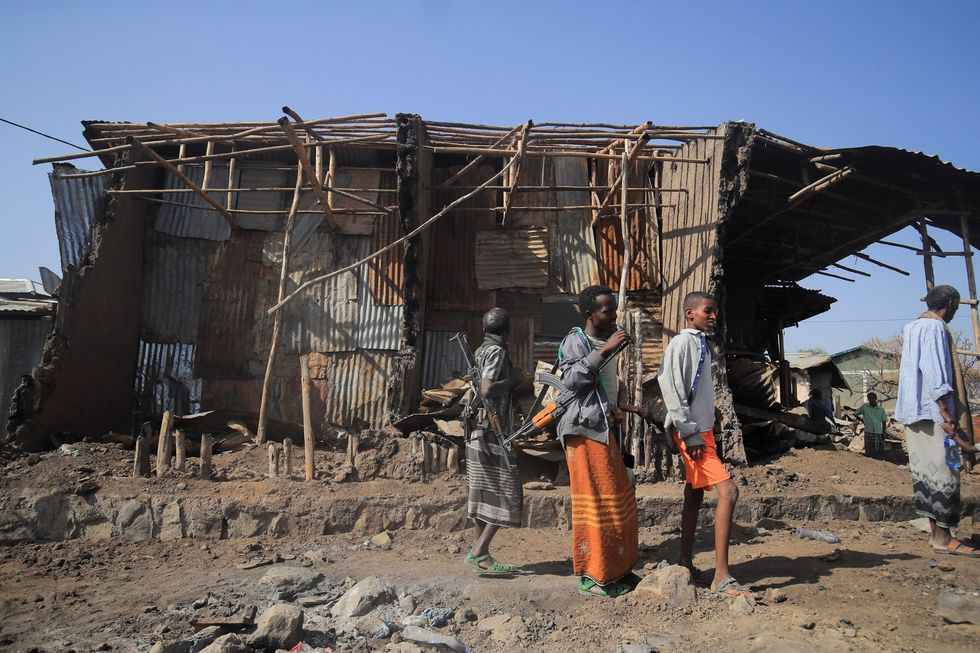
Fighting between Ethiopian federal forces and rebel groups in the northern states of Tigray, Amhara and Afar killed hundreds last week, raising fears that Ethiopia could be headed towards another civil war. The country is still recovering from the 2020-2022 conflict, which killed approximately 600,000 people, and renewed clashes could draw in neighbouring countries already facing their own disputes and conflicts.
The violence escalated as seven rebel groups from different parts of Ethiopia announced a military coalition, the Ethiopian Peoples’ Forces Alliance for Survival. The alliance says its aim is to remove from power the federal government led by Prime Minister Abiy Ahmed Ali. So far, the most significant fighting has remained in Tigray, where the previous civil war was fought.
The Tigray People’s Liberation Front (TPLF), the main rebel group, made substantial territorial gains in the state last week. Its forces took control of Alula Aba Nega International Airport in Mekelle, Tigray’s capital, and airports in the nearby cities of Axum and Shire. Ethiopian Airlines then suspended service to those airports, cutting off much of Tigray from commercial air travel.
The Ethiopian military appears to have recovered some ground in recent days. On Monday, the government and allied militias said they had recaptured Alamata, a strategic town about 75 miles south of Mekelle. The competing gains have followed months of rising tensions and sporadic clashes across Tigray.
The rebellion has brought together groups that fought on opposite sides in the last war. The Fano National Movement, a separatist coalition based in northern Amhara, supported the federal government against the TPLF during that conflict. It has now joined forces with the TPLF against the government in Addis Ababa.
Fano has pursued its own campaign to end what it calls the “oppression” of Amhara by the federal government, and has fought federal forces to seek that goal. Its alliance with the TPLF aligns with its push for greater independence from a government it views as overbearing, despite the groups’ former rivalry.
The latest escalation follows a political shift in May, when the TPLF reclaimed control of Tigray’s political administration. The group said the federal government had failed to fulfil its obligations under the Pretoria Agreement, which ended the previous civil war. Since then, sporadic fighting between federal troops and TPLF forces has broken out in several parts of the state.
Federal drone attacks, which have killed civilians, have also drawn scrutiny from human rights activists. They argue that the attacks should be investigated for possible war crimes. The renewed clashes are therefore unfolding amid unresolved disputes over the peace agreement and concerns about civilian harm.
Washington has mostly adopted a wait-and-see approach, although the violence is beginning to draw attention in Congress. Semafor reported on Monday that Senate Democrats, led by Sen. Jeanne Shaheen (D-N.H.), are pressing Secretary of State Marco Rubio to intervene. What such an intervention might involve remains unclear.
The White House imposed visa restrictions on unnamed TPLF officials in June after reports of clashes between the group and federal forces. A few weeks ago, however, Washington lifted sanctions on Eritrean officials and the Eritrean military. The Biden administration had imposed those sanctions during the previous war to curb Asmara’s role in the fighting. Removing them could make it easier for Eritrea to intervene if conflict resumes.
Eritrea backed Ethiopia during the previous civil war, viewing the TPLF and its ambitions as a threat to its interests. Relations between Eritrea and Ethiopia have since deteriorated following the signing of the Pretoria Agreement, prompting Eritrea to shift its support away from the federal government and towards the TPLF.
A central source of tension is Ethiopia’s renewed push for access to the Red Sea. Ethiopian officials have increasingly sought free access to Eritrea’s Port of Assab, which Ethiopia controlled until Eritrea became independent in 1993 and Ethiopia lost its coastline. Ethiopia now relies on the port in neighbouring Djibouti for most of its maritime trade, under an agreement that costs between $1.5 billion and $2 billion a year in fees.
Egypt is another potential regional influence. Cairo and Addis Ababa have a long-running dispute over the Grand Ethiopian Renaissance Dam (GERD), a major hydropower project on the Nile. Inaugurated on September 9, 2025, after about fourteen years of construction, it is the largest hydropower generator in Africa.
Egyptian officials say the dam threatens the country’s water security because Ethiopia’s control could reduce the water flowing downstream. They warn that lower flows could severely threaten Egypt’s extensive irrigation system, which supports its agricultural economy. Cairo has sought leverage with Addis Ababa partly through diplomatic backing and, at times, military assistance to neighbouring governments with strained relations or overlapping territorial claims with Ethiopia.
Those countries include Eritrea, which has received diplomatic support; Sudan, which has received diplomatic support and may have been offered arms sales; and Somalia, where Egypt has offered diplomatic support and deployed troops. Sudan is engaged in a brutal civil war, with its army fighting the Rapid Support Forces for control of the country. Somalia has spent decades fighting armed groups and is also contending with growing ties between foreign governments and several regions that claim independence from the central government.
The combination of changing alliances and intense domestic conflicts in surrounding countries could make a new war in Tigray difficult to contain. A wider, multi-layered regional conflict has become a distinct possibility. The analysis argues that Washington has little choice for now but to monitor events and consider targeted sanctions case by case against entities that could intensify the fighting, including Eritrean officials.
It also argues that military intervention by the United States should be ruled out, while the country remains preoccupied with the consequences of its ill-planned war against Iran.
Based on reporting by Responsible Statecraft.