
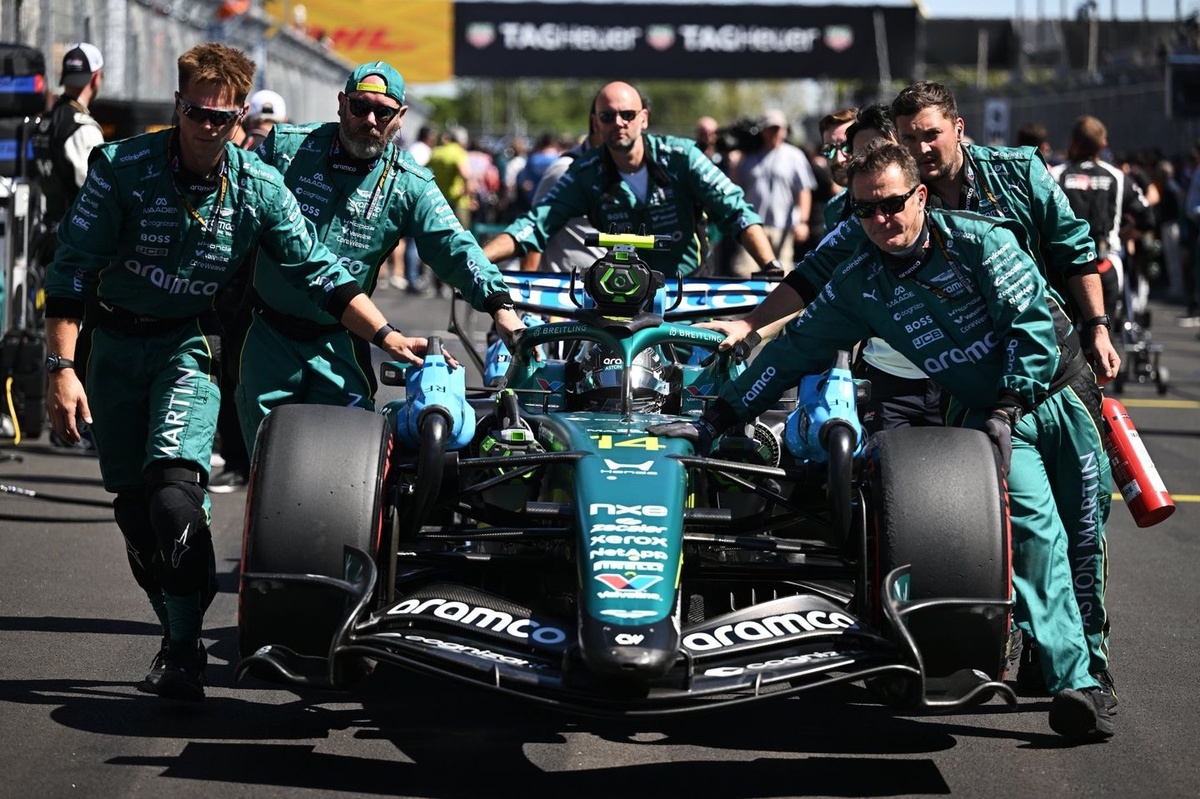
Honda introduced its second Formula 1 Additional Development and Upgrade Opportunities (ADUO) update at the Spanish Grand Prix, months before the power unit was fitted with its first ADUO upgrade in the Netherlands, Honda Racing Corporation president Koji Watanabe said. The Spanish change focused on the turbocharger and was installed in Lance Stroll’s car, while the Netherlands upgrade was part of a new power unit specification.
Aston Martin and Honda had struggled from the start of the season. The team’s performance improved slightly after a major chassis upgrade at the Hungaroring, and it later introduced the Netherlands power unit, known as Spec 2, with the first ADUO update. Honda’s internal combustion engine had been measured as more than 4 per cent behind the Red Bull Ford Powertrains engine, which was rated as having the season’s highest output. That gap allowed Honda to use two ADUO tokens during the season.
Honda and HRC had previously said they planned to use only one of those opportunities. Asked by Autosport why Honda had decided to use only one ADUO upgrade, Watanabe said: “We used both of them,” then explained: “We introduced the first ADUO upgrade in the Netherlands, and then we put a PU incorporating the second update into Lance Stroll's car at the Spanish Grand Prix.”
“The Spec 2 PU we introduced in the Netherlands had some drivability issues, so we introduced an improved turbo at the Spanish Grand Prix,” Watanabe said. Asked whether the aim was to address turbo lag, he replied: “Yes.” The FIA’s power unit component usage list showed Stroll received his fifth turbocharger of the season at the Spanish Grand Prix. Fernando Alonso’s car received its fifth turbo at the Azerbaijan Grand Prix, which the report said appeared to be the upgraded version.
Watanabe said Honda split the work because it wanted to bring Spec 2 to the track in the Netherlands while developing a response to turbo lag at the same time. “It would have been better if we could have introduced everything at once, but it was important to introduce Spec 2 in the Netherlands first. We were also working on measures to address the turbo lag in parallel, so we introduced that in Spain,” he said. “So the application ended up being split between the two.”
Honda has now used all its ADUO opportunities for the season, but Watanabe said its power unit still has performance potential that the team has not fully extracted. When Honda supplied Red Bull, it was not permitted to introduce performance upgrades. It continued using simulations to find the unit’s operating limits and gradually raise them year after year, a process Honda called “reliability development”.
The report cited Red Bull’s 2024 car as an example: it used extremely small sidepods and smaller openings for cooling airflow, changes made possible in part by raising the power unit’s operating limits. Watanabe said Honda’s work now would centre on making better use of its existing hardware and preparing developments for the future.
“As far as ADUO is concerned, we have used up our opportunities for this season. From here, we will continue working on things that don't involve hardware, as well as developments that will lead into the future”, Watanabe said. “I don't think we are anywhere near extracting the full performance of the PU. I believe there is still room to improve its competitiveness.”
“There were still areas where we were lacking power, so we developed Spec 2 with target figures in mind. We have achieved those targets, so for the remainder of the season, our focus will be on making full use of what we have, rather than continuing to develop the hardware,” he said. “Even so, we want to make sure we are able to fight properly.”
Based on reporting by Autosport.