
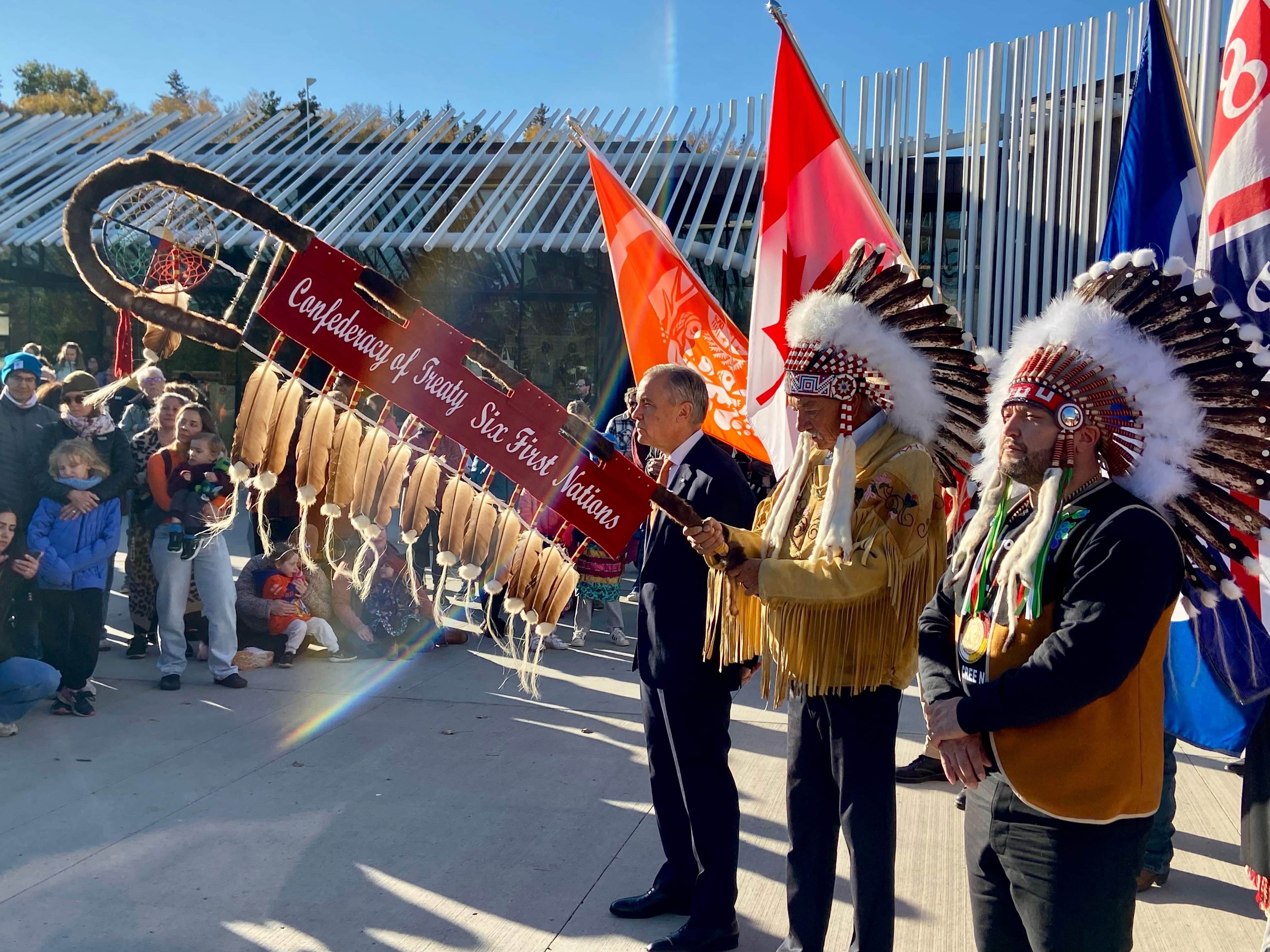
Prime Minister Mark Carney said Canada owes residential school Survivors and their families more than remembrance as Canadians marked the National Day for Truth and Reconciliation on Wednesday, Sept. 30. Speaking at Fort Edmonton Park in Edmonton, he called the Truth and Reconciliation Commission’s 94 Calls to Action a roadmap for the work ahead. “We owe them action. The Truth and Reconciliation Commission’s 94 Calls to Action remain a roadmap for that work,” Carney said in a statement issued before the event.
Carney’s statement was released in English, French and nine Indigenous languages: Algonquin, Denesuline, Innu-Aimun, Inuktitut (Northern Baffin), Mi’kmaq, Michif, Oji-Cree, Plains Cree and Western Ojibway. At the Edmonton event, he said Canadians should not choose which parts of the past to remember. “We shouldn’t admire the beadwork and forget the children that were forced into uniforms. We shouldn’t honour the drum and ignore the years that it was made to fall silent,” he said. “And we should not hear the truth of residential schools and fail to act on it.”
The commission’s 94 recommendations remain at different stages, according to independent monitor Indigenous Watchdog. Fourteen have been completed in the 11 years since the commission’s final report, 41 are considered in progress, 24 are stalled and 15 have not been started.
Conservative Leader Pierre Poilievre also attended the Edmonton event. In a social media post, he described residential schools as a “massive intrusion of government coercion imposed on Indigenous families.” He said: “They removed children from their parents and communities, while attempting to break their connection to their very identity.”
Poilievre said the day was an occasion to honour the children, families and communities affected by the schools and to recommit to reconciliation grounded in self-determination, opportunity and true partnership. Carney, in his statement, said, “The federal government established and sustained this system, and Canada bears responsibility for the profound and enduring harm it caused.”
Beginning in the 19th century, more than 150,000 Indigenous children in Canada were separated from their families and communities and sent to residential schools run by churches and funded by the government. Abuse, malnutrition and inadequate health care were widespread in the schools. The Truth and Reconciliation Commission concluded in its landmark 2015 final report that the system was a central element of a state-backed policy of cultural genocide.
The National Day for Truth and Reconciliation, observed on Sept. 30, was among the recommendations in the commission’s report. More than 6,600 Survivors and witnesses came forward to share their experiences with the commission. “Their courage ensured that Canada listened, remembered, and reflected,” Carney said.
Governor General Louise Arbour called for “honest dialogue, ongoing learning and concrete action.” In a statement Wednesday, she said many Canadians, including herself, did not grow up knowing this history. “Facing it can be painful and unsettling, but understanding the truth is essential to building a more just future,” Arbour said. “We cannot change the past, but we can choose how we move forward,” she added, saying reconciliation “begins with listening with empathy to First Nations, Inuit and Métis voices.”
CBC/Radio-Canada, APTN and the National Centre for Truth and Reconciliation hosted their annual Remembering the Children event on Parliament Hill. The 90-minute ceremony featured speeches by residential school Survivors, elders and Indigenous leaders. Performances by Tia Wood, Soleil Launière, Silla and Adrian Sutherland were also scheduled.
Guests and participants were encouraged to bring a pair of children’s shoes and place them at the front of the stage to honour children who attended residential schools. Separate events marking the day were taking place across the country, including in Toronto, Vancouver, Calgary and Iqaluit.
Stephanie Scott, executive director of the National Centre for Truth and Reconciliation, said the day was an opportunity to honour every child taken by the residential school system and stand with those who survived. “As denialist voices seek to distort the past, our collective responsibility to uphold the truth is more important than ever,” she said. “Honouring these children means facing our history with unwavering honesty and ensuring that ‘Never Again’ is not just a phrase, but a binding commitment backed by meaningful action.”
Canadian Heritage Minister Marc Miller said the day gives Indigenous and non-Indigenous Peoples an opportunity to come together and reflect on the schools’ legacy. “Reconciliation is a responsibility we all share, and by connecting with each other and our history, we can help build a future grounded in understanding, respect and hope.”
Based on reporting by Global News Edmonton.