
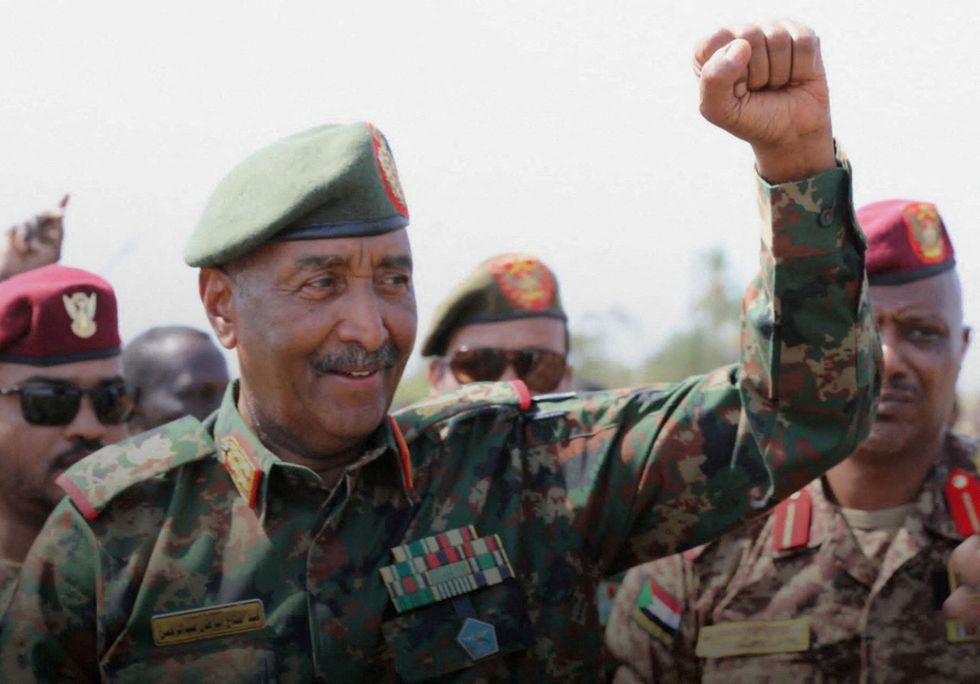
Sudan’s army chief Abdel Fattah Burhan was in Khartoum on September 24 instead of addressing the United Nations General Assembly in New York, after he was reportedly offered a U.S. visa on the condition that he sign a 90-day ceasefire. Burhan rejected the condition, then told a crowded stadium in Khartoum on September 26: “we do not want a visa to any country...we will stay here with you until we die here in this country.”
The ceasefire proposal had been promoted for months by Massad Boulos, U.S. President Donald Trump’s adviser for Arab and African affairs. Reuters reported that the visa offer was conditional on Burhan agreeing to the plan. Days later, Burhan said Sudan could not be “blackmailed,” referring to the denied visa.
The episode comes as U.S. policy toward Sudan’s civil war has grown more hostile toward Burhan and the Sudanese Armed Forces (SAF), which he leads. In a May interview, Boulos had described the army as the “constitutional institution” that must be preserved. The SAF is also Sudan’s internationally recognized government, a status that shapes debate over arms supplies and the proposed ceasefire.
The war began in April 2023, when the SAF split from the Rapid Support Forces (RSF), a paramilitary group it had once nurtured. The conflict has created the world’s largest displacement crisis and caused famine in parts of Sudan. Both sides face accusations of atrocities, while the gravest allegations have been directed at the RSF. When the group captured el-Fasher in October 2025, the United Nations said the violence bore “hallmarks of genocide.”
The SAF currently holds battlefield momentum. During the past year, it recaptured Khartoum and large areas of central Sudan. Just days before Burhan’s September speech, it took Sodari, a strategic town in North Kordofan state. Those gains put the army at the edge of Darfur, the RSF’s stronghold. SAF forces and their allies had been driven violently from the region the previous year when el-Fasher fell.
High-level defections have also weakened the RSF. Against that backdrop, an outright military victory for the SAF appears possible for the first time since the war began. The U.S. has increased pressure while the army is advancing, with most of that pressure falling in practice on the side gaining ground.
Washington imposed sanctions on Burhan in January 2025, citing his refusal “to participate in international peace talks” and “indiscriminate bombing of civilian infrastructure.” In May 2025, the U.S. government determined that Sudan’s government, led by the SAF, had used chemical weapons.
In early September, The New York Times and The Washington Post reported on a “secret dossier” alleging chemical weapons use by the SAF. The reporting drew on information provided by a “Middle Eastern intelligence agency.” The allegation is serious and supports Washington’s earlier determination, but the reported programme appears to have ended, caused no confirmed fatalities and was described in a dossier that contained no victim testimony.
Sources who spoke to Middle East Eye said the dossier originated with Israeli intelligence. The account has drawn attention because Israel has reportedly had recent contacts with RSF leaders and is regionally aligned with the United Arab Emirates (UAE), the paramilitary group’s primary foreign patron.
While the chemical weapons allegations were becoming public, the U.S. was also trying to expand a United Nations arms embargo on Sudan. The existing restrictions apply to weapons flows into Darfur, which is dominated by the RSF. Boulos and U.S. Ambassador to the U.N. Michael Waltz have advocated extending the embargo across the entire country.
Boulos and Waltz described the proposed measure in a Foreign Policy article as applying to both sides “with no carve-outs.” A nationwide embargo would formally cover the SAF and RSF alike, but the article argues it would affect them differently. The SAF’s weapons purchases are currently those of an internationally recognized government defending itself; under an embargo, those purchases would become contraband. The RSF, as a paramilitary force without that standing, would lose no equivalent status.
Boulos has also repeatedly avoided naming the UAE when discussing foreign support for the RSF. Conflict experts, U.S. lawmakers and American sanctions have identified Abu Dhabi as the group’s main foreign backer, supplying drones, armoured vehicles and Colombian mercenaries. When the BBC asked Boulos directly about Abu Dhabi’s role, he said only that “there might be some traders or whatever that are doing these sorts of supplies.”
The war is also entangled with an increasingly sharp rivalry between the UAE and Saudi Arabia. In November 2025, Saudi Crown Prince Muhammad Bin Salman (MBS) pressed Trump at a White House meeting to take part in peacemaking in Sudan. Burhan welcomed the initiative and reportedly told MBS in a phone call before the trip that the war could not end without U.S. pressure on Abu Dhabi.
That approach came from Riyadh and favoured the SAF. Saudi Arabia sees the army as a bulwark against state collapse, rather than treating it as one of two morally equal combatants, a position attributed to Washington and Abu Dhabi. Trump pledged in November to “start working on Sudan,” but his attention has since been consumed by a grinding war with Iran. The Sudan file has been left to Boulos, whose responsibilities cover the entire African continent.
Riyadh and Abu Dhabi have since diverged on several fronts. The Emirates left OPEC in the spring, where Riyadh is the de facto leader, and deepened defence ties with Israel during the U.S.-Iran war. Saudi Arabia took a different course, joining the Mecca Defense Pact with Turkey and Pakistan. The pact is widely viewed as an effort to curb Israel’s hawkishness and establish collective deterrence.
Saudi banks have quietly increased scrutiny of transfers to the UAE, applying enhanced anti-money-laundering checks used for high-risk jurisdictions. Cargo trucks at the countries’ shared border reportedly waited for days this summer for Saudi clearance. In New York, Emirati presidential adviser Anwar Gargash said: “the areas of interest between us and Saudi Arabia far outweigh any sort of disagreement.” Reporting on the countries’ differences points to a more strained relationship.
Saudi concerns about Sudan are also tied to security along the Red Sea. The kingdom’s war against the Houthis across its southern border recently resumed after Houthi gains on Yemen’s western coast. Riyadh has long viewed the prospect of a second fractured state on the Red Sea, potentially overrun by a group it neither trusts nor controls, as a threat. That concern helped prompt Saudi Arabia to co-host the first ceasefire talks in Jeddah at the start of Sudan’s war.
Saudi Arabia is pushing back as its patience with Washington’s handling of Sudan appears to diminish. The Africa Report said Riyadh recently threatened to leave the “Quad,” the mediation group convened by Washington and including Cairo, Riyadh and Abu Dhabi.
In New York, Saudi Arabia’s foreign minister met with Egypt’s foreign minister and the foreign ministers of Turkey and Pakistan, Riyadh’s partners in the Mecca Pact. All four countries back Sudan’s army: Turkey supplies drones, while Pakistan has sent armoured vehicles. Their statement supported Sudan’s “legitimate national institutions” and rejected “parallel entities,” language that favoured the SAF and opposed the RSF. Neither Washington nor Abu Dhabi attended the meeting.
Burhan’s rejection of the visa condition puts the need for his cooperation at the centre of a peace process that depends on his agreement. The episode also reflects mounting frustration among U.S. partners in the Middle East over the direction of American policy toward the war, with one exception.
Based on reporting by Responsible Statecraft.