
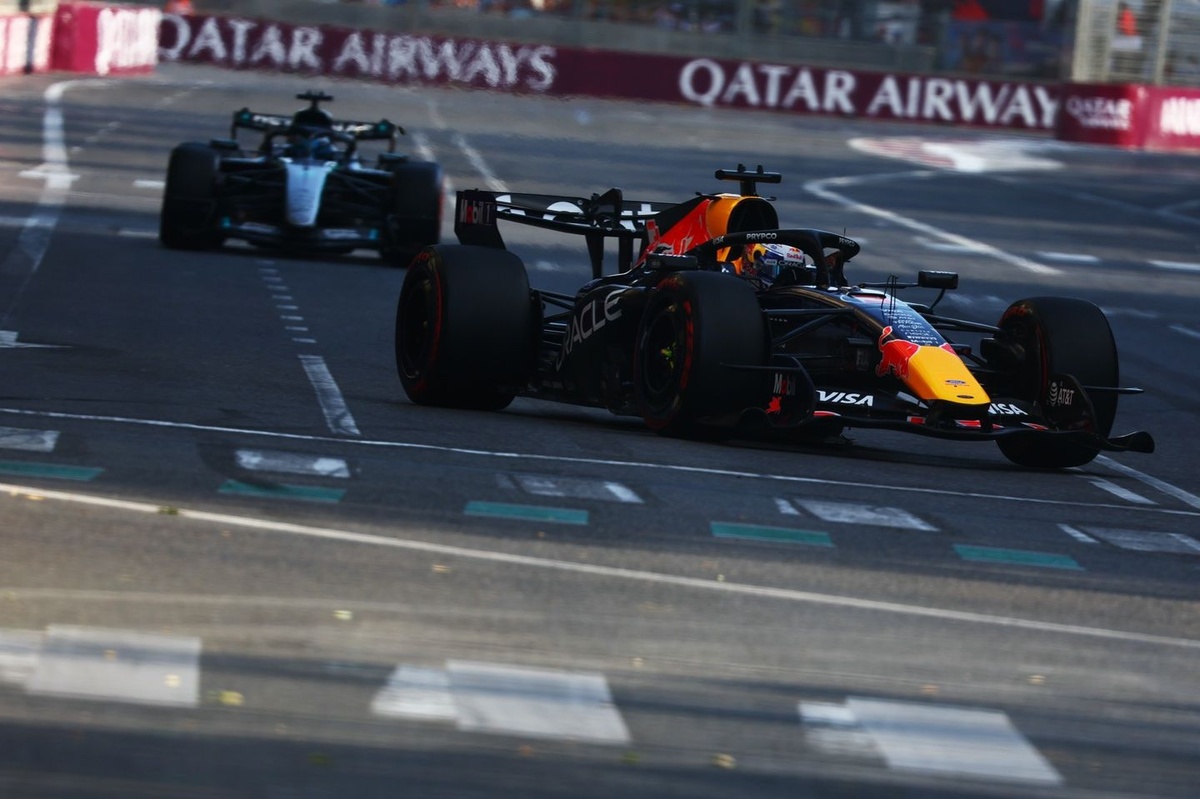
Red Bull’s power unit and recent car upgrades helped Max Verstappen and Isack Hadjar finish second and third at the Azerbaijan Grand Prix in Baku, giving the team its first double Formula 1 podium in almost two and a half years. The result followed repairs to Verstappen’s internal combustion engine after a problem in qualifying left him eighth on the grid. Red Bull said a stronger result, including a possible victory, could have been within reach without that setback.
The performance was a sharp change for a team that had been regarded as having the fourth-fastest car on the grid for long stretches of the season. Both drivers moved through the field in Baku, where the car’s pace on the straights helped them pass frontrunners. Red Bull team principal Laurent Mekies said the weekend’s performance reflected work the team carries out routinely to get the most from its power unit.
“We have a fantastic PU, we have a fairly narrow band to use it at best. And it takes a lot of energy from everyone back in Milton Keynes and on the race track to try to keep us on the narrow window of performance. So that's what we do every day, there was nothing different this weekend,” Mekies said.
“Every track comes with this challenge on how you do that and you hear it with our radio communications, with our drivers. So getting the right energy management, getting the right deployment and getting the right power is certainly something that keeps us busy.”
The FIA has assessed Red Bull as having the strongest power unit, an advantage Mekies described as potentially both a blessing and a curse. Red Bull’s internal combustion engine is understood to be the most powerful on the grid, but extracting that performance requires the team to keep it within a relatively narrow operating range and optimize its electrical deployment. In Baku, that combination gave the cars substantial speed on the long straights.
Red Bull’s sister team, Racing Bulls, uses the same engines. Its driver Liam Lawson recorded the race’s top speed-trap reading, 349.4 kilometres per hour. Verstappen and Hadjar also ranked among the top 10 for highest speeds, giving both drivers the means to make progress through the field.
Mekies said Verstappen’s qualifying trouble had cost the team, while noting that two separate power-unit problems had affected its cars. “We had two different issues in terms of power units,” he said. “It has cost us a lot yesterday [in qualifying]. But that's what it is, that's part of the game.”
He added that Verstappen had been strong from Friday and could have contested a front-row start if the engine issues had not intervened. “I think in fairness Max was very strong from Friday onwards and probably would have been fighting for that first row or more yesterday without the issues we had with the PU. So of course, fixing that today [in the race] with the new engine has allowed us to go back to the competitive level that we were hoping to have.”
Verstappen had viewed Baku as Red Bull’s best and potentially last opportunity to claim its first win of 2026. The source report said Mercedes, described as the dominant team, was due to bring a major upgrade package to the following weekend’s Bahrain Grand Prix in Malaysia. Red Bull, meanwhile, has said it will not introduce another major upgrade package this year.
Mekies said the competitive order this season has shifted as teams introduced upgrades at different times. During a long stretch between the races in Australia and Baku without a major Red Bull package, the team nevertheless reduced the gap, he said. He cited Madrid, where Red Bull was a tenth and a half from pole, and Monza, where it was two tenths from pole.
“We have seen this year the pecking order has been alternating based on the timing of the upgrades,” Mekies said. “I think what is however important is that in the fairly long timeframe between Australia and here, where we didn't have a big package coming, we have nonetheless managed to close that gap.”
He said work by the chassis and power-unit groups, along with extracting more from the existing car specifications, contributed to that progress. “So we have managed to close that gap with everyone in the team, chassis side, PU side, extracting from the actual car specifications. And then yes, the upgrades today probably gave us another edge and has eaten up that last tenth.”
Mekies said Red Bull would need to see whether the gains persisted at other circuits and how it responded to rivals. “We need to see how it's lasting on other tracks and then how we will react to the other competitors.” The team remains hopeful of avoiding its first winless Formula 1 season since 2015.
Based on reporting by Autosport.