
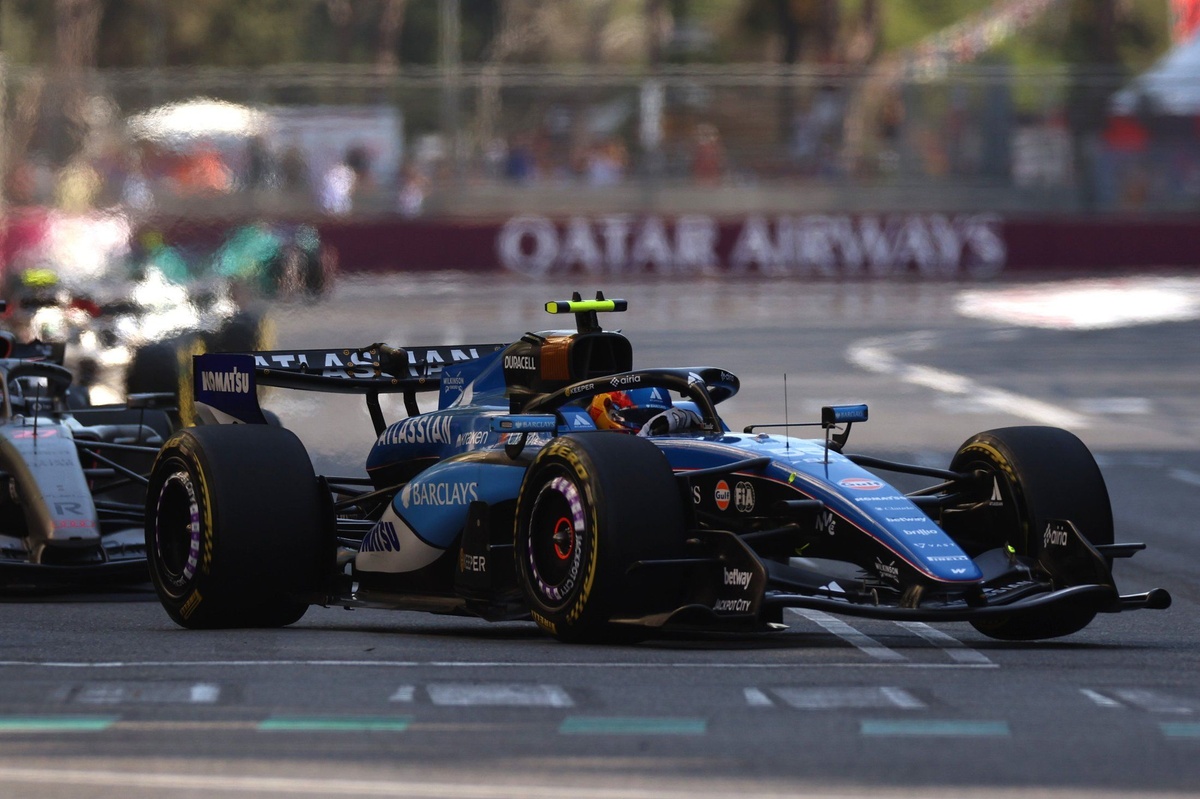
Williams left the Azerbaijan Grand Prix with a point and a clearer measure of its new car, after an upgrade helped Carlos Sainz reach Q3 for the first time in 2026. The result was tempered by Sainz’s grid penalty and Alex Albon’s crash, while the team expects its pace to face a harder test at the next rounds in Malaysia and Singapore. Williams is ninth in the standings, and its leaders described the Baku changes as a foundation for the 2027 car project.
The Grove-based team had marked Baku as a key opportunity to introduce long-awaited performance improvements to the FW48. The car received an all-new chassis, finally at the required weight, along with a new floor and other aerodynamic parts. The team had gone months without significant upgrades.
Practice offered an early sign of improvement. Williams’ long-run pace in the second practice session, FP2, looked encouraging and suggested it could join the midfield group alongside Haas, Racing Bulls and Audi. In qualifying, Sainz secured ninth place, but a grid penalty dropped him to 14th, behind Albon.
From that position, the chance to score points appeared to be slipping away. The race changed after Franco Colapinto took out Pierre Gasly and Lando Norris at a restart. Williams ultimately earned a point for 10th place, its first points since Monaco, though the result came with some fortune and Albon retired.
Team principal James Vowles said the update had required a major effort from the team. “It's been a mammoth effort to bring the update that we have here this weekend and it's nice to walk away with a point,” he said. He also identified a problem in the race’s opening phase: “You can see we didn't have the pace on that first stint, and we need to dig and understand that because that was a critical part of the race where we weren't able to make progress.”
Albon said the car’s performance matched what Williams had expected, even if the team had not necessarily anticipated reaching Q3. “I think it's exactly the step we expected,” he said. “Maybe we didn't expect Q3, to be fair to you. But yes, it put us in a midfield fight.”
Sainz likewise described an improvement, while stressing that Williams still has ground to make up. “Our initial feel is that the car feels just a bit quicker,” he said. “But we were so far away that even though we've been bringing such a big upgrade, it still feels like we are playing a lot of catch-up. So as promised, no big massive surprises in terms of pace, a healthy step forward.”
Baku’s suitability for Williams also complicates the picture. The circuit favoured the team even before the upgrade, according to Albon, so the result does not settle how the new parts will perform elsewhere. Malaysia’s Sepang circuit and Singapore’s street track place a greater emphasis on downforce, a characteristic expected to make the coming races more difficult for Williams.
“This track, even without the upgrade, it would have favoured us,” Albon said. “Malaysia will be telling to see where we are on a much more downforce-focused circuit. We've also got now a few days to actually understand the package.” He said there was scope to improve the car through optimisation, but predicted it would lose ground relative to rivals in Malaysia. “If you look at the big picture, we'll make the car go faster in terms of optimising it. But we'll be slower relative to the rest of the field, because that track will not suit us. Expect us to fall back in Malaysia, and then maybe in Singapore we can come somewhere in between.”
Albon’s race ended in a crash that brought out the safety car on lap 31. He accepted responsibility for braking too late, while saying a gust of wind contributed to the incident. He also said the crash exposed a recurring weakness in the car’s braking behaviour.
“It was odd,” he explained. “I braked a little bit later, but not much later. Then we had a big wind gust. I thought I would run a little bit wide, but I never thought I would hit the wall.” Albon said he had to accept responsibility, but noted that the team had encountered similar issues before. “I'm sure I have to hold my hand up in that situation, but at the same time we've had these issues before. We know our car likes to lift the front wheel and we three-wheel. We know when we brake a little bit late, we can expose ourselves to that three-wheeling. And sometimes when it does that, the penalty for front locking is huge on our car. It happens.”
He said the combination of the wind and late braking pushed the car beyond its limit. “For sure, with the wind gust and braking late at the same time, it just tips it over the edge. It wasn't a huge amount; it was a few metres, but that's too much.”
The upgrade’s value may extend beyond Williams’ immediate results. The team is using the chassis redesign and aerodynamic work to assess its development process and gather evidence as planning for 2027 advances. The latest chassis is expected to carry over into that season, addressing one major item early. The article described 2026 as a lost season on track for Williams, which remains ninth in the standings.
Vowles told Sky he expected the team to make progress after the major rule change. “I'm confident you're going to see us stepping forward now that that big rule change is behind us,” he said. He noted that 2027 will still bring an aerodynamic change and a power unit change, but said their smaller size should be manageable. He added that recovering from problems over the winter will take time, and that Williams needs more investment to keep pace with teams ahead, while the cost cap limits that investment.
“[The upgrade] is directionally right,” Vowles said. “I think more importantly, it's the foundation we wanted to set ourselves for next year. We recognise this year's a little bit behind us, unfortunately, but there's a lot to do in going into 2027.” Autosport’s report ended by inviting readers to say what they would like to see from the publication in the future, and was signed by the Autosport.com Team.
Based on reporting by Autosport.