
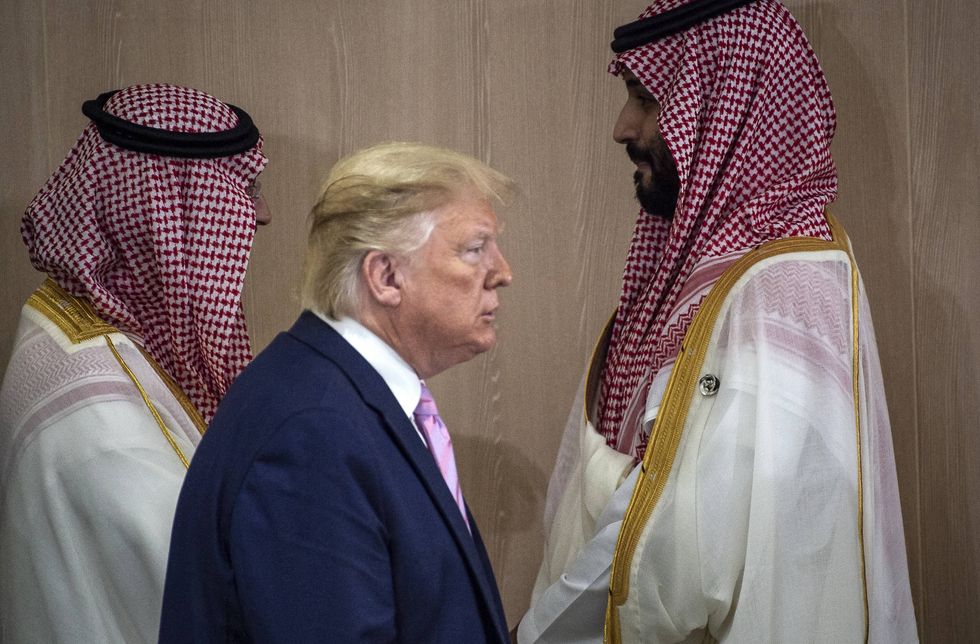
Four Democratic members of the U.S. House have introduced a resolution to disapprove President Donald Trump’s nuclear cooperation agreement with Saudi Arabia, arguing it lacks safeguards against the Kingdom producing nuclear fuel or pursuing a bomb. Representatives Gregory Meeks, Brad Sherman, John Garamendi and Don Beyer say the pact does not require Saudi Arabia to renounce uranium enrichment and spent-fuel reprocessing, or to adopt the International Atomic Energy Agency’s Additional Protocol for inspections.
The resolution comes as a war with Iran has heightened regional nuclear risks. It faces long odds: Democrats need Republican support to pass it in both chambers, and if Trump vetoes it, opponents would need two-thirds majorities in the House and Senate to override him. Congress must vote within a 90-session-day review period or the agreement takes effect automatically. That period began after Trump sent the deal to Congress in late August.
The agreement establishes a 30-year framework for peaceful nuclear cooperation. It would allow the United States to transfer nuclear material, equipment, components and information to Saudi Arabia for peaceful purposes, including technology for power reactors. The pact does not itself provide a reactor, approve a specific export or establish an enrichment facility; each would require further U.S. approval.
In a letter to Congress backing the agreement, Trump said it “would permit the transfer of material, equipment (including reactors), components, and information for peaceful nuclear purposes” and “the transfer of sensitive nuclear technology to support a joint enrichment and conversion study or upon written agreement of the parties but would not permit the transfer of restricted data.” The agreement thus leaves open the possibility of future enrichment or reprocessing cooperation, although it does not authorize an enrichment plant on its own.
The first concern raised by the lawmakers and critics is the absence of a commitment against those parts of the nuclear fuel cycle. Saudi Arabia would not be required to give up enrichment or reprocessing, unlike the United Arab Emirates, which renounced both in its nuclear agreement with Washington. The UAE pact is widely considered the “gold standard.”
The proliferation concern is sharpened by comments from Saudi Crown Prince Mohammed bin Salman. He said in 2018 and again in 2023 that “if Iran developed a nuclear bomb, we would follow suit as soon as possible.” The source text notes that an enrichment facility or the reprocessing of spent fuel could give Riyadh options that critics view as significant risks, even though no such facility is established by the current agreement.
Inspection arrangements are a second concern. Saudi Arabia has had a Comprehensive Safeguards Agreement with the IAEA since 2009. A “Small Quantities Protocol” had suspended many reporting and inspection procedures while the Kingdom possessed very little nuclear material. Riyadh rescinded the protocol at the end of 2024 as it prepared to expand its civilian nuclear programme, bringing the fuller safeguards procedures under the Comprehensive Safeguards Agreement into effect.
The Comprehensive Safeguards Agreement does not include the IAEA’s Additional Protocol, which gives inspectors broader powers to investigate possible undeclared nuclear activities. The U.S.-Saudi pact does not require Saudi Arabia to adopt that protocol, an arrangement described in the source as unprecedented. Instead, it calls for additional IAEA verification at sites covered by U.S.-Saudi cooperation.
Critics say Congress should establish whether inspections limited to those sites could identify activity elsewhere, and what conditions the U.S. government would impose before approving enrichment cooperation. The resolution could also prompt hearings and media attention that press the administration to disclose the safeguards arrangement, clarify whether side letters exist and preserve congressional oversight of export approvals and later enrichment decisions.
Political disagreements could complicate implementation. Trump has said Saudi adoption of the Abraham Accords and normalization of relations with Israel are conditions for the deal. The White House has said the agreement would be off without normalization. Saudi leaders, however, continue to demand a pathway to Palestinian statehood before considering normalization and are frustrated by Washington’s decision to link nuclear cooperation to relations with Israel.
The published nuclear agreement does not explicitly make normalization a condition. That difference between Trump’s public position and the written terms could stall implementation before the most difficult technical questions are resolved. The article also notes that the deal’s viability is uncertain even apart from congressional action.
A renewed conflict involving Yemen’s Houthis is adding strain to the relationship. Saudi Arabia has sought stronger U.S. action as Houthi advances threaten its security and Red Sea shipping routes, while Trump has held back from another military escalation. Reporting on the dispute indicates Washington and Riyadh disagree about what their partnership should require during a regional war.
That tension may leave both governments with less room to compromise on nuclear conditions. It does not guarantee the agreement will collapse, but a Saudi enrichment project would depend on diplomacy beyond the nuclear file. The source says the pact weakens the standard Washington is seeking in any eventual nuclear negotiation with Tehran, while also facing the possibility it could fall apart before its sensitive nuclear provisions are implemented.
U.S. policymakers can distinguish between helping Saudi Arabia generate electricity and helping it produce its own nuclear fuel, the source argues. A reactor needs fuel, but the country operating it does not have to enrich uranium. The UAE provides an example: its four Barakah reactors generate electricity using fuel bought from international suppliers, while the country has ruled out domestic enrichment.
Saudi Arabia could likewise contract for reactors and purchase fabricated fuel assemblies abroad. Conventional power reactors generally use uranium enriched to about 3 to 5 per cent, and do not require the operator to run centrifuges. Riyadh could argue that domestic enrichment would protect it from interruptions in foreign supply, much as Tehran has argued, but the source points to alternatives: contracts with several suppliers, reserves of fabricated fuel and arrangements for replacement fuel over a reactor’s lifetime.
Those options would not require an enrichment plant in Saudi Arabia. Congress could support a civilian nuclear power programme while setting a substantially higher threshold for any U.S. assistance with enrichment. The source argues that the same proliferation test should apply to Riyadh and Tehran, even though one is a U.S. partner and the other a declared foe, because the technology has the same proliferation potential in either country.
Washington also helped strengthen Nuclear Suppliers Group guidance on transfers of enrichment and reprocessing technology. The source warns that carving out exceptions for allies could set a poor example for nuclear suppliers and countries seeking nuclear power, including Iran. A recent Institute of Global Affairs poll found that 43 per cent of Americans believe Iran is more likely to develop a nuclear weapon than it was a year earlier, before U.S. attacks on its nuclear facilities.
The source adds that after attacking Iran and starting a war, the United States does not know how much Tehran is enriching, if anything, because there is no verification. Congress’s review of the Saudi agreement offers an opportunity to ask what inspectors can establish, which transfers can still be stopped and what would happen if the political bargain fails. The agreement may never lead to a Saudi enrichment plant, but the rules set during its review could outlast the Trump administration and the current war.
Based on reporting by Responsible Statecraft.