
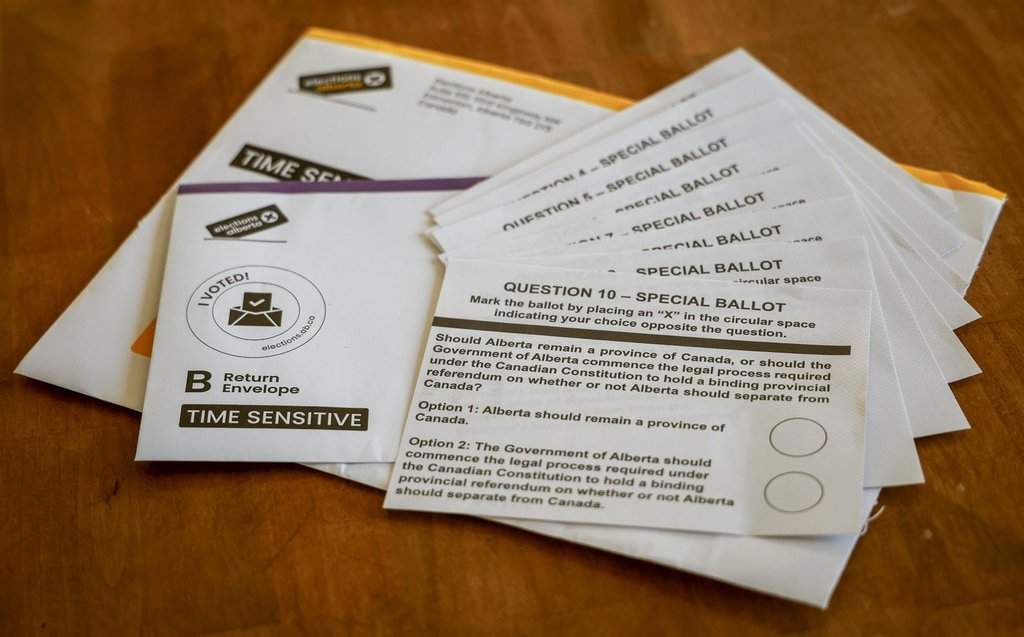
Albertans will vote on 10 questions on Oct. 19, covering immigration, access to provincial programs, election rules, constitutional changes and whether Alberta should begin the legal process for a binding referendum on separation from Canada. The separation question has drawn much of the attention, but Premier Danielle Smith is also asking voters to weigh proposals she has presented as ways to address provincial concerns while avoiding a break with the country.
The first question asks whether Alberta should take greater control over immigration to reduce arrivals to more sustainable levels, prioritize economic migration and give Albertans first priority for new jobs. Smith has said she wants an arrangement similar to Quebec’s accord with Ottawa, which allows that province to set eligibility requirements for economic migrants. In February, she described a “normal” and “sustainable” immigration level as less than one per cent of Alberta’s population, or about 50,000 newcomers a year.
Critics have argued that Smith’s government failed to plan for population growth it encouraged through a countrywide advertising campaign in recent years. The debate over immigration levels is tied to pressure on public services. Smith has blamed rapid population growth over the past five years for overburdened services, while critics say the province has not accounted for the economic contributions and benefits newcomers bring.
A second question asks whether Alberta should pass a law limiting provincially funded programs, including health care, education and other social services, to Canadian citizens, permanent residents and people with an Alberta-approved immigration status. The provincial government’s website says temporary residents cost Alberta more than $1 billion in health care, education and social services. Critics dispute those figures, and say they overlook the economic contributions temporary residents make.
The practical effect of a yes vote on that proposal remains uncertain because the government says it will define “Alberta-approved immigration status” only after the referendum. The third question asks whether people with non-permanent legal immigration status should have to live in Alberta for at least 12 months before qualifying for provincially funded social support programs. The question assumes Canadian citizens and permanent residents will continue to qualify as they do now.
The government has not said which programs would be covered by a 12-month residency requirement if voters approve it. Temporary workers are already ineligible for some provincial programs, including Assured Income for the Severely Handicapped. The Canadian Bar Association’s provincial chapter has said a proposed restriction could conflict with the Canada Health Act or equality provisions in the Charter.
The fourth question asks whether Alberta should charge a reasonable fee or premium to people with non-permanent immigration status who live in the province, for their own and their family’s use of health care and education. Citizens and permanent residents would continue to qualify for public health care and education under the terms of the question. The government would set any new charge after the vote, although Smith told Calgary business leaders on Sept. 22 that a health premium could reach $1,900.
Education leaders in Alberta have opposed restricting access to schooling, saying such limits would run against internationally agreed children’s rights. The referendum question does not state what a fee would be or how it would apply. Those details remain for the government to determine after the vote.
A fifth question asks whether voters should have to show proof of Canadian citizenship, such as a passport, birth certificate or citizenship card, to vote in an Alberta provincial election. Only Canadian citizens are currently eligible to vote. Elections Canada and Elections Alberta have both reported very few cases of ineligible voting.
Smith has said citizenship documentation would strengthen the integrity of provincial elections. Critics say the requirement could lengthen lineups at polling places and create opportunities for racial or ethnic bias at the voting booth. The question asks voters to support or reject a new legal requirement for proof of citizenship.
Four questions propose constitutional changes. The sixth asks whether Alberta should work with other willing provinces to amend the Constitution so provincial governments, rather than the federal government, select justices appointed to provincial King’s Bench and Appeal courts. Approval by Alberta voters would commit the provincial government to work with other provinces and federal lawmakers on the change; it would not make the change by itself.
General constitutional amendments usually require approval from seven provincial legislatures representing at least 50 per cent of Canada’s population, along with the House of Commons and Senate in Ottawa. The seventh question asks whether Alberta should work with willing provinces to amend the Constitution to abolish the unelected federal Senate. That proposal faces a higher bar: abolition would require unanimous provincial approval and ratification by both the Senate and the House of Commons.
The eighth question asks whether Alberta should pursue a constitutional amendment allowing provinces to opt out of federal programs that intrude on provincial jurisdiction, including health care, education and social services, while retaining associated federal funding for their own social programs. Ottawa’s spending power allows the federal government to attach conditions to funding given to provinces. Health-care funding under the Canada Health Act is a key example of that arrangement, and a permanent provincial opt-out clause would require a constitutional amendment.
The ninth question asks whether Alberta should work with willing provinces on a constitutional change giving provincial laws priority over federal laws when they conflict in provincial or shared areas of jurisdiction. Under the current Constitution, federal laws take precedence over provincial laws when jurisdictional issues arise. The proposed change would require approval from the Senate, House of Commons and seven provinces representing at least half of Canada’s population.
The tenth and final question asks whether Alberta should remain a province of Canada or whether its government should start the legal process required under the Constitution to hold a binding provincial referendum on separation. Advocates say leaving Canada would free Alberta from federal taxation and regulation, releasing wealth and encouraging economic development. Federalists argue separation would harm businesses and leave the landlocked province with debt and the substantial cost of providing services that are now federal.
Smith has characterized the other nine questions, on immigration and constitutional reform, as a political compromise. She has said the proposals could address Alberta’s grievances and give it leverage with Ottawa without dismantling Canada. The referendum will put those proposals, alongside the separation process question, to a provincewide vote on Oct. 19.
Based on reporting by Global News Edmonton.