
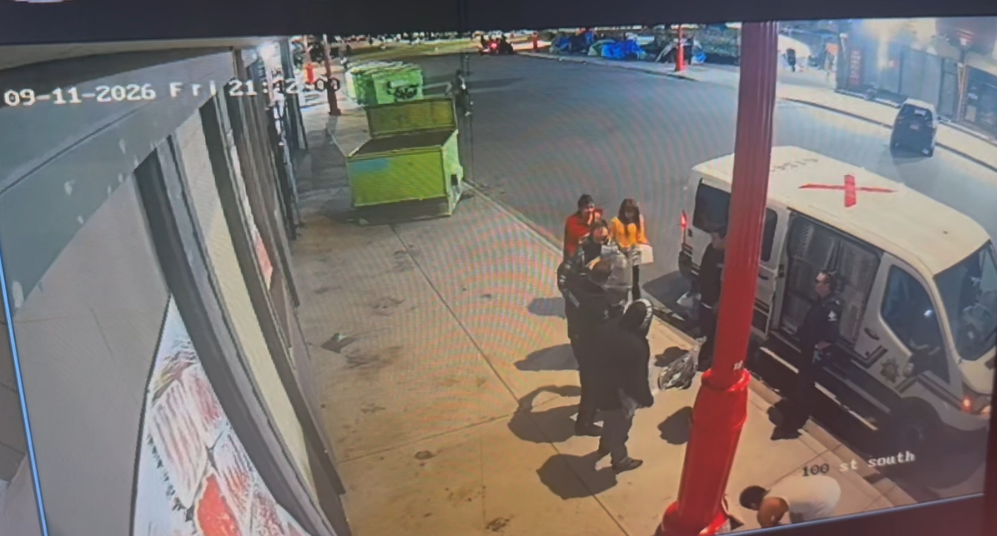
Alberta Public Safety Minister Mike Ellis said two recent incidents in which former correctional facility detainees were dropped off on Edmonton streets resulted from “human error.” Surveillance video published by CBC and Global News earlier this month showed provincial corrections transport vans leaving detainees in an inner-city neighbourhood, prompting concern and calls for reform from officials, residents and business owners in Edmonton’s Chinatown area.
Edmonton Mayor Andrew Knack asked Ellis on Friday what the province was doing to prevent similar drop-offs. Ellis said he was outraged to learn of the incidents and said they had not followed a directive from him. Speaking at an unrelated news conference, he said street drop-offs of former detainees were not common practice. “In both of those cases, it was human error,” he said. “We’re all human beings.”
Knack and Dylan Bressey, president of Alberta Municipalities and a city councillor in Grande Prairie, said the issue extends beyond Edmonton. Knack told reporters at the Alberta Municipalities convention in Edmonton that he wanted to work with Ellis, but saw a gap between the province’s understanding of the process and what happens in municipalities. “There’s a disconnect from what is believed to be the actual process and what is actually happening in municipalities across this province,” Knack said.
Bressey said communities near correctional facilities across Alberta, including Grande Prairie, were dealing with people being released without adequate supports. “They’re getting unloaded on our city streets where there isn’t adequate social services for them, and it’s creating social chaos as well as costing a lot of money and police, fire, and parks response,” he told reporters Friday.
Bressey said he had heard anecdotes from councillors in several communities, but that they lacked good data. “For us, it’s really important that when somebody is released from either care or prison, that they’re released with a proper plan and the proper resources to help them be healthy and also receive whatever supervision or care they need going forward,” he said.
Ellis, a former associate minister of mental health and addiction, said the province’s recovery-focused system was built around arranging a supported transition. “This is what I am vehemently opposed to, is just dropping people off where they have no supports,” he said. He said Corrections Alberta had told him it would take measures to ensure the same kind of drop-off did not happen again, but he did not provide details.
Asked about reports of similar incidents in Grande Prairie, Ellis said he was not aware of them. He said Corrections Alberta would drive people to wherever they needed to go, which could mean an hours-long trip to their home community. Bressey’s comments point to the difficulty of assessing the scale of the issue: municipal councillors have shared accounts, but communities do not have reliable data, while Ellis said he had not heard of the reports from Grande Prairie.
Based on reporting by Global News Edmonton.