
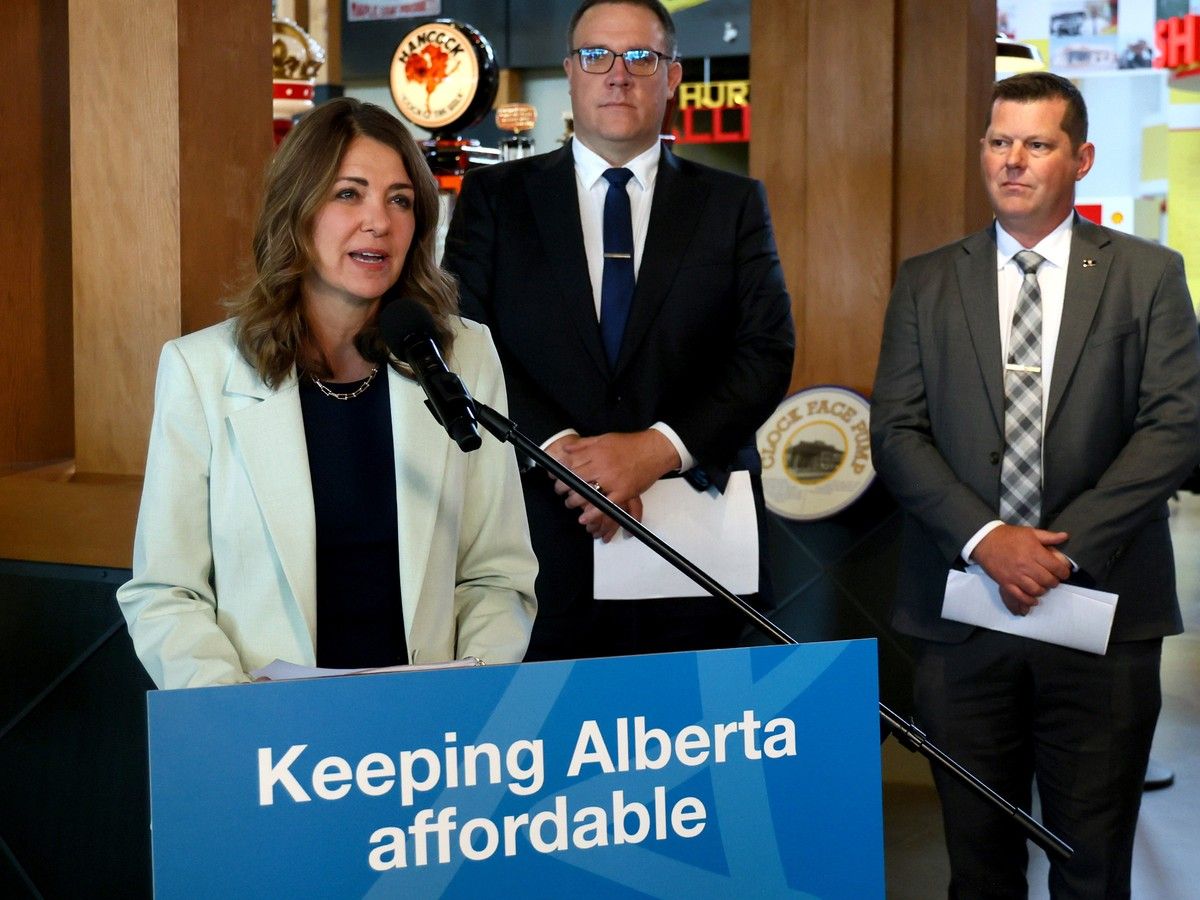
Alberta will suspend its 13-cent-a-litre tax on gasoline and diesel from Oct. 1 through Dec. 31, Premier Danielle Smith said Tuesday, giving drivers a break as producers continue to receive discounted prices for heavy crude. North American oil prices averaged nearly US$91 a barrel over the past month, triggering the tax relief, but Alberta crude sold on the open market has been trading about US$21 below those benchmarks.
The gap widened after ExxonMobil Holdings Corp. shut its refinery in Joliet, southwest of Chicago, following a power outage last week. Built in 1972 to receive Canadian crude by pipeline, the refinery can process up to 275,000 barrels a day, the company says. Its closure has reduced a major outlet for Alberta oil, even though the province also has refineries.
At a Shell station in Edmonton on Tuesday, gasoline averaged about $1.71 a litre. Leopold Kinyarwanda was filling his black Toyota 4Runner and said a tank that cost him about $65 a few weeks earlier now costs $75. He fills up every day while working six days a week and 12 hours a day, spending more than $400 a week on fuel.
Kinyarwanda has considered switching to a hybrid vehicle but cannot afford a more expensive car. Asked what he thought about saving 13 cents a litre, he raised both hands and said, “Excited,”
The tax suspension follows criticism of an earlier provincial program that offered rebates instead of reducing fuel prices. In a separate Edmonton Journal column, Lorne Gunter said the tax should have been removed over the summer, arguing that West Texas Intermediate crude traded above US$90 for much of the spring. He said the full tax should have been suspended from July 1 to Sept. 30 as well.
Gunter wrote that the United Conservative Party government chose an Alberta Energy Rebate while facing a projected $9.4-billion deficit. The program offered eligible Albertans a $100 payment, but he said only about one-third successfully received it. He described the application process as complex and intrusive, requiring applicants to provide financial information through a government web portal.
He said Albertans complained to MLAs by phone and email, objecting both to the process and to rebates being chosen over lower pump prices. Gunter speculated that officials may have designed an overly bureaucratic system to limit costs, but said he believed the process emerged from civil servants trying to distribute payments equitably. He wrote that drivers now get savings directly at the pump, without supplying social insurance numbers or the amount on line 15000 of their tax returns or their spouses’ returns. He also included a trivia question about the two Blue Jays’ second basemen in the Baseball Hall of Fame, answering Roberto Alomar and Jeff Kent.
Gunter said the government is now projecting a surplus of $2 billion to $3 billion, instead of a $9.4-billion deficit, making it more comfortable with a tax cut. He quoted Smith’s Tuesday announcement: “We have heard from Albertans who are facing continued high costs at the pump, so we’re taking action to help with the cost … It’s direct relief that will help Albertans keep more of their hard-earned money.”
Finance Minister Jason Nixon said, “With global uncertainty and prices rising, we are ensuring Albertans have the support they need to address the higher costs of everyday essentials.” Gunter also quoted the government’s claim that it is “helping make life more affordable.” He wrote that those reasons applied in June, too, and said he welcomed the decision while rejecting the idea that drivers should be eternally grateful for a measure he believed should have come earlier.
The outlook for Alberta oil producers remains uncertain. Richard Masson, former chief executive of the Alberta Petroleum Marketing Commission, expects heavy crude to remain discounted until at least February. “We’ve had production growth; the pipelines are full, and we’re likely to have wider discounts over the course of the winter,” he said. “Every time we build a new pipeline, we tend to fill it up, and then we run out of options.”
Matthew Lewis, founder of Denver-based Plainview Energy Analytics, sees room in pipelines out of southern Alberta this winter even as production rises. “If there’s no constraint on the pipelines and the refineries are back up, I think you’re in a pretty good position to see that differential narrow back to what it was a month or so ago,” he said. However, forward contracts for late 2026 and early 2027 point to Western Canadian heavy oil continuing to trade US$21 below North American benchmarks, according to Lewis’s research newsletter.
North American oil topped US$100 a barrel last week before falling to just over US$90 as markets reacted to developments in the Middle Eastern war. Lewis also pointed to a planned outage at BP PLC’s Whiting, Indiana, refinery, another major buyer of Canadian crude, but said the market generally handles planned outages well. “I would attribute most of the weakening over the past 10 days to the Joliet issue,” he said.
Suzanne Gray, a sales and services consultant at fuel pricing firm Kalibrate Technologies, said the Illinois shutdown can affect Alberta prices despite the province’s own refineries. The Prairie provinces are “part of the same supply orbit as the U.S. Midwest,” she said.
Based on reporting by Edmonton Journal.