
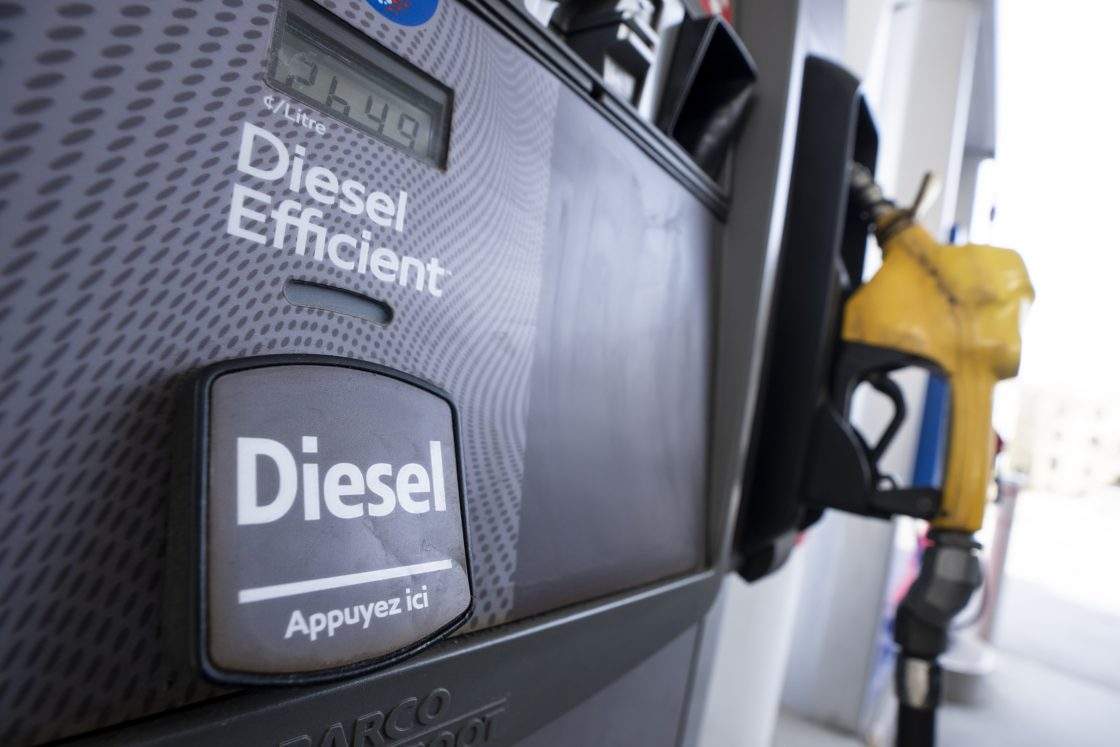
U.S. President Donald Trump has backed considering a ban on diesel exports, a move that could provide short-term relief to American consumers but push prices higher around the world, including in Canada. A Politico report on Wednesday, citing five people familiar with the discussions, said the proposal could cover a 90-day period. Experts warned that a restriction could also disrupt refining and keep prices elevated over time.
Trump spoke to reporters on Tuesday while meeting Ukrainian President Volodymyr Zelensky at a UN General Assembly. “I’ve called for that too. I’ve said, ‘Let’s not send out the diesel.’ We make a lot of diesel. That could have a little bit of an effect on regular automobile gasoline.” Treasury Secretary Scott Bessent was also present and said the administration was studying “whether it’s feasible in terms of the overall refining capacity and whether a full or partial ban would work.”
The comments came as diesel costs climbed on both sides of the border. The American Automobile Association reported the average U.S. price at a record US$6.5107 per gallon, while Canadian diesel was averaging more than CA$2 per litre at the time of publication. Restricting exports could leave more fuel available in the United States, potentially lowering domestic prices as supplies are absorbed, while removing a major source of diesel from international markets.
Richard Masson, former chief executive officer of the Alberta Petroleum Marketing Commission, said diesel is central to transportation and commerce. “Diesel is the backbone of the economy for trains, for ships, for trucks, so many trucks around the world. We depend on it,” he said. A market disruption on top of already high prices, he added, would worsen the strain, although businesses and economies would still need to buy the fuel to keep operating.
Masson said he considers a U.S. export ban unlikely. If imposed, however, he said it would add significant pressure to an already disrupted global market. Diesel prices have risen amid Ukrainian attacks on Russian refineries and the U.S.-Iran war, which has disrupted or halted trade along major routes, including the Strait of Hormuz.
The United States has become an increasingly important supplier as disruptions abroad have pushed countries to seek fuel elsewhere. It exported a record 1.6 million barrels per day of diesel in August, compared with about one million barrels per day in February, before the war began. Brazil, Chile, Mexico, Peru, Morocco, France and the United Kingdom are among the leading buyers, according to Kpler, a commodities statistics platform.
The American Petroleum Institute said a restriction would harm markets and refinery operations. “Restricting U.S. diesel exports would wreak havoc on fuel markets at home and abroad, destabilize refinery operations and deepen a global refining crisis already putting upward pressure on U.S. prices,” the group said in a statement.
Analysts who spoke with Reuters said an export ban could lower U.S. prices initially while raising diesel costs globally and reducing American refining margins. Energy economist Philip Verleger said, “Initially, a diesel ban would send global prices skyrocketing … A ban could raise world prices by as much as 100 per cent, given the fuel’s low price elasticity of demand.”
Kenneth Medlock III, a fellow in Energy and Resource Economics at the Baker Institute for Public Policy, said refiners could respond by reducing production if they lost access to overseas buyers. “Banning exports of diesel would drive refiners to cut runs because the physical market they can access would be cut, and no market participant in any market sells product at a loss. While an export ban might have a very short-term impact that lowers price, it would not be long-lived,” he said.
Fuel shortages can also feed inflation because diesel is used to move groceries, consumer goods and industrial materials. Higher transport costs would add pressure for households and businesses. Inflation is already a major concern for Trump and Republicans ahead of the November midterm elections.
Oil and gas prices are largely determined in global markets based on expected supply and demand. If U.S. diesel could no longer be exported, a domestic surplus might temporarily weigh on American prices as available fuel was used to meet local demand. At the same time, international buyers would have to find replacement supplies, potentially sending global diesel prices sharply higher.
Masson said Canadian producers could benefit from the competition for fuel, even as Canadian buyers face higher costs. “If that 1.6 million barrels a day isn’t in the market anymore, everybody else in the world is going to be scrambling to find supplies, and they’re going to come knocking at the Canadian door and ask for our supplies,” he said. Buyers, he added, would effectively offer more to secure shipments: “They’ll ask by saying, ‘We’ll pay you more if you can get it to us.’ And so prices move up. And that’s kind of the mechanism that would be a play.”
That stronger demand could raise domestic prices as well. Masson said the resulting surge in demand for diesel fuel “could result in higher prices for Canadians.” The potential policy remained under examination, with Bessent’s comments indicating officials were assessing whether a full or partial restriction could work within the country’s refining capacity.
Based on reporting by Global News Edmonton.