
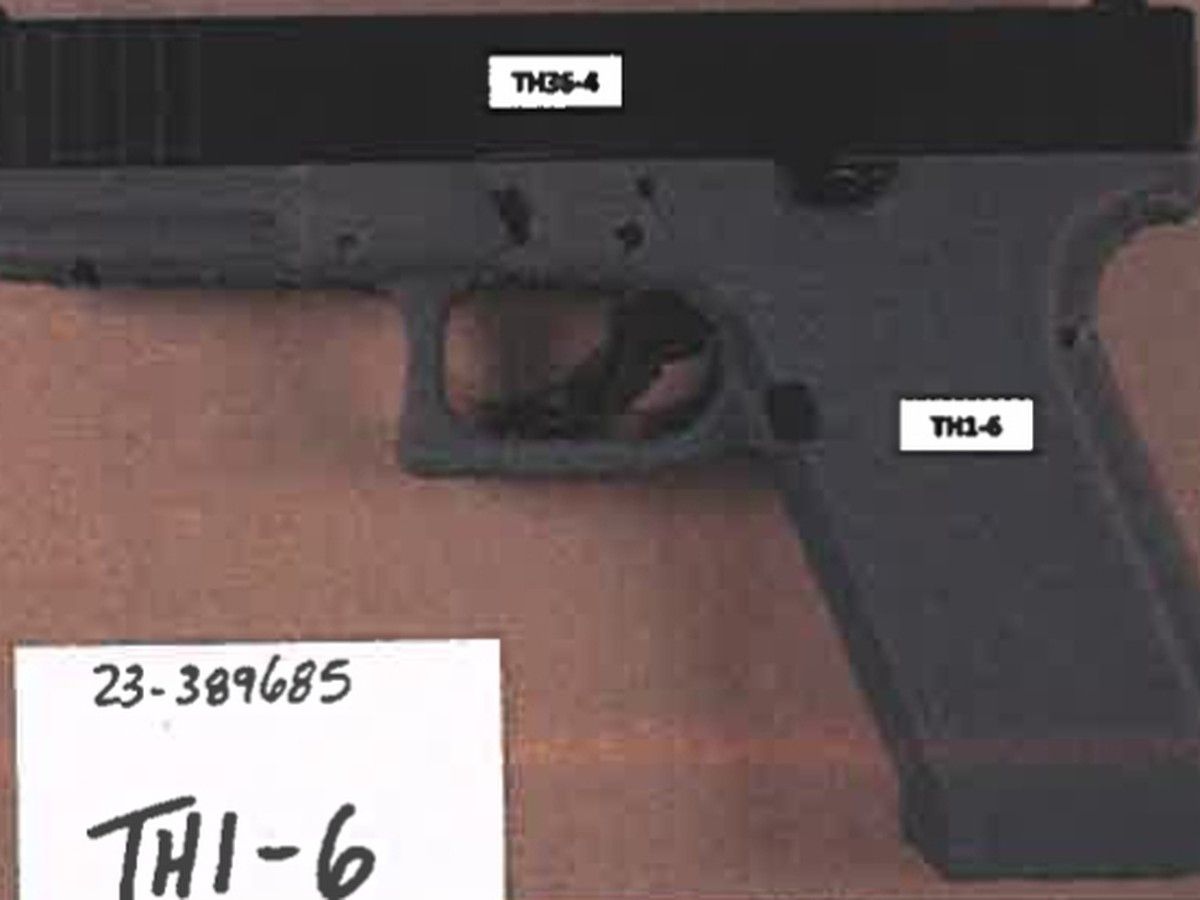
Roy Tucker, an Edmonton man who used a 3D printer to make parts for handguns, was sentenced to three years in prison Thursday after Court of King’s Bench Justice John T. Henderson rejected the defence request for him to serve his sentence in the community. Henderson said the offences were too serious for a conditional sentence, despite the absence of injuries, sales or evidence that Tucker planned to remove the guns from his home.
Tucker, 31, held his head in his hands as the sentence was delivered. Several family members bowed their heads, and one woman wept as sheriffs handcuffed him. He was released after turning himself in following his 2024 arrest and had spent no time in custody, so he will receive no credit for time served.
The Crown sought a sentence of four and a half years. The defence asked for a conditional sentence, with submissions seeking two years served in the community, including house arrest. Henderson said manufacturing illegal firearms carries a sentence of three to 14 years, while the mandatory minimum sentence was not in force when Tucker was charged.
“He is an intelligent and educated man,” Henderson said. “He possessed (appropriate licensing) for many firearms, he understood the need for regulation. He proceeded with the manufacturing of firearms in the face of this knowledge.”
The judge said that producing untraceable “ghost guns” warranted prison even when an accused had no criminal record, was remorseful and had not sold the guns or taken them out of the home. “The gravity of these offences is very high,” Henderson said. “The gravity is not diminished in any way because no one was injured … the mere presence of (illegally) manufactured firearms presents a risk to the public.”
Tucker was educated at the Northern Alberta Institute of Technology as a mechanical engineering technologist and worked for a steel pilings company. He began collecting firearms at 18 and held a possession and acquisition licence for nine restricted firearms. Henderson said Tucker’s familiarity with Canada’s rules for legal gun ownership was an aggravating factor because he would have understood the risks posed by untraceable weapons.
Police became aware of Tucker during a national investigation into illegal firearms reproduction. In 2022, Quebec investigators were examining a man suspected of importing firearm rail kits from the United States in packages described as furniture parts. Tucker had ordered several kits from the importer. CTV News reported that he purchased 12 kits, which could be used in 3D-printed gun production.
Edmonton police executed a search warrant at Tucker’s home on June 20, 2023. They found a sophisticated 3D-printing operation, 38 legally owned restricted and unrestricted firearms, 36,000 rounds of ammunition, 27 over-capacity magazines, a homemade pipe gun, a suppressor and a switchblade. The magazines, suppressor and switchblade were prohibited under the Criminal Code of Canada. Police also seized printed gun parts and other firearm components.
Tucker had printed 11 receivers for Glock-style handguns. A police gun analyst converted three into operational firearms in about 15 minutes using only parts found in the house. Court heard that eight other printed guns could have been made operational, with enough additional parts to make five more. Henderson said there was no evidence Tucker meant to sell the guns and that he made them as part of his firearm hobby.
Tucker was charged in 2024 with 43 firearm-related offences. Henderson found him guilty of manufacturing firearms after partly rejecting his application to exclude evidence obtained through the home search warrant. The judge also convicted him of illegal possession of 27 over-capacity magazines for conventional firearms.
Investigators found Tucker’s notes on weapons offences and sentencing provisions, along with a printed and highlighted copy of Bill C-21, which codified a national freeze on handgun sales. “His notes specifically refer to the provisions of Bill C-21 and the penalties associated with those provisions,” Henderson said. “He knew what he was doing was unlawful and he knew it carried a significant penalty.”
The Crown also raised handwritten notes referencing the 1989 Montreal Polytechnique mass shooting. Prosecutor Kerri Facchinutti described the comments as “alarming,” but Henderson declined to treat them as aggravating because there was too little context to establish what Tucker meant. His lawyer, Graham Rapson, said Tucker was not a misogynist and was frustrated that the federal government had invoked a mass shooting carried out with a long gun when restricting handgun ownership.
The defence argued that Tucker’s autism diagnosis should reduce his sentence. Henderson found “no nexus” between the diagnosis and the offences, despite evidence that Tucker fixated on collecting firearms and solving technical problems. He cited Tucker’s NAIT education, social relationships and long employment history in rejecting the argument that autism reduced his moral culpability. “At best, the fact Mr. Tucker has autism spectrum disorder only minimally reduces his moral blameworthiness,” Henderson said.
Henderson also considered character letters submitted for Tucker, a report assessing him as a low risk to reoffend and what the judge called a genuine show of remorse. Tucker is in a common-law relationship and has two young children, court heard. Henderson said the operation involved a high level of planning and that guns without serial numbers are particularly dangerous because they cannot be traced.
Based on reporting by Edmonton Journal and CTV News Edmonton.