
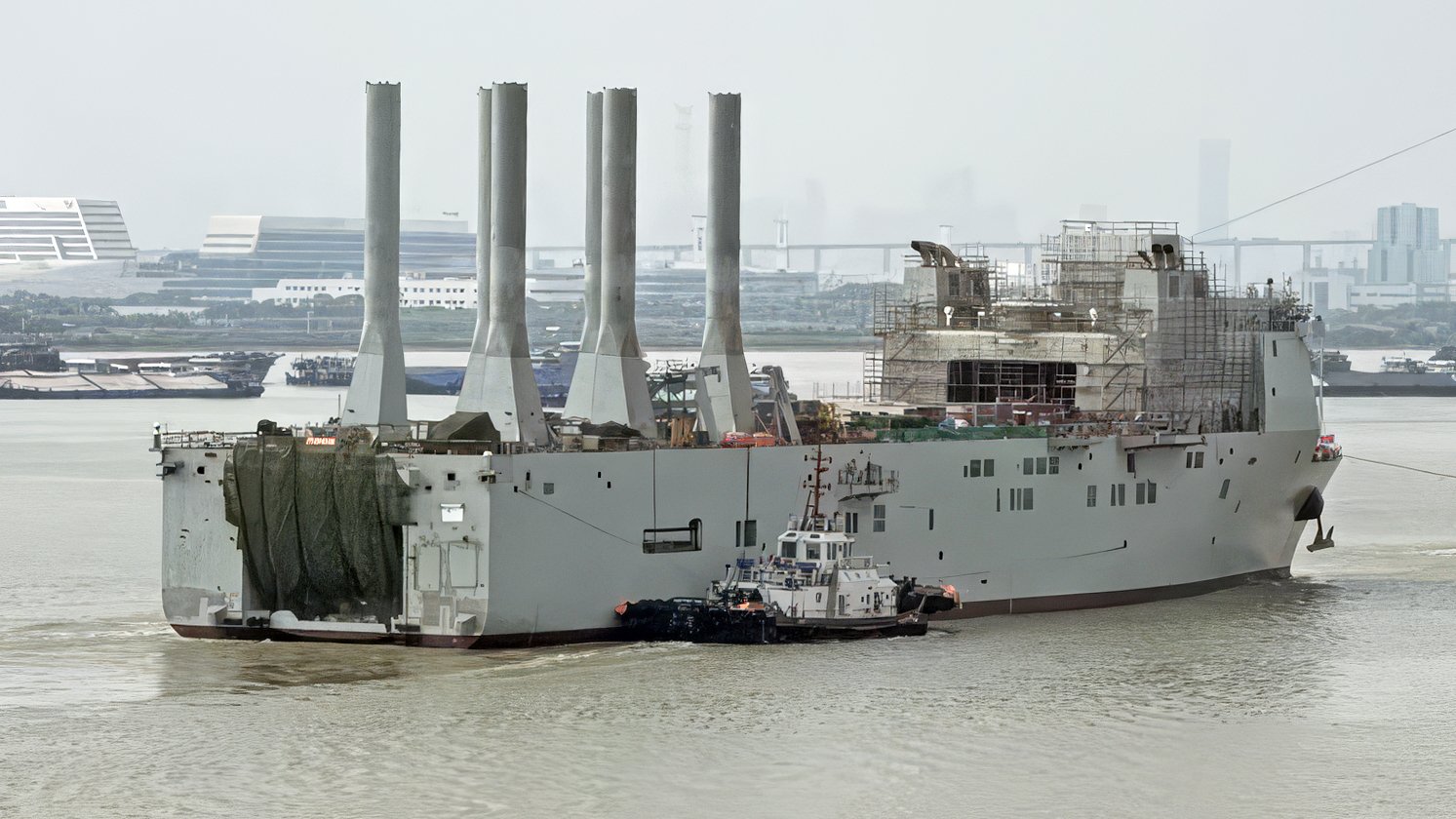
The War Zone has reported:
China appears to have a second ship designed to deploy and recover uncrewed underwater vehicles (UUVs), adding to a larger vessel nearing completion at a shipyard in Shanghai. The smaller ship was photographed in Guangzhou and shares the main features of the Shanghai vessel, including a stern garage and well deck intended to handle underwater vehicles. The new image indicates China may be developing more than one platform for supporting UUV operations at sea.
The first vessel came to notice nearly a month earlier while under construction at Hudong-Zhonghua Shipyard on Changxing Island in Shanghai. Its configuration suggested it could carry several very large UUVs or a larger number of smaller vehicles. A stern garage door and well deck would provide access for launching and recovery, while large pylons could raise and lower vehicles from the water and move them between levels inside the ship.
The Guangzhou vessel has a similar overall shape but smaller proportions and some differences in its exterior outline. It appears to be about one-third smaller than the Shanghai ship. It has six lift towers, compared with six larger towers and six smaller ones on the Shanghai vessel, while retaining major design elements such as a flight deck and hangar behind the forward superstructure, as well as the smokestacks in a similar position.
Online discussion had raised questions about where the Guangzhou ship was built. Guangzhou Shipyard International, or GSI, was identified as a possible builder because its facilities on Longxue Island lie just southeast of Guangzhou. GSI is a subsidiary of China State Shipbuilding Corporation (CSSC) and has built a range of unusual ships, including various drone test vessels, large beach landing barges and giant supply ships.
A review of archival satellite imagery confirmed the ship was built at GSI. An image dated Oct. 2 showed it emerging from a covered graving yard area at the facility before its launch. The image was credited to Planet Labs Inc. and reprinted by permission.
The ships’ appearance has prompted speculation that they belong to a broader programme involving the construction of more vessels with similar capabilities. If that is the case, their purpose could extend beyond experiments and limited operational use. The known pair could still be primarily experimental, but a larger fleet would signal a more substantial commitment to deploying, recovering and maintaining UUVs far from China’s shores.
Such a fleet could support vehicles that remain on patrol for long periods. That would give China a way to send a few very large underwater vehicles or many smaller ones into distant waters, creating an asymmetric capability. The vessels could also indicate how significant the Chinese military considers UUV operations in its future strategy.
Large, long-range UUVs have a range of potential missions, from mapping the sea floor and searching for mines to hunting submarines and ships. They could also carry cruise missiles or drones, or serve as weapons themselves. For China, these capabilities could put U.S. outposts deep in the Pacific and even the U.S. seaboard within reach as potential targets.
The United States has no comparable ship in the U.S. Navy’s inventory, and the launch and recovery of large UUVs remains a conceptual work in progress there. The emergence of the two Chinese tenders in a short period highlights the scale of China’s investment in the technologies they could support. If more ships join the currently known pair, the People’s Liberation Army Navy’s plans for large UUVs and its ability to operate them far from home may become clearer.
Chinese military parades have also displayed underwater drones. On Sept. 3, 2025, HSU100 uncrewed underwater drones were carried on military transporters at Tiananmen Square in Beijing during a parade marking the 80th anniversary of the end of the Second World War. An AJX002 UUV was also seen in Tiananmen Square during a military parade marking the 80th anniversary of victory over Japan and the end of the war. The AJX002 image was dated Sept. 3, 2025, and credited to Greg Baker of AFP; the HSU100 image was credited to Johannes Neudecker of dpa and picture alliance via Getty Images.