
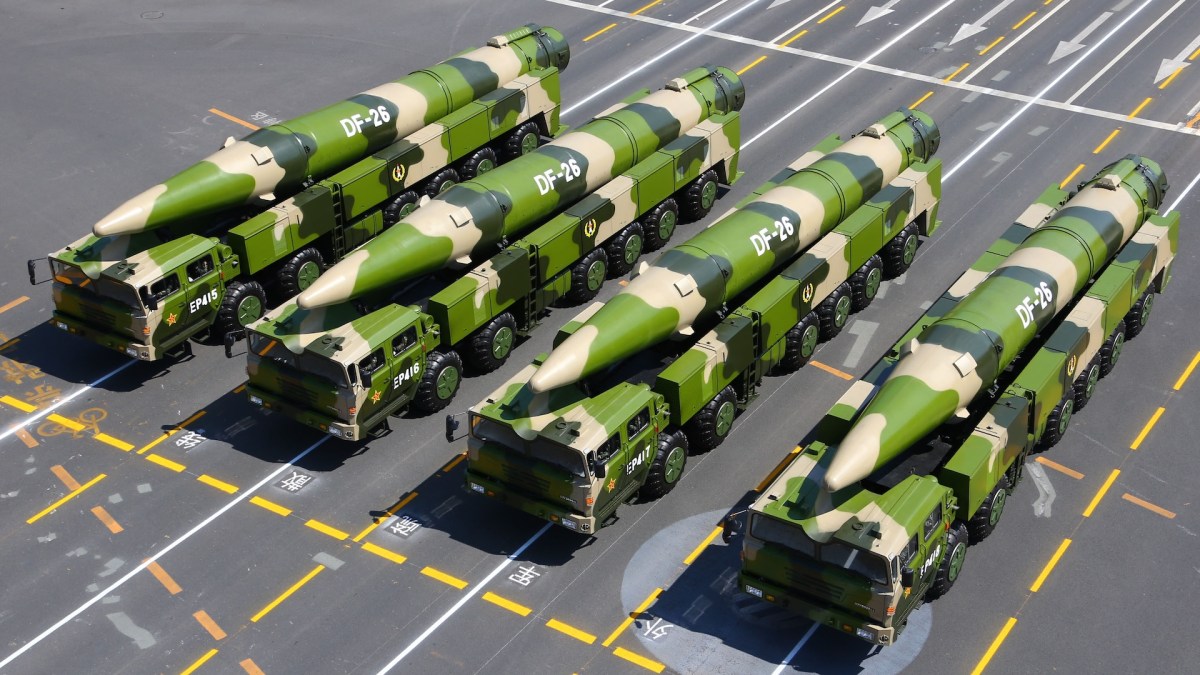
The War Zone has reported:
China’s People’s Liberation Army Rocket Force (PLARF) now fields the world’s largest and one of its most diverse forces of conventional and nuclear-armed ballistic missiles, a marked shift from the smaller nuclear deterrent force it operated two decades ago. Among the expanding arsenal are regional missiles that can carry conventional or nuclear warheads, a dual-use capability that can make crises harder to manage. The short-, medium- and intermediate-range systems are central to Beijing’s anti-access/area-denial strategy, which is intended to challenge opposing forces operating in the region.
The arsenal includes short-range weapons aimed at nearby targets such as Taiwan, as well as intermediate-range missiles able to reach Guam and threaten U.S. naval forces far into the Western Pacific. China’s land-based missiles are road-mobile and solid-fuelled, and the systems have become more precise. Some carry hypersonic or manoeuvring warheads designed to complicate air defence efforts.
The Pentagon assessed last year that China had 600 missiles in the “boosted hypersonic” category. That grouping includes systems carrying hypersonic glide vehicles (HGVs), as well as air-launched ballistic missiles. The figure reflects a broad category rather than a count limited to the regional land-based systems discussed here.
The range categories used for ballistic missiles distinguish their likely reach and role. A short-range ballistic missile (SRBM) travels up to 1,000 kilometres, or 621 miles, and is generally intended for battlefield or nearby regional targets. A medium-range ballistic missile (MRBM) covers 1,000 to 3,000 kilometres, or 621 to 1,864 miles, while an intermediate-range ballistic missile (IRBM) reaches 3,000 to 5,500 kilometres, or 1,864 to 3,418 miles, allowing it to strike more distant regional targets.
Some of the missiles also carry an HGV or a manoeuvrable re-entry vehicle (MaRV), technologies that may be adapted to attack moving vessels. A MaRV travels on a broadly ballistic path but can manoeuvre near its target to improve accuracy and evade missile defences. With a seeker and other modifications, such a warhead could potentially be used against ships.
An HGV follows a different flight path from a traditional ballistic re-entry vehicle. It is accelerated to high speed, released, and then travels towards its target along a relatively shallow path through the atmosphere. Its ability to manoeuvre for much of the flight and vary altitude makes its trajectory less predictable and can reduce the time available to air defences, assuming they have weapons capable of engaging it.
China’s principal SRBM families include the DF-11, DF-15 and DF-16, each with multiple versions. Their leading regional roles include putting Taiwan and the southern reaches of the Japanese archipelago at risk. Modernization has focused on accuracy, survivability and operational flexibility, qualities relevant to a possible cross-Strait campaign. The number of missiles is also significant: a large inventory could sustain strikes against the many military and infrastructure targets that would be involved in a major conflict.
The DF-11’s development began in 1985, when China started work on a single-stage, solid-fuel missile. The initial requirement called for a range of 300 kilometres, or 186 miles, comparable to the widely used Soviet Scud-B, and a similar road-mobile transporter-erector-launcher (TEL). Development lagged behind the DF-15, and the missile completed a successful flight test in mid-1990. The PLARF began using the DF-11 in 1992.
Work on an improved version reportedly began almost immediately. Development of the DF-11A, designated CSS-7 Mod 2, started as early as 1993, with the main aim of extending the range to about 600 kilometres, or 373 miles, roughly twice that of the original. After its first flight in 1997, the programme was publicly acknowledged the next year. The DF-11A formally entered Chinese service in 1999.
China also developed the DF-11AZT, a specialized bunker-busting variant believed to use the DF-11A airframe. Reportedly introduced in 2013, it replaces the standard high-explosive payload with a penetrator warhead for hardened and fortified targets. Images appeared in Chinese media in 2016, followed the next year by footage of a test launch conducted in 2013. Rumours have periodically suggested that the DF-11 family can carry a nuclear warhead, but the available evidence does not support that claim. Today, only one brigade appears to operate the system.
China began developing a new generation of conventionally armed, mobile SRBMs during the 1980s, initially with export customers chiefly in mind. The DF-15, designated CSS-6, has passed through several iterations, but public information about the family is fragmented and sometimes contradictory. The first major upgrade, the DF-15A, reportedly entered service in 1996 and has sometimes been described as capable of carrying a nuclear payload. However, open-source assessments consistently identify the only PLARF brigade still believed to operate it as a conventional missile unit.
Estimates of the DF-15A’s maximum range vary, running from the original 600 kilometres, or 373 miles, to as much as 900 kilometres, or 559 miles. A more extensive redesign produced the DF-15B, or CSS-6 Mod 3, which reportedly entered operational service around 2006 and was publicly displayed at China’s 2009 military parade. Its most visible change is a triconic re-entry vehicle with control fins, a configuration widely understood to incorporate a MaRV warhead.
Another variant, the DF-15C, or CSS-6 Mod 2, reportedly entered service around 2013. Its warhead shape has led to the widespread view that it is designed to attack hardened, deeply buried targets, much like the DF-11AZT. The DF-15 remains with only a small number of PLARF brigades and appears to be gradually replaced by the newer DF-16, which has greater range and capability.
The PLARF fired multiple DF-15 missiles into waters around Taiwan during live-fire drills in 2022. The exercises followed then-U.S. House Speaker Nancy Pelosi’s visit to Taiwan. The launch illustrated the continuing role of missiles in this class in any contingency involving the island.
The conventionally armed, mobile DF-16, known as CSS-11, has steadily replaced the DF-15. It was publicly unveiled at China’s 2015 military parade, though it is widely believed to have entered PLARF service several years earlier, around 2011 or 2012. Its capabilities remain unclear in several respects. The missile resembles the DF-15 but lacks that earlier system’s prominent aerodynamic fins, suggesting it may rely on more advanced guidance and flight control to stay stable without large external surfaces.
The DF-16’s range is also uncertain. It could exceed 1,000 kilometres, or 621 miles, which would put it in the MRBM category. Stills from a video have shown a DF-16 test with a submunitions warhead. Submunitions have an established role against land targets, while their potential use against large and medium naval targets by anti-ship ballistic missiles has drawn interest for the possibility of causing a mission kill.
A DF-16 version with what appears to be a MaRV, commonly identified as the DF-16A or CSS-11 Mod 2, appeared in footage of a Chinese military exercise released in early 2017. Its presence indicated that the variant was operational by then. Chinese state media showed another DF-16 warhead configuration in 2018, widely interpreted as evidence of an additional version, the DF-16B, sometimes identified as CSS-11 Mod 3. Despite the emergence of different configurations, open-source reporting consistently describes the DF-16 family as intended exclusively for conventional strike missions.
Over the past decade, Beijing has invested heavily in improving both the quality and quantity of its medium-range ballistic missile force. China now fields a varied group of MRBMs, supported by long-range land-attack cruise missiles, for conventional and nuclear missions across the Indo-Pacific. The MRBMs are carried on wheeled TELs and use solid-fuel rocket motors. Their mobility allows them to disperse quickly and launch with little preparation, complicating attempts to destroy them before or after firing.
Among the PLARF’s significant recent additions is the DF-17, designated CSS-22. It is described as the world’s first operational ballistic missile designed from the outset to deliver an HGV. China publicly unveiled the system during its 70th anniversary military parade in 2019, and it is estimated to have entered service shortly before that appearance. Its estimated range is 1,800 to 2,200 kilometres, or 1,118 to 1,367 miles.