
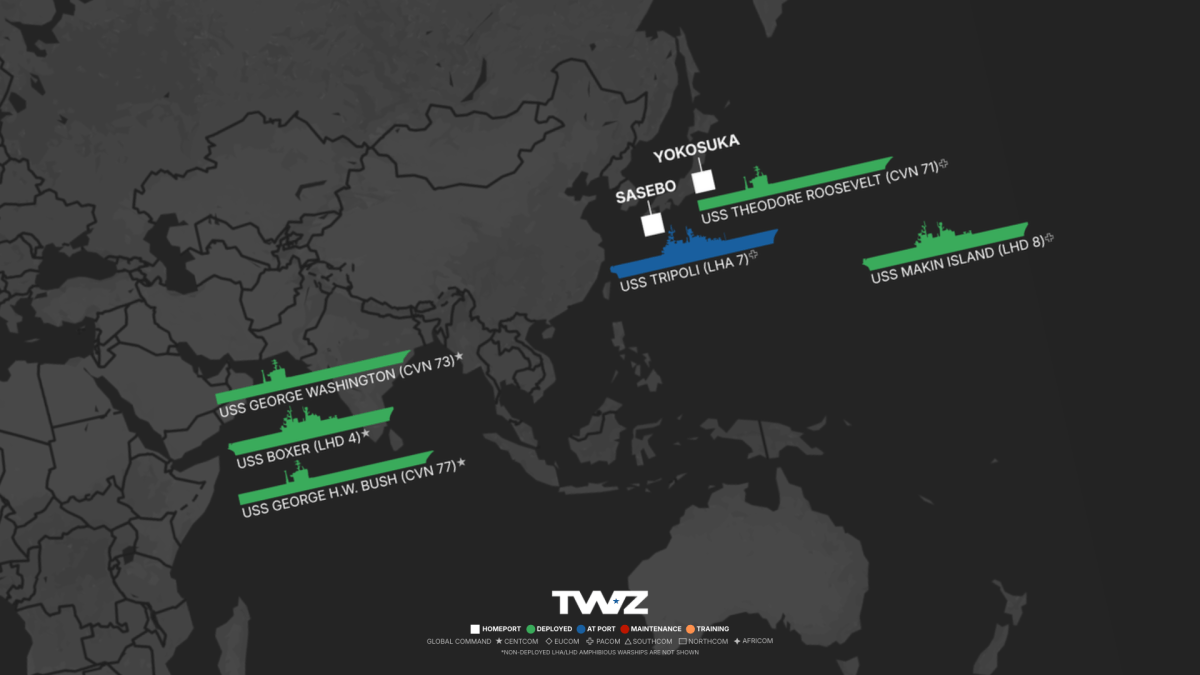
The War Zone has reported:
The USS Theodore Roosevelt arrived at the U.S. naval port of Yokosuka, Japan, on October 16, becoming the first non-resident American aircraft carrier to visit the port in more than four years. The carrier came from San Diego with its flight deck packed with aircraft, including F-35C stealth fighters, and is scheduled to take part in the upcoming Keen Sword 27 exercise with Japan. The USS George H.W. Bush, meanwhile, left Thailand after a five-day port visit and returned to the Middle East, while the USS Abraham Lincoln reached home after nearly eleven months at sea on combat deployment.
The Roosevelt serves as flagship of Carrier Strike Group 9 (CSG 9), accompanied on its voyage by guided-missile cruiser USS Chosin and destroyer USS Decatur. The journey from San Diego took 19 days and included manoeuvring around a typhoon in the Western Pacific. Yokosuka sits on Japan’s east coast and is home to the USS George Washington and America’s only forward-based carrier strike group.
Roosevelt and Chosin entered the U.S. 7th Fleet-Pacific Command area of responsibility and reached Commander, Fleet Activities Yokosuka on the morning of October 16. The strike group is expected to spend a few days in port before joining Keen Sword 27, which the 7th Fleet described in a press release as a “premier joint-bilateral field training exercise designed to increase readiness and interoperability between the Japan Self-Defense Forces and U.S. military forces.” The short stop gives the crew time for maintenance, resupply and liberty before routine operations resume.
“Our crew is honored to visit Yokosuka and experience the rich culture and hospitality of Japan,” Capt. Will Mathis, Roosevelt’s commanding officer, said in the release. “Port visits like this are vital for crew morale and mission readiness, allowing our Sailors to rest, recharge, and prepare to operate seamlessly alongside our allies during exercise Keen Sword.”
A Navy official confirmed the five-ship composition of CSG 9. The group is operating in a disaggregated configuration, a common arrangement for strike groups with several missions underway. Roosevelt and Chosin left the United States at the end of September and linked up with Pearl Harbor-based destroyer USS Decatur while steaming west past the Hawaiian Islands, according to public Automatic Identification System (AIS) data. Decatur arrived in Yokosuka the day after Roosevelt and was not mentioned in the 7th Fleet release.
The first CSG 9 ship to deploy was USS Carl M. Levin, based in Hawaii. It left on September 9 and is operating at an undisclosed location, according to DVIDS, the military’s content-sharing platform. USS Paul Hamilton, the last assigned ship to deploy, departed San Diego on October 10 after loading ammunition at Bravo Pier and reached Joint Base Pearl Harbor-Hickam on October 15, AIS data shows.
USNS Tippecanoe, a Henry J. Kaiser-class fleet replenishment oiler, supported the strike group’s Pacific crossing with multiple replenishments at sea. It recently entered the East Sea, also known as the Sea of Japan, through the Tsugaru Strait and then stopped broadcasting on AIS.
The status of medium unmanned surface vessel (MUSV) Seahawk (2) has also drawn attention. Several reports said it deployed with CSG 9, which would mark a significant operational milestone and the first assignment of a drone boat to a carrier strike group. Seahawk, however, left Point Loma on October 8, more than ten days after Roosevelt, reappeared on AIS and docked in Hawaii for a few days before continuing west across the Pacific on October 16. If it is assigned to CSG 9, it is currently operating separately from the rest of the group; whether it will join Roosevelt for Keen Sword 27 is unknown.
Acting Secretary of the Navy Hung Cao appeared to confirm the deployment at a panel during the Association of the United States Army convention. “the Teddy Roosevelt carrier strike group just deployed on October 8 with a medium sized unmanned surface vessel. This is the first carrier strike group to ever deploy with a large size unmanned surface vessel,” he said. Roosevelt was already more than halfway to Japan on the date Cao cited. “This is a force multiplier, imagine having more guns out there,” he added.
The War Zone contacted the Secretary’s office to seek clarification and confirmation but received no response. A Navy official said, “Seahawk’s operations represent continued progress in the Navy’s efforts to integrate unmanned systems into Fleet operations. As with any emerging capability, we continue to learn, adapt, and refine how these systems are employed.”
The USS Abraham Lincoln arrived at Naval Air Station North Island in San Diego Bay on October 8, ending a historic ten-and-a-half-month combat deployment. The carrier, flagship of CSG 3, moored at Berth Lima 321 days after departing on November 21, 2025. More than 5,000 sailors and Marines served aboard during the deployment. Hundreds of spectators lined the bay channel as thousands more watched online; small boats and jet skis carrying American flags escorted the ship, while family and friends waited at the pier. Sailors in dress whites stood along the rails, and the Pentagon shared video of the homecoming.
Lincoln’s 321-day deployment is the second-longest in the modern carrier era, five days shorter than the 326-day post-Vietnam record held by USS Gerald R. Ford. The carrier travelled more than 93,000 nautical miles, equivalent to more than four trips around Earth, and completed 72 replenishments at sea. It received more than 20 million gallons of aviation fuel, while its air wing flew more than 14,000 sorties totalling 28,500 flight hours, according to Navy figures highlighted in a press release and by the ship’s public affairs officer.
The Navy release also confirmed that Lincoln set a modern-carrier record for time underway between port visits, breaking the previous mark of 206 days set by USS Dwight D. Eisenhower during the COVID pandemic, as previously reported by The War Zone. “The ship’s 208 uninterrupted days at sea between Guam and Oman, and its 286 consecutive days at sea between departing San Diego and arriving in Thailand, are record-breaking marks for modern aircraft carriers.” The cruise took Lincoln through the U.S. 7th Fleet and 5th Fleet areas of responsibility.
During Operation Epic Fury, which began February 28 and lasted almost 40 days, Lincoln operated in the northern Arabian Sea as Commander, Task Force 50, applying pressure on Iran’s southern flank. After major combat operations wound down, the carrier and its air wing patrolled and enforced the blockade line during both subsequent rounds. Carrier Air Wing 9 (CVW-9), described by the Navy as its “Navy’s premier next-generation air wing that served as the primary offensive power” for CSG 3, flew 14,037 sorties, including 4,000 combat missions. It dropped more than 1.37 million pounds of ordnance on thousands of targets and used 1,499 precision weapons.
“This concentrated firepower significantly degraded Iranian Navy capabilities,” a separate statement said. Capt. J.W. Stigi, commander of CVW-9, said: “The rapid mobilization and combat execution of CVW-9 during Operation Epic Fury demonstrated the unmatched flexibility of a U.S. Navy carrier strike group. Pairing fifth-generation F-35C stealth and sensor fusion with fourth-generation workhorse strike and electronic attack platforms, Team Shogun destroyed Iran’s conventional Navy and secured vital maritime chokepoints in support of our commander’s objectives.”
Kill marks on Lincoln’s island superstructure credit CSG 3 with destroying 106 one-way attack drones fired by Iran’s Islamic Revolutionary Guard Corps, 34 Iranian Navy and IRGC ships, 23 incoming cruise missiles and 10 enemy submarines. A sailor explaining the marks in a social media video said the strike group dropped 1,463 air-to-ground munitions in total.
The USS George H.W. Bush and its destroyer escort, USS Delbert D. Black, departed Phuket, Thailand, on October 9 after a five-day liberty visit. The carrier had anchored about two nautical miles south of Ao Makham Deep Sea Port on October 4, following 187 consecutive days at sea. A press release said nearly 5,000 sailors from across the strike group experienced Thailand’s sights and sounds, deepening their understanding of Thai people and strengthening personal ties.
“The Sailors and I had an amazing time in this beautiful country, and I sincerely thank the people of Thailand for their incredible welcome,” Capt. Justin T. Issler, the Bush’s commanding officer, said. “This port visit to Phuket was a tremendous opportunity for the crew. We are grateful to our Thai allies for hosting us, and we look forward to continuing our mission here in 7th Fleet, alongside Thailand and our other regional allies and partners.”
After leaving Phuket, Bush stopped broadcasting AIS while travelling due south at 10 knots. DVIDS imagery confirmed that the strike group returned to the Middle East and is operating in the U.S. 5th Fleet area of responsibility to “support maritime security and stability,” joining the George Washington strike group once again as the second carrier strike group in the region. The weekly tracker follows U.S. aircraft carriers, deployed carrier strike groups and Amphibious Ready Groups using publicly available open-source information; the previous report was published the week before.