
Autosport has reported:
Max Verstappen said he was not aware that Red Bull’s Baku upgrade would make the team competitive again when he agreed to extend his contract by two years. The Dutch driver said the discussions focused on the team’s plans and direction, while team principal Laurent Mekies said the upgrade was not used to persuade him to stay.
The extension was announced ahead of Verstappen’s home race at Zandvoort. His already long-term Red Bull deal was renegotiated and extended by a further two years, after renewed speculation about his future amid the team’s difficult start to the season. At the time, Verstappen had said he came closer to retiring from Formula 1 early than to switching teams.
The situation on track has since shifted. Verstappen was still seriously contemplating the possibility of finishing the season without a win when he was at Monza, but came close to victory in Baku and then won the following races in Malaysia and Singapore, the final events of a triple-header.
That run contrasts with Red Bull’s position at the start of the year, when the Milton Keynes-based team was a distant fourth in the competitive order and at times was fighting with Haas and Alpine. Its recent improvement raised the question of whether Verstappen had known a major upgrade was coming when he signed the revised deal.
“No, not really, it was more just talking about the future, and of course the ideas about how the team is moving forward,” Verstappen said. “And I liked those ideas. It’s also not that they really needed to convince me or whatever, it's just the general chat that you have with the team.”
He said his enjoyment of working with the team was part of the context, and that its improved results had been an added benefit. “And for me, it's been really enjoyable to work with this team. Naturally, yes, with the progress that we have had, it's a nice bonus, because fighting up front is a lot more satisfying, of course.”
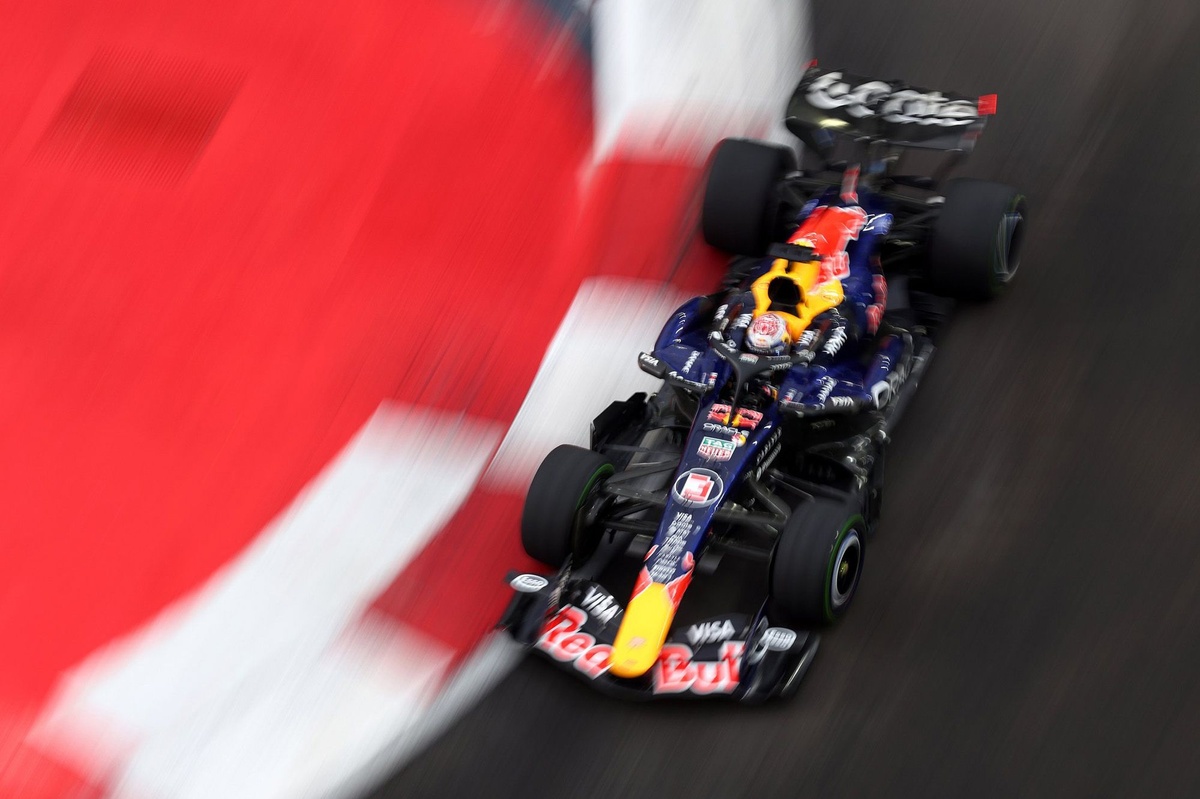
Verstappen also pointed to changes in the car’s behaviour after the Baku upgrade. He said its improved predictability and balance were as significant as gains in downforce and lap time, because the driver can judge the limits more consistently. The RB22 had been difficult to read early in the season, making it harder to push to the limit.
“The big thing that has changed with our car is that has just become a lot more predictable and balanced, where in the beginning of the year many times I didn't know what was going to happen going into a corner,” Verstappen said. “Back then, a lot of weird things did happen with the car.”
He explained that uncertainty had affected how aggressively he could drive. “That's why you could never really run it to the limit, because you didn't know where the limit was, or suddenly the limit had shifted. That [change] has made it a lot better in the last few race weekends, just knowing a bit more where the limit is and having a more predictable balance.”
Mekies rejected the idea that Red Bull had foreseen the scale of the improvement in Baku and used that prospect to secure Verstappen’s signature. “The short answer is no. We were not waiting for a magic upgrade that was supposed to bring us to the performance,” the Frenchman said.
He said the team knew it had upgrades planned, and that Baku would bring its final update of the year. The work continued the car’s development trend, but the team had expected it would struggle to make up the final three tenths of a second. “So it was certainly not an argument of convincing [Max] at the time of the discussions,” Mekies said.
Instead, Mekies said the contract talks centred on Red Bull’s longer-term prospects and its ability to provide competitive cars in future seasons. The Baku package was an illustration of what could be achieved when the team’s strengths aligned, rather than a specific promise made to Verstappen during negotiations.
“I think more globally, we knew that the dynamic was very strong in Pierre [Wache]'s team and in Ben [Hodgkinson]'s team, in terms of what we felt was still the potential of the car package, both on the chassis side and on the PU side,” Mekies said. He added: “And yes, this is the sort of discussion we had with Max. It’s not about the Baku package or any other package, but about the underlying factors and where we felt the long-term opportunities were. But no, nothing specifically about the Baku package.”
Both Mekies and Verstappen have said the team’s current position remains insufficient. Red Bull still has underlying weaknesses to address, and the current chassis and budget cap constraints mean it cannot make all the needed changes for 2026. Verstappen has repeatedly said further changes will be required for the 2027 car if the team is to compete consistently at the front.
The discussion about Mekies’ leadership at Red Bull, including how it differs from Christian Horner’s, and the factors giving Verstappen and the team hope for 2027 were also identified as related topics.