
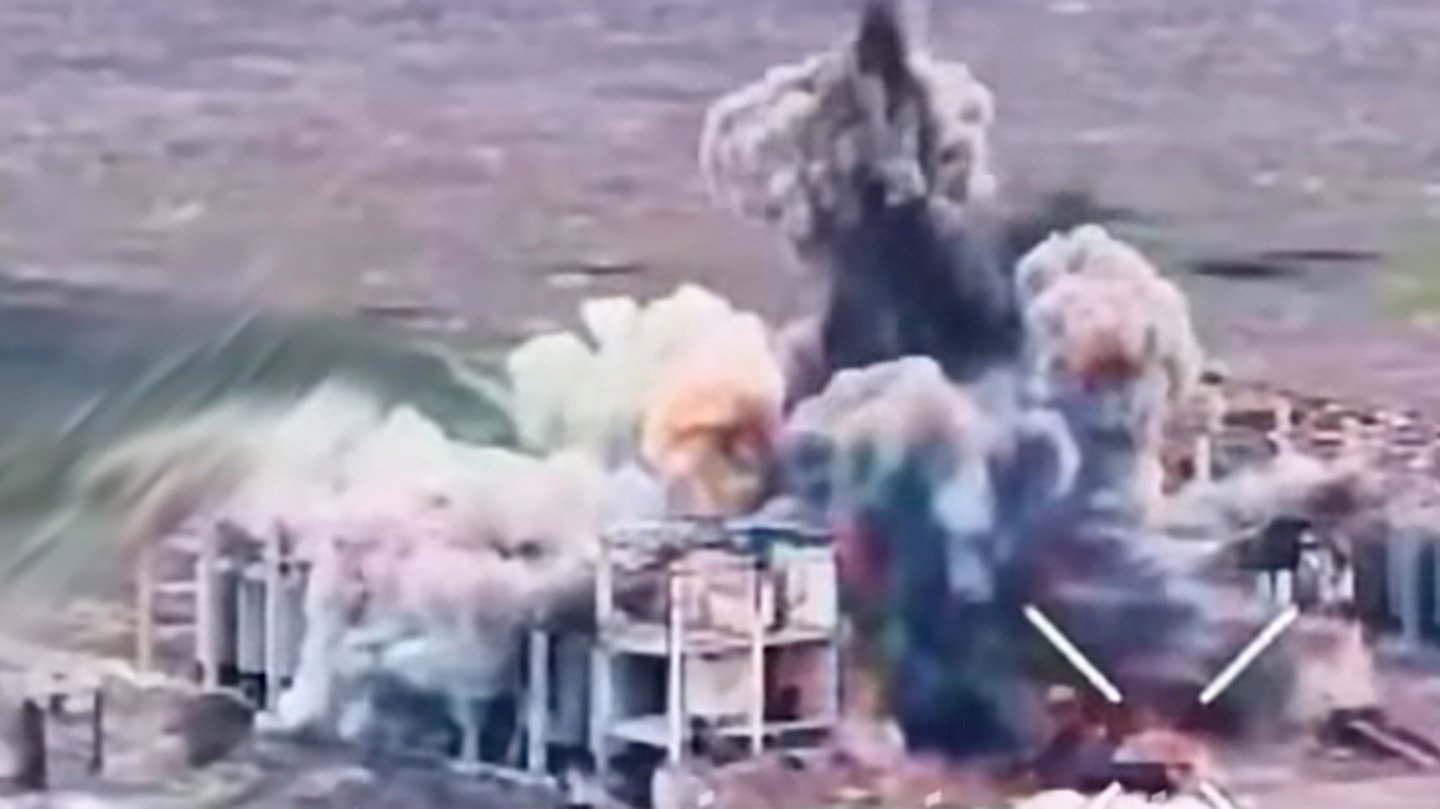
Ukraine claims it has recently regained about 125 sq. km. of territory near the town of Lyman in the eastern Donetsk region during what has been dubbed Operation Vivaldi. Rodion Kudryashov, a Ukrainian colonel and deputy commander of the Third Army Corps, offered some insights into this offensive and what made it different.
Though the operation is still ongoing, the success of Vivaldi began long before any troop movements, Kudryashov explained in an editorial he published in Ukrainian Pravda. Ukraine is making advances near the town of Lyman, located in the Donetsk region. (Google Earth) “After the Third Army Corps was formed, we changed the command system of its subordinate units,” he noted. “Some brigades came to the corps after very heavy fighting, with losses, manning problems and, most importantly, eroded trust in their leadership.” Third Army Corps Commander Brig.
Gen. Andriy Biletsky “then set out one of our key principles: a commander must be responsible for the entire cycle, from training a soldier to the result on the battlefield,” Kudryashov pointed out. “In some places that meant replacing a commander. In others it meant restructuring a staff or strengthening the NCO chain.
In some cases we had to build, almost from scratch, processes that on paper should have been working long ago.” At issue was changing the culture from a more rigid Soviet-era model, with a cumbersome chain of command, to a modern, more flexible one better suited for the current conflict. “A modern commander has to handle an enormous flow of information and make decisions quickly,” the deputy commander proffered. “He has to understand what unmanned systems, logistics, reconnaissance and adjacent units can do, while not smothering initiative at lower levels with endless approvals.
An army where every decision takes hours to travel up and down the chain loses to an army that makes the same trip in minutes.” Once those changes were put in place, the Third Army Corps had to first stop Russian advances in the sector before it could move forward. VIVALDI GoPro footage from Ukrainian assault troops who took part in the Vivaldi counteroffensive, which resulted in the liberation of five settlements in the Lyman direction. pic.twitter.com/2SVXSKlEX0 - 𝔗𝔥𝔢 𝕯𝔢𝔞𝔡 𝕯𝔦𝔰𝔱𝔯𝔦𝔠𝔱 (@TheDeadDistrict) September 17, 2026 “When the corps took over its area of responsibility, our first task was not an offensive,” the officer said. “We had to stop the situation from deteriorating and stabilize the forward edge.” “The enemy was pressing.
In some sectors our combat formations were losing cohesion,” he underscored. “The Russians were actively using infiltration tactics: small groups seeped between positions, massed in our rear, threatened logistics and gradually eroded the defensive line.” “We had to stabilize the forward edge and stop the infiltration,” Kudryashov said. “We had to rebuild command, put in commanders capable of making decisions, form new teams and reconstitute units.
We had to set up the surveillance-and-strike system and sustain the front line. We had to stockpile ammunition, drones and other resources, understand the enemy, and plan the next step before the previous one was finished. Only after that could we move forward.” By June, the corps was able to secure the front “in the sector from Borova to Lyman and eliminate the enemy’s infiltration zones,” Kudryashov continued. “That sounds less impressive than the word ‘offensive,’ but no offensive ever happens without it.” “You cannot plan a complex operation if you don’t know where your forward edge will be tomorrow,” the deputy commander extrapolated. “You cannot build up forces if your logistics are constantly under threat.
And you cannot form a strike group if your units are always forced to patch new breaches. So the first phase of ‘Vivaldi’ was not an advance at all. It was creating the conditions that made an advance possible in the first place.” Once the front was stabilized, the next step was shaping the battlefield for the offensive.
The corps’ unmanned systems units went to work against Russian logistics, striking a pipeline and depots. That forced the enemy to change its fuel and lubricant supply routes. Ukraine’s 3rd Army Corps released new footage of search-and-strike operations on the Lyman front.
FPV drone operators from the 60th Mechanized Brigade’s FATUM unit targeted Russian armored vehicles, a Grad multiple rocket launcher and personnel. #Ukraine pic.twitter.com/1iNG7z2N1c - NOELREPORTS (@NOELreports) September 24, 2026 “The operation also involved the corps’ brigades, its reconnaissance and unmanned units, and attached forces from the SSO (Special Operations Forces), GUR (Defense Intelligence) and DPSU (State Border Guard Service),” the deputy commander said. “To counter infiltration, a joint headquarters was set up to coordinate special and reconnaissance units at the tactical level under a single concept.” “In my view, this is one of the main characteristics of modern war,” he further stated. “It is not 10 strong units that each fight well on their own.
It is 10 different elements that start working as one system at the right moment.” An interesting new detail from Ukraine’s 3rd Army Corps about Operation Vivaldi on the Lyman axis. The Corps says Ukrainian forces carried out a flanking maneuver and, for the first time, airlifted unmanned ground vehicles behind Russian lines, while also suppressing Russian… https://t.co/ZEq8C75bN4 pic.twitter.com/KgKcZ0Zs2P - Special Kherson Cat (@bayraktar_1love) September 20, 2026 The influential, Kremlin-connected Rybar Telegram channel has acknowledged Ukrainian gains in this sector. “In the first half of summer, Russian units gradually advanced in Lyman,” Rybar wrote this morning. “However, in August, the enemy launched counterattacks and, by the first week of September, regained some positions, and also began attempts to recapture Shandryholovo and Zarechnoye.” “The enemy did not inflict significant losses on Russian troops, as the concentration of units of the West group of forces in the salient remained relatively low,” Rybar added. “However, later, the UAF deployed reserves to launch an offensive towards Zherebets in order to align the front along the water barrier and return it to the configuration of the end of 2025.” rybar now saying the 144th division is still falling back. the 3rd corps is still advancing and destroying an entire army group as they move. this is historic. pic.twitter.com/2jOa8KR9oA - david D. (@secretsqrl123) September 22, 2026 Though the battle is still in flux, Kudryashov said there are lessons the rest of the Ukrainian military should heed. “Winning one battle is not yet winning the war,” he said. “The enemy is learning too.
He changes tactics, looks for weak spots and tries to scale what works for him.” “So our task is to be faster, not only in physically moving forward but also in our ability to see, think, decide and put into practice what delivers results,” the deputy commander avowed. “And to do everything possible so that our soldiers pay the lowest possible price for every next kilometer of Ukrainian land.” The Latest On the battlefield, in addition to the gains Ukraine has made near Lyman, it has also largely been able to hold off Russian advances across the front lines.
Here are some key takeaways from the latest Institute for the Study of War assessment of frontline operations: Sumy: Russian forces recently conducted an infiltration mission east of Sumy City, and they continue to conduct glide bomb strikes against frontline settlements in northern Sumy Oblast to set conditions for future offensives.
Kharkiv: Russian forces continued offensive operations in northern Kharkiv Oblast and in the Borova, Kupyansk and Velykyi Burluk directions on Sept. 21 and 22 but did not advance. Donetsk: Ukrainian forces reportedly continue counterattacks in the Lyman direction, including southeast of Lyman, as Russian forces are attempting to use redeployments to stabilize the area.
Russian forces continued offensive operations east and southeast of Slovyansk near Rai-Oleksandrivka and toward Mykolaivka and Fedorivka Druha on Sept. 21 and 22 but did not advance. During this period, they also tried to advance in the Novopavlivka and Oleksandrivka directions but made no gains, as Ukrainian forces counterattacked in both areas.
Zaporizhia: Ukrainian forces recently advanced or maintained positions in western Zaporizhia Oblast. Kherson: Neither Russian nor Ukrainian forces reported ground activity in the Kherson direction on September 22. Russian Offensive Campaign Assessment, September 22, 2026: The Russian Ministry of Defense (MoD) falsely claimed that Russian forces have encircled Dobropillya - an intensification of the Kremlin’s cognitive warfare campaign alleging encirclements across various sectors of the… pic.twitter.com/yMoAcyVIme - Institute for the Study of War (@TheStudyofWar) September 23, 2026 In his speech to the U.N.
General Assembly this afternoon, Ukrainian President Volodymyr Zelensky called for Russia to end its war and said it was paying a heavy price - and exacting a terrible toll - for little territorial gain. “This ridiculous and never-ending war with Ukraine must be ended,” the Ukrainian leader urged. “I do not know a single world leader who would say otherwise.
I do not know anyone who is openly for this war, except one man.” He was referring to Russian President Vladimir Putin. “Ladies and gentlemen, for almost five years now, Russian generals have been trying to carry out Putin’s crazy order to seize our eastern land, the Donetsk region,” Zelensky continued. “And just this year, from January through August, the Russian army lost 248,964 people on the battlefield in Ukraine in eight months.
Twenty-one countries in the world have smaller populations… than the number of Russian troops lost in just eight months.” “It’s madness, but they still keep going there to die because that is what Putin wants,” Zelensky suggested. “After losing so many people, Russia managed to capture just over 1,000 square kilometers of our land this year, and we have already liberated a significant part of it.
Russia is a country that already has 17 million square kilometers of its own land without any Ukrainian territory, by the way. So to add another 1,000 square kilometers, Putin is paying with 248 people for every kilometer. Does anyone still think that he is reasonable?
And moderate?” “Russia’s leader, Patient Zero, the man from whom this war began and spread into the world, becoming the largest war in Europe since World War II, will inevitably leave this war,” Zelensky proffered. “But the longer Putin is able to wage war, the more evil he will leave behind in this world. Today, nothing in war works the same way it did, by the way, in 2022, except the courage of people.” Russian missile and drone barrages have “caused damage, but they didn’t break us,” the president proclaimed. “We build our defense.
What is really difficult for us now is Russian ballistic missiles and their new jet-powered Shaheds - Iranian technologies.” Residential buildings stand against the backdrop of smoke from a Russian attack on Kyiv. (Photo by Bohdan Diev/Global Images Ukraine via Getty Images) Tatyana Kudel’s’ka “Just imagine this: since the beginning of this year, Russia has already used more than 2,100 missiles of different types again against us, against Ukraine, our people and our children,” Zelensky stated. “More than 950 of them were ballistic missiles.
In eight months of this year, Russia used 63,000 attack drones of different types against Ukraine, our people, and more than 7,700 of them were jet-powered Shaheds, truly destructive and very dangerous weapons. Just think about it. The Russians launch jet-powered Shaheds every hour, every hour, against our cities, our economy, our infrastructure.
Our combat aircraft are fighting them 24/7, and this is part of Russia’s strategy to create a new...