
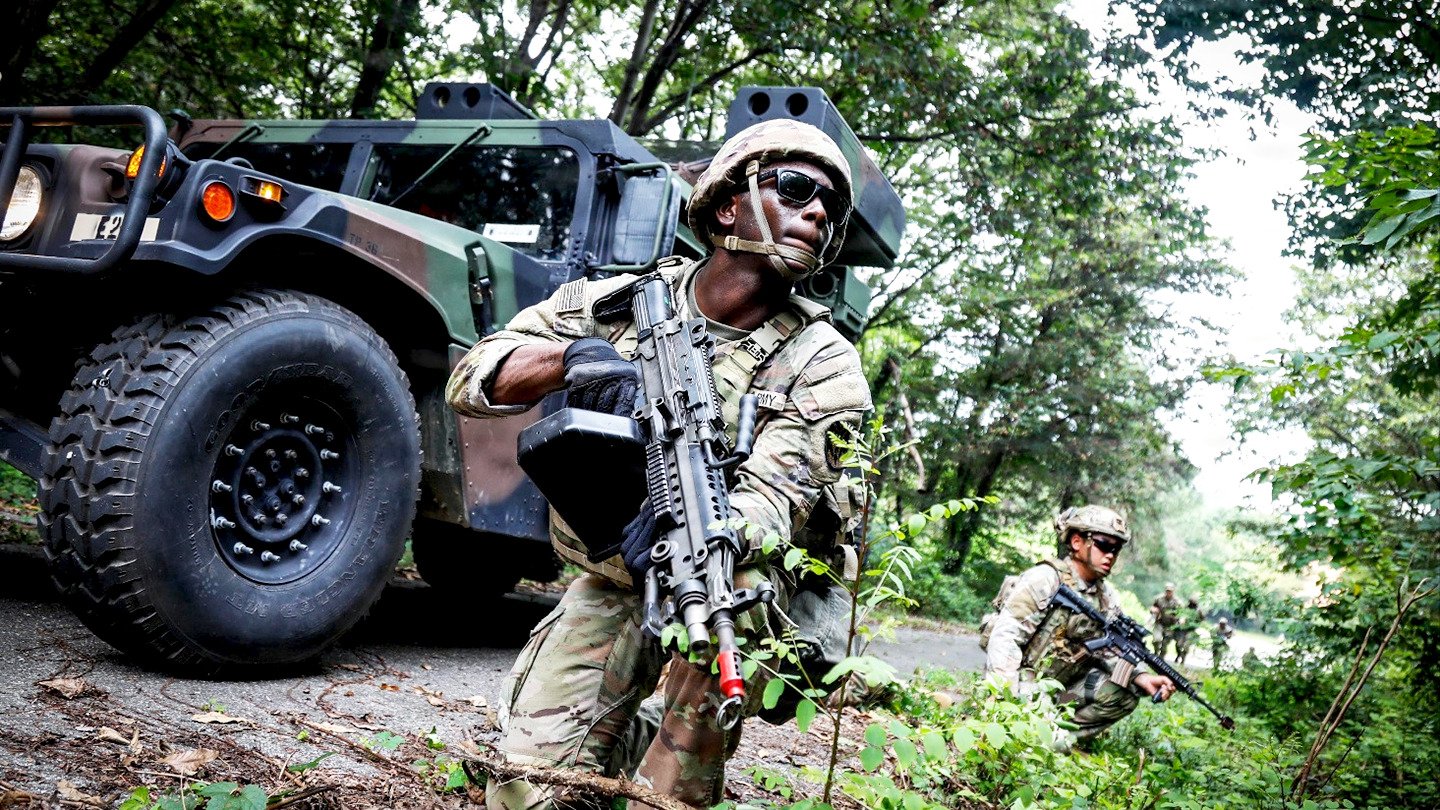
The War Zone has reported:
U.S. Army commanders preparing for a potential conflict in the Pacific say the wars in Ukraine and the Middle East are reinforcing the need to move forces and equipment whenever possible, and to improve camouflage for assets that cannot move. The lessons are influencing how the Army trains, equips and operates as it considers the prevalence of drones in Ukraine and the U.S. troops killed and equipment damaged or destroyed by large Iranian barrages against fixed installations during America’s now-paused fight against Iran.
The commanders discussed those lessons at the Association of the U.S. Army’s annual convention in Washington, D.C., which recently concluded. Gen. Ron Clark, commander of U.S. Army Pacific (USARPAC), said long-range fires and integrated air and missile defence are among the subjects whose lessons can be applied to potential challenges in the Pacific.
“Specifically, I am thinking through mobility and camouflage. So it’s one of those age-old Army forgotten sciences of how to hide in plain sight and how to camouflage ourselves from observation, because the ability to be able to see surface entities is almost ubiquitous,” Clark said at a media roundtable.
“Our ability to be able to use electronic warfare, to be able to use just good old-fashioned camouflage, and the ability to deceive our adversary is a must,” he added. The Army’s attention to concealment reflects the broad availability of drones, which can observe and attack targets, as well as the danger posed by strikes on forces that remain concentrated in known locations.
In Ukraine, both sides have drawn on established methods to avoid detection, including smokescreens to obscure forces from drones. They have also adapted older camouflage techniques, including paint patterns intended to make vehicles and other equipment harder for artificial intelligence-enabled targeting systems to identify. One example described in the source coverage was a Russian heavy-duty truck painted with zebra-style stripes to confuse AI-assisted target-seeking equipment.
Clark said the Pacific presents a more demanding adversary challenge than the conflicts in Europe and the Middle East. He described Russia and Iran as not being near-peer adversaries in those respective regions, then contrasted that with the Pacific without naming China directly.
“Whereas in our theater, it absolutely is,” Clark said. He said the Army spends considerable time with the joint force considering how to address different types of unmanned aircraft systems, or UAS, and how to approach ballistic missile defence across the region. He also raised the question of how forces can manoeuvre through an archipelagic environment.
The need to move across islands and wide stretches of ocean is a central feature of the Army’s Pacific planning. Soldiers could be operating under persistent surveillance and within the Chinese weapons engagement zone. Clark said the service’s own maritime assets will help it manoeuvre, including landing craft, small tugs and modular causeway systems run by the 8th Theater Sustainment Command.
The Army is struggling to keep its ageing fleet of 70 vessels in service, and has disposed of additional vessels over the years. Concerns about the role of this comparatively underappreciated force have been raised for years. Clark said ships and other transport assets are only part of the requirement: ground forces must also move after carrying out missions, including the use of long-range precision fires.
“But we also have to be able to conduct tactical maneuver with forces on the ground that can provide long-range precision fires, as an example, and then move so that fires, radars, sensors are not easily targeted,” Clark said. “Because if they can see you, they can hit you. And if you know they have an opportunity to return fire, they will. So our lessons that we’re learning are, in some cases, are very, very relevant. In some cases, we can learn from some of the changing characteristics of war.”
He cautioned that conditions in Ukraine do not directly match the terrain and methods the Army would encounter in the Pacific. Ukraine’s open plains and dense cities differ from the region’s beaches and jungles. The Army would seek to combine operational and tactical movement to gain advantageous positions, rather than rely on a prolonged exchange of drone attacks and long-range fires.
“The way we generally fight does not equate specifically in the Ukraine piece to the maneuver that you would see out of U.S. forces if deployed in a conflict like that,” Clark said. “To be able to use operational maneuver and tactical maneuver in a way that it’s not just simply drone on drone or firing long range fires at one another at scale for an extended period of time. We find our way to work through that problem set and maneuver to positions of advantage and to prevail.”
The threat from drones has made movement and resupply dangerous in Ukraine, where front lines have become bogged down and neither side has made large territorial advances. Gen. Xavier T. Brunson, commander of United Nations Command, Combined Forces Command and United States Forces Korea, said forces operating amid constant sensing will need to seek advantage from dispersed positions and use sensors and weapons across the joint force.
“To be able to move with sensors everywhere at all times causes us to achieve positions of advantage from distributed locations,” Brunson said. “So the fight is: you look at maneuver. You might maneuver to a position of advantage, knowing that you’re going to change that again. The ability to utilize not only joint sensors but joint effectors, if you will, joint fires, to be able to use those things from different positions changes the shape of the operating environment.”
Brunson said movement would still involve travelling from one point to another, but could require a series of intermediate positions. “Maneuver is always going to be maneuver. You’re going from A to B, but you might go from A to A1 to A2 to A3 to get to B, and that’s what I think we realize in this distributed fight that’s going on in Ukraine, and so we continue to watch to see what lessons might be coming back into” effect, he said.
Clark said the Army is also reconsidering its training in South Korea in response to lessons from Ukraine and the Middle East. He said the service has traditionally focused heavily on two large annual exercises, which centre on major command posts. The Army wants to move away from that concentration and use its understanding of threats observed in Ukraine to shape training.
“We recognize… that largely the two big exercises every year in Korea focus on large command posts,” Clark said. “We’ve got to move away from that. So what we intend to do is take advantage of the knowledge that we have of the threats that exist or that prevail in the Ukraine fight.”
Clark said he is discussing changes with his deputy commander, Republic of Korea Army Gen. Sungmin Kim. One idea is to train across a wider area of the peninsula instead of repeatedly gathering at the same location. Clark said the Army could consider exercises that extend from Jeju in the south to Gyeonggi Province in the north, including training with headquarters spread across that territory.
“We talk about how we would operate in a distributed fashion. You know as well as I do, there’s a location that we go to to train every year in Korea, and we stay in that place,” Clark said, answering a question from another reporter. “What would it look like if we train from Jeju all the way up to Gyeonggi Province in the north? What would that look like, just with our headquarters alone?”
He said a more distributed approach could make it harder for North Korea to apply lessons from Ukraine against forces in South Korea, because the Army would also have adopted those lessons and avoided remaining fixed in one place. Clark said positions could change as circumstances shift between competition, crisis and conflict.
“So just imagine,” Clark said, “if we train across the entirety of the peninsula, and got ourselves in the shape where we would say [to North Korea], ‘You can’t utilize the things that you’ve learned in the fight and the battlefield in Ukraine on us, because we learned the same lessons and we’ve distributed ourselves in such a way that we don’t make ourselves the target. We won’t be moored in place,’ and that’s what I’m talking about when I talk about positional advantage. It might not be the same place to the continuum. It might not be the same place when you’re in crisis or conflict or competition. We might have to change that, and that’s what we’re learning.”
Tara Murphy Dougherty, chief executive officer of Air, a company that provides AI-based sustainment solutions to the Army, said autonomy is another lesson from Ukraine. Both sides have used aerial and ground drones to supply frontline troops and evacuate wounded personnel as sending people to carry out those tasks has become increasingly dangerous.
“I think you also can’t talk about Ukraine without talking about autonomy,” Dougherty said. She argued that simulation and automation can help the Army plan convoys more efficiently than relying on people using spreadsheets, reducing the number of real-world convoys needed while making better use of available capabilities.
“One of the advantages that you get from using simulation and automation, and really using models and compute in order to create convoy plans, as opposed to humans with Excel spreadsheets, is you are able to do many fewer actual convoys because you’re using all of your capabilities so much more effectively and efficiently,” Dougherty said. “And while it’s an indirect