
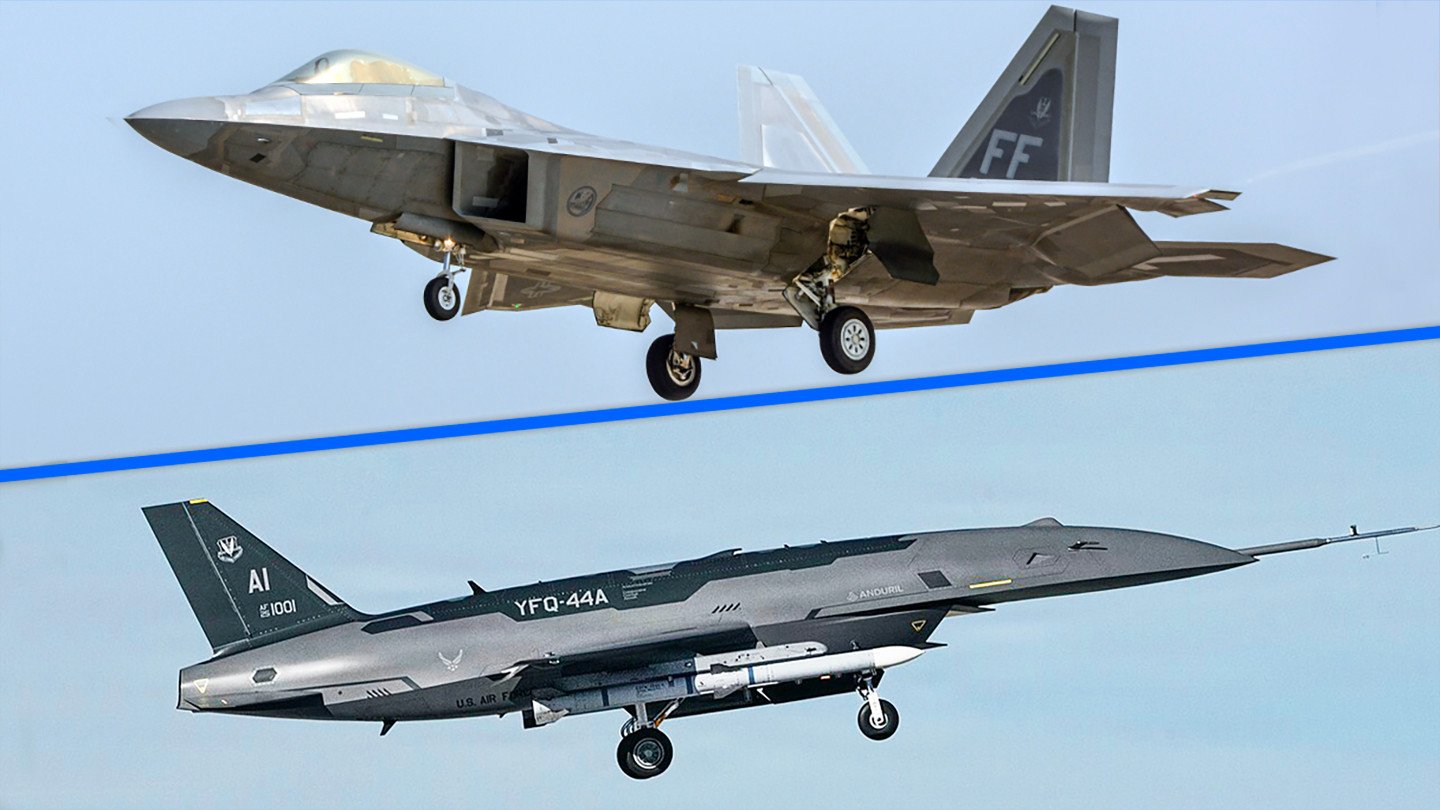
The War Zone has reported:
An F-22 Raptor pilot issued commands to a YFQ-44A Fury Collaborative Combat Aircraft drone in a first-of-its-kind test for the fighter and the pre-production drone. The airborne tactical-control demonstration took place earlier this month, with the Air Force and Anduril, Fury’s prime contractor, announcing it today. The test advances preparations for F-22s to serve as the first crewed aircraft directing uncrewed aircraft in the Air Force’s collaborative combat aircraft program.
The Air Force said the pilot acted as an airborne “quarterback,” sending high-level tactical directives to one YFQ-44A. “The aircraft’s onboard autonomy software interpreted and executed those directives in real time, conducting dynamic flight maneuvers and simulated combat tasks,” the service said in a press release.
Anduril said the Fury and an F-22 took off from Edwards Air Force Base in California and joined up in midair. The Raptor pilot then used a tactical data link to send an updated mission plan and command Fury through operationally relevant manoeuvres from the cockpit of the crewed aircraft.
An Anduril spokesperson confirmed to The War Zone that this was the first such test involving an F-22 and a pre-production YFQ-44A. The Air Force and company have not released further details on how the Raptor was configured, including what equipment or software was used to send the commands.
The Air Force has previously identified tablets, cables and associated materials as equipment that may be needed to integrate drone control into the F-22. Lockheed Martin, the Raptor’s prime contractor, has been working with the service on control architectures and user interfaces for both the F-22 and the F-35. Known work on cockpit interfaces for drone control has largely involved touchscreen, tablet-like devices, though those are understood to be an initial approach.
Using a tablet could add work for pilots, particularly in single-seat fighters, an issue raised in past discussions of these interfaces. The Air Force expects a single F-22 to be able to manage multiple CCA drones simultaneously, which makes the design of the controls and their effect on pilot workload relevant to future operations.
The latest test follows earlier steps in Fury’s flight and weapons trials. Last month, Anduril disclosed that Fury had flown in formation with F-35 fighters, while clarifying that the F-35 pilots were not issuing commands to the drone in flight. Earlier this year, a Fury drone launched an AIM-120 Advanced Medium-Range Air-to-Air Missile, or AMRAAM, for the first time.
The Air Force’s CCA program currently includes production orders for the FQ-44A Fury and General Atomics’ FQ-42A Vengeance under its first phase, known as Increment 1. The service is also planning a follow-on Increment 2 that could include additional aircraft types. Its current goal is to field at least 500 Increment 1 aircraft by 2032, with an initial group of CCAs expected to begin entering operational service around the end of the decade.
The Air Force release said the demonstration involved personnel from the 412th Test Wing, the 422nd Test and Evaluation Squadron, the 309th Software Engineering Group, the Experimental Operations Unit, the F-22 System Program Office, and the CCA Software Autonomy and Teaming Branch. The Experimental Operations Unit, based at Nellis Air Force Base in Nevada, has been leading work to prepare for future Air Force CCA operations.
General Atomics announced a similar demonstration involving an F-22 and its MQ-20 Avenger in November 2025. The company has used the MQ-20 as a CCA surrogate in several types of tests. It is not clear what the plan is for demonstrating an F-22’s ability to control the production FQ-42A in flight. General Atomics has previously released an image of a Vengeance flying with an F-35A Joint Strike Fighter and an F-15E Strike Eagle, though the fighters were not directly controlling it.
Fury and Vengeance are also scheduled to take part in a large-scale exercise before the end of the year. The aircraft are expected at the next iteration of Exercise Emerald Flag, giving the Air Force an opportunity to assess them alongside crewed fighters in a more operationally relevant setting.
“We have not yet done a LFE [large-force employment exercise] with these [CCAs], for real. The first one is going to be Emerald Flag. That’s in December,” Lt. Col. Lyndon “OTTO” Bartlett, the Experimental Operations Unit’s Director of Operations, said at a panel during the Air & Space Forces Association’s 2026 Air, Space & Cyber Conference in September. The War Zone attended the panel. Bartlett described the exercise as “our first tip [sic] dip of the toe in an actual force integration.”
The Air Force and its industry partners still have work to do on how CCAs will be deployed, launched, recovered, supported and operated. Those aircraft will require policies and procedures suited to operations that differ from those of crewed aircraft. The service also needs pilots to trust that uncrewed wingmen will behave as expected. The same broad challenges apply to CCA programs being developed by the U.S. Marine Corps and U.S. Navy, which are closely coordinated with the Air Force’s effort.
Secretary of the Air Force Troy Meink said the test showed the value of working with industry to speed capability development. “This achievement demonstrates what is possible when we are aligned with industry on a shared imperative: delivering capability to the warfighter at unprecedented speed,” he said in a statement today. “We are driving urgency into every part of acquisition from rapid integration and flight learning to disciplined assessment, so we can turn promising technology into combat capability at the pace the threat demands.”
Air Force Chief of Staff Gen. Ken Wilsbach said the flight demonstrated the benefits of pairing crewed and uncrewed aircraft. “This flight shows the power of crewed-uncrewed teaming and the advantage it provides our warfighters,” he said. “We must test often, learn fast, and give commanders what they need, when they need it.”
Mark Shushnar, Anduril’s Vice President of Autonomous Airpower, described the Air Force program as the world’s fastest-moving and most mature CCA effort, and said it would be the first to field operational aircraft. “Getting there demands that Anduril and the U.S. Air Force work together to prove out the capability, define the operational procedures, and build trust between operators and their semi-autonomous wingmen,” he said.
The demonstration provides an early example of how an F-22 pilot may direct uncrewed aircraft during future operations. The Air Force’s next steps include continued flight learning and assessment, along with the planned Emerald Flag exercise and the broader work required to integrate CCAs with crewed forces.