
The War Zone has reported:
The U.S. Army is incorporating long-range one-way attack drones such as the Low-Cost Uncrewed Combat Attack System, or LUCAS, into training for future operations. Leaders described how these weapons and other uncrewed systems could help forces disrupt enemy defences, create openings for joint forces and strike high-value targets in the Pacific and Europe.
The discussion took place during a panel at the Association of the U.S. Army’s main annual symposium earlier this week. The panel focused on how Army training is changing to meet the demands of future combat. The War Zone’s Howard Altman asked how long-range strike drones such as LUCAS were being incorporated into planning and training.
Maj. Gen. Bernard Harrington, head of the 7th Infantry Division, said the Army had begun training for these weapons at Bayonet Academy, a training area at Joint Base Lewis-McChord (JBLM) in Washington State. He said the work covers maintaining the systems, employing them and coordinating their use to achieve a desired effect.
“We’ve taken our Bayonet Academy, as we call it, a training area at JBLM [Joint Base Lewis-McChord in Washington State], and have started incorporating the employment of long-range one-way attack. Like, how do I maintain it? How do I employ it? How does that then get orchestrated in order to achieve that effect?” Harrington said.
“So we see that playing a key role in order to be able to achieve that effect at mass, … [and] in an affordable manner, while also being able potentially to preserve something that’s more exquisite for something that requires an exquisite munition,” he said.
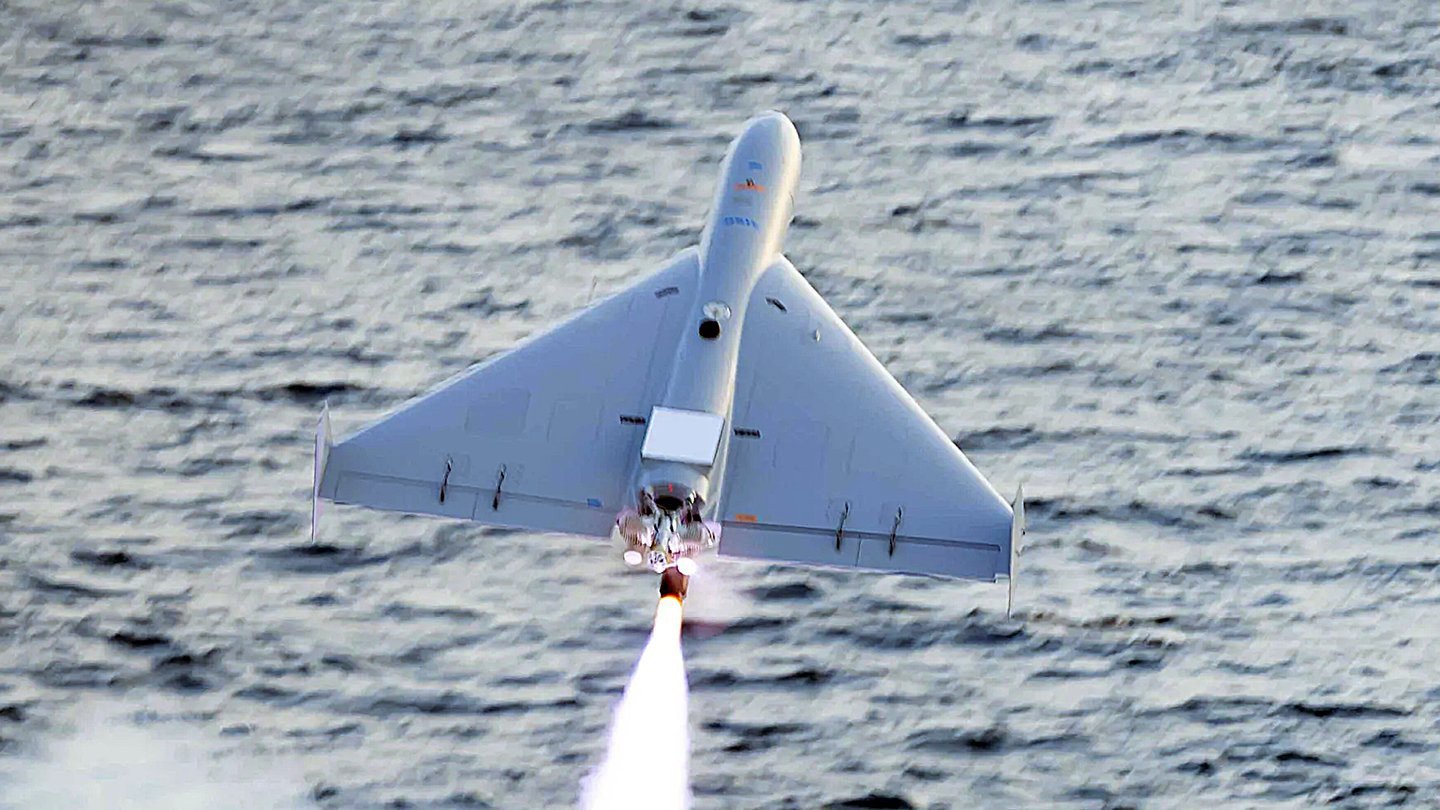
The U.S. military announced in December 2025 that it had begun fielding LUCAS, a system reverse-engineered from Iran’s Shahed-136. That announcement came months after The War Zone had made a case for the U.S. military to acquire large numbers of Shahed-136 clones. LUCAS made its official combat debut in the opening phases of major combat operations against Iran earlier this year.
The drones are powered by combustion engines and use pusher propellers. They are launched from static systems that can be placed on the ground or installed on ships, with a small rocket booster assisting the launch. America’s top commander in the Middle East later called the drones “indispensable.”
Harrington also commands Multi-Domain Command-Pacific (MDC-PAC), formed earlier this year under an Army arrangement that brought the 7th Infantry Division and the 1st Multi-Domain Task Force together. He has previously described uncrewed capabilities as critical to overwhelming adversaries in future conflicts. The Army now has four Multi-Domain Task Forces, which have been at the forefront of introducing new long-range strike and other advanced capabilities.
Harrington said his planning includes scenarios in which U.S. forces try to penetrate anti-access and area-denial (A2/AD) networks in the U.S. Pacific Command area of operations. China has established extensive A2/AD zones in the Western Pacific and continues to expand that strategy. He said planners are examining how to achieve mass at a sustainable cost and what effects against an individual system could create an opening for a joint force commander.
“So as we start modeling out what it looks like to be able to penetrate a portion of the anti-access/area denial network in support of the joint task force in the PACOM [U.S. Pacific Command] area of operations, we started looking at, well, how do I bend - how do I achieve mass at a cost curve?” Harrington said. “What effect am I really trying to achieve on a system in order to provide that window of opportunity for that joint force commander?”
He said an attack might disable systems on a ship without sinking the vessel, temporarily creating an opportunity for other forces to move. “So maybe I don’t necessarily need to sink a ship, but if I take out certain systems on that vessel, well then it creates this temporal window opportunity,” he said. “Then that joint force commander can surge in that carrier strike group or bomber task force.”
That approach is known as a mission kill. Attacks on a ship’s radars, communications antennas or other subsystems can reduce its combat effectiveness and leave it more exposed to later attacks. The time needed to repair damage could keep the ship out of service for an extended period.
Harrington said lower-cost weapons could achieve some effects without revealing or using a more sophisticated system. He said Army modelling had pointed to the potential of combining uncrewed surface vessels (USVs), long-range one-way attack weapons and other long-range launch effects, with the ability to synchronize and concentrate them.
“So when we started looking at that, we saw great value. That maybe I don’t have to use specifically or unmask an exquisite system to achieve that effect,” Harrington said. “If I can achieve [the] effect of mass utilizing lower cost systems, hey, maybe that will get me there. So we modeled that, and what we saw was, particularly with our unmanned surface vessels [USV], long-range one-way attack, long-range launch effects, the ability to synchronize and mass that could potentially get us to achieve that effect.”
The U.S. military’s use of kamikaze USVs is also developing quickly. The source says America first used the capability in real combat against Iran in July. A July 13, 2026, post from U.S. Central Command said three Corsair uncrewed surface vessels struck a submarine and ship maintenance facility at the port at Bandar Abbas Naval Base. CENTCOM described it as the first time U.S. forces had employed sea-based one-way attack vessels.
Harrington’s reference to “launch effects” covers a broad range of uncrewed aircraft designed to be launched from platforms in the air, on land or at sea. These systems can conduct surveillance and reconnaissance, electronic warfare, signal relay and other tasks, as well as serve as loitering munitions. The boundaries between launch effects, long-range one-way attack drones, cruise missiles and decoys are increasingly blurred.
The planning described by Army leaders is not limited to the Pacific or Middle East. Brig. Gen. Steven Carpenter, head of Multi-Domain Command-Europe (MDC-E), said Europe’s forces are looking at systems including LUCAS and Covenant’s weapons. He said these could help create parity in counter-fire and long-range fires against adversaries, while enabling commanders to accept risk in some areas and target an A2/AD network elsewhere.
“So, in terms of launch effects, I think you mentioned LUCAS. Covenant’s out there. There’s other systems that are out there,” Carpenter said. “In Europe, we like that, more than accepting risk in an area, maybe we’re disintegrating an anti-access/area denial bubble in the center, and then way up north, we’re going to go ahead and accept some risk there. We like to use those systems to create counter-fire parity, long-range fires parity with an adversary.”
MDC-E was created last year by combining the 56th Artillery Command and the 2nd Multi-Domain Task Force, both forward-deployed in Germany. Carpenter said the systems are attractive because they can withstand electromagnetic interference, travel farther and carry more destructive power.
“The reason we like those types of systems is because they’re EMI [electromagnetic interference] resilient, they’re longer range, and they’re higher yield, so they can go ahead and destroy like SS-26 systems, SS-21 systems,” Carpenter said.
SS-26 Stone and SS-21 Scarab are NATO reporting names for Russia’s Iskander-M and the older Soviet-designed OTR-21 Tochka short-range ballistic missiles. Both are launched from road-mobile systems. Russia and Ukraine have used Tochka during their ongoing conflict, but its role on both sides has declined as inventories shrink. The missile is also increasingly limited in service elsewhere. Iskander-M is more capable and has featured in U.S. military planning in Europe for years. The U.S. military has acknowledged that the war in Ukraine prompted improvements to the missile that have made it more dangerous and harder to intercept.
Long-range one-way attack weapons such as LUCAS can be used against surface-to-surface and surface-to-air missile launchers, as well as other valuable targets that may need to be struck quickly. The Shahed-136 traces its origins to early Israeli work on this class of weapon, which initially focused on finding new ways to neutralize hostile air defences. Iran has previously shown Shahed-136s and related systems being used for that purpose in large-scale exercises.
Iranian forces have also demonstrated the potential of these systems in real-world attacks on air-defence radars on the opposite side of the Persian Gulf. The source text ends while describing those retaliatory attacks, so it provides no further details about the targets or their outcomes.
Images accompanying the report showed a LUCAS drone on a static launcher, credited to Shield AI; Chinese military outposts in the Spratly Islands alongside other facilities in the disputed region, credited to the U.S. Department of Defense; and a LUCAS launch from the stern flight deck of the U.S. Navy Independence-class littoral combat ship USS Santa Barbara during a test, credited to NAVCENT, C5F and U.S. Army Spc. Kayla Mc Guire. Another image showed Covenant’s Anthem long-range strike weapon during U.S. Army testing, credited to the Army, and a stock image depicted an Iskander-M missile launching from a road-mobile transporter-erector-launcher, credited to the Russian Defence Ministry.
Covenant, a U.S.-Israeli company, is developing the Anthem long-range strike weapon system. The U.S. Army’s active testing of Anthem was confirmed in September, and the programme included a live-fire demonstration in Morocco earlier this year.