
Global News Edmonton has reported:
Quebec sovereigntists say Alberta’s separatist movement is driven by different aims and political beliefs from Quebec’s independence movement, as Alberta voters prepare to decide whether the province should begin the legal process for a binding separation referendum. The ballot question, Question 10 of 10, asks whether Alberta should remain in Canada or whether the government should start that process. Advance polls opened Tuesday and run until Saturday; the referendum is scheduled for Monday.
Marie-Anne Alepin, president of the Société St-Jean-Baptiste de Montréal, a prominent Quebec nationalist group, sees Alberta’s referendum as leverage in negotiations with Ottawa rather than evidence of a genuine desire to form a country. “They want a bigger role within Canada and we want to leave,” she said. “They want more control over their oil and gas … we don’t want pipelines.”
Alberta separatist leaders have nevertheless presented Quebec’s sovereigntist movement as a potential ally. Quebec elected the Parti Québécois, which has promised a third independence referendum, to a minority government on Oct. 5. After the result, Alberta columnist Cory Morgan, a founding member of the Alberta Independence Party in 2001, wrote on social media: “Quebec rejected the status quo today. Alberta can do the same in two weeks by choosing to send a message with Option 2 on Question 10.”
The day after the provincial election, Alberta separatist Jeffrey Rath also posted on social media, saying that “for the first time in history, Alberta Independence will have the support of the elected government of Quebec.” He congratulated premier-designate Paul St-Pierre Plamondon and “the country of Quebec.” Rath, Morgan and lawyer Keith Wilson have lamented that Quebec’s independence campaign is treated as legitimate while Alberta separatists say they are sneered at.
During a visit to Calgary last year, St-Pierre Plamondon said he would recognize an independent Alberta if the province voted to separate. Rath said he met the PQ leader during that visit. Quebec sovereigntists say that such expressions of support do not erase the differences they see between the movements.
Former PQ leader Jean-François Lisée described Alberta’s referendum as unlikely to produce a separation mandate. “It’s mostly a waste because defeat is certain,” he said. “There’s really nothing much to gain from watching the Alberta independence movement, except maybe negative lessons.” Louise Harel, a former PQ minister during Quebec’s 1995 sovereignty referendum and later interim leader of the party, shares Lisée’s view that the Quebec and Alberta movements are fundamentally different.
Harel and Lisée say Quebec sovereigntists are motivated by preserving cultural and linguistic identity, while Alberta separatists are driven by economic concerns and political libertarianism. They also perceive a desire in Alberta to move closer to the United States, while Quebecers are wary of talk of assimilation. Alberta Premier Danielle Smith has repeatedly said she opposes secession; PQ leaders, by contrast, have openly called for sovereignty.
“In Quebec, the idea is to give a unique historical nation in North America, which … has valiantly resisted assimilation, the powers it needs to survive in a globalized world,” Harel said. “But there is no such issue of identity or culture in Alberta.” Lisée said Quebec sovereigntists also feel economically disadvantaged within Canada, but that feeling is not central to their movement. He noted that Quebec’s sovereigntist parties have historically been social-democratic, while Alberta separatism appears connected to conservatism.
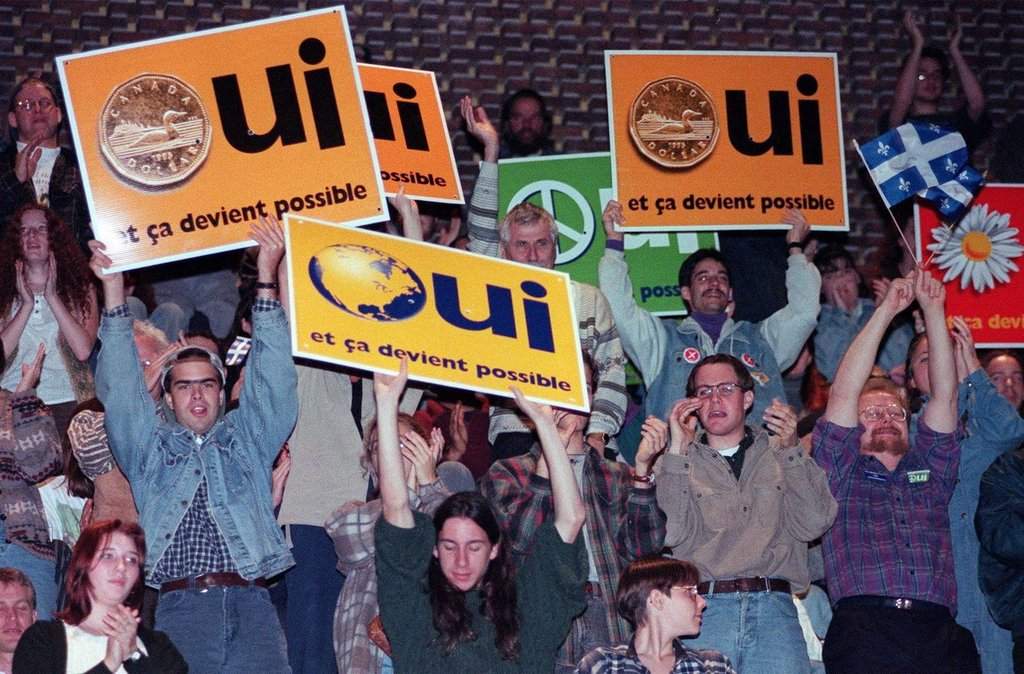
Quebecers have twice voted on sovereignty. In 1980, René Lévesque’s Parti Québécois asked whether the province should begin negotiations to leave Confederation. Nearly 60 per cent of voters opposed the proposal. A second referendum followed in 1995, when the No side won narrowly.
Daniel Turp, a Université de Montréal law professor who represented both the Bloc Québécois and the PQ, points to differences in how the referendums were framed. Quebec’s two independence votes each posed a single question on sovereignty, prompting weeks of mass mobilization by both federalists and sovereigntists. Public support for independence also differs sharply between the provinces, he said.
On the eve of Quebec’s 1995 referendum, polls showed opinion evenly split. Three days before voting, Canadians from across the country travelled to Montreal to urge Quebecers to reject independence. More than 90 per cent of registered voters cast ballots, and federalists won with 50.58 per cent. Harel said: “That’s the kind of voter turnout you see in countries where voting is mandatory. I would be extremely surprised if voter turnout in the Alberta referendum were the same.”
By contrast, poll aggregator 338Canada showed less than 25 per cent support for Alberta leaving Canada as of Oct. 11. Turp said: “There hasn’t been a love-in in Alberta yet. Maybe we’re not as worried because the polls show the option to remain will win.”
The Quebec sovereigntists do not dismiss Alberta’s claim to autonomy or self-determination. “If Alberta were to vote yes, and then Ottawa would say, ‘well, you can’t leave,’ we will be on the side of Alberta,” Lisée said. Harel said that despite the lack of ideological similarities, the democratic process must be respected. She added that Alberta’s referendum could lend legitimacy to the referendum promised by the PQ.
Asked whether a No vote in Alberta on Monday could affect the PQ’s promised referendum, all four sovereigntists said it would not. Alepin said the movements are too different for Albertans to influence Quebecers’ appetite for sovereignty. Lisée expects Alberta’s result to have little effect, predicting that “the defeat of the yes side in Alberta will be a negative but very insignificant factor in (Quebec’s) referendum debate.”
If Alberta remains in Canada, Turp said the province could take inspiration from Quebec’s efforts to negotiate greater autonomy with Ottawa. “And then they can organize a second referendum, like we did,” he added.