
Responsible Statecraft has reported:
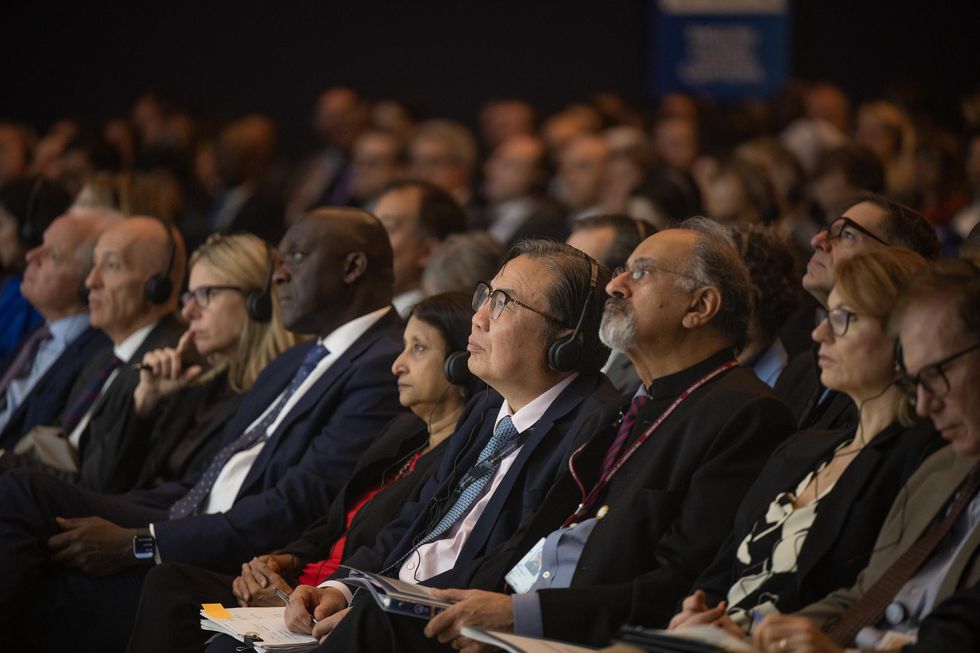
The global economy has remained resilient through a prolonged war in the Middle East, but energy pressures, rising borrowing costs and uncertainty over artificial intelligence are weighing on the outlook as the International Monetary Fund and World Bank hold their annual meetings in Bangkok. The meetings are taking place amid a mix of relief at the economy’s performance and concern that the forces supporting growth could weaken or bring new shocks.
IMF managing director Kristalina Georgieva said in a speech opening the meetings that the global economy had navigated successive shocks with “remarkable agility.” She said the discussions would focus on energy prices, high government debt and the rise of AI.
The relief reflects the economy’s resilience during a war in the Middle East that has lasted much longer than expected at the spring meetings in Washington in April. The concerns include the continuing war in the Gulf and other conflicts, dwindling energy buffers, the prospect of job losses if AI proves highly effective, and financial shocks if it fails to deliver expected returns.
Rising yields on long-term government bonds are also threatening economic growth and fiscal solvency in many countries. Those pressures are unfolding alongside the AI investment surge, renewed inflation linked in part to the war, and concerns about the debt outlook for G7 members, including the United States and France.
In its latest World Economic Outlook, the IMF kept its global growth projections essentially unchanged at 3.1 per cent for 2026 and 3.4 per cent for 2027. The Fund attributed the resilience in part to flexible oil markets, including higher production outside the Persian Gulf, alternative transport routes out of the region and greater use of other energy sources.
The extraordinary increase in spending on AI has also helped cushion the global economy, although the benefits have been uneven and come with costs and uncertainty. The technology boom has driven a rise in global investment, concentrated geographically: U.S. companies are expected to spend close to $1 trillion on AI infrastructure this year alone.
That investment has been accompanied by a sharp increase in imports of key semiconductor inputs from East Asia, particularly Taiwan and Japan. The boom has contributed to larger Asian trade surpluses and U.S. trade deficits, which are often a source of friction, while the scale of the buildout has increased competition for savings and pushed up interest rates on long-dated government debt in many countries.
In the United States, concern about the Federal Reserve’s independence has also contributed to upward pressure on interest rates. President Donald Trump continues to pressure the institution through social media and efforts to remove key personnel.
In France, anxiety about rising deficits and debt overlaps with concerns about the 2027 election. Two major contenders, Marine Le Pen on the right and Jean-Luc Mélenchon on the left, appear unwilling to comply with policy constraints imposed by the European Commission and the European Central Bank.
The broadly stable global forecast masks a more uneven outlook across countries. Emerging-market growth is expected to reach 3.7 per cent in 2026, just 0.1 percentage points below the IMF’s April estimate. India’s resilience has lifted its forecast by 0.6 percentage points to 7.0 per cent, while the Middle East and North Africa face a one-percentage-point reduction.
Saudi Arabia accounts for a sharp part of that regional downgrade. Its growth estimate has fallen by 5.0 percentage points compared with April, to a projected contraction of 3.3 per cent.
The number of economies expected to account for most global growth has also narrowed. In April, 54 economies were projected to generate 95 per cent of growth; the latest outlook puts that share in just 32 economies. Growth prospects have been lowered for 47 per cent of the economies covered by the Fund.
The IMF analysis links the diverging outcomes to countries’ differing exposure to wars in the Middle East and Europe and to the lift from AI-related investment. South Korea and Taiwan, both oil importers and major producers of equipment needed for the AI boom, have benefited from AI-related exports enough to outweigh the drag from higher oil prices.
Singapore, Malaysia and Vietnam have seen similar effects on a smaller scale. Oil exporters in the Global South that are far from the Persian Gulf have also received growth upgrades compared with April estimates, while oil importers with less exposure to the technology boom could face tougher conditions. Among Africa’s two largest economies, Nigeria is expected to benefit, while South Africa is projected to be held back.
The outlook also includes climate-related risks. The years 2026 and 2027 are projected to bring a Super El Niño, at a time when farmers around the world are already under strain from higher diesel and fertilizer prices.
The climate phenomenon is associated with heavier rainfall in some places, including Northern East Africa and South India, and drier conditions in others, including Southern Africa and North India. Those shifts raise the prospect of higher food prices, with the poorest people facing the greatest impact.
Higher U.S. Treasury yields could also tighten financing conditions for countries in the Global South. The analysis notes, however, that as of the time it was written, growing anxiety about the AI growth trajectory had brought U.S. Treasury yields down.
Many Global South borrowers, particularly countries running trade deficits, may have to keep interest rates higher than they otherwise would to attract capital when U.S. rates are high. That can be the case even when their budget deficits and gross debt are far below those of developed countries.
Brazil’s current interest rates are roughly 9 per cent above inflation, for example. High rates can slow growth and worsen a country’s debt trajectory.
AI itself remains a source of both economic support and anxiety. One medium-term concern is that the technology could eliminate service-sector jobs, particularly entry-level positions. Singapore President Tharman Shanmugaratnam highlighted that risk at the IMF meetings.
The employment concern is global, but especially significant in countries with large youth populations seeking upward mobility through education, particularly in Africa and South Asia. India is one example. The Gen-Z cockroach movement began there with protests over leaks and other irregularities in nationwide competitive exams that govern entry into education and employment.
A separate concern is that AI investments may not earn the returns expected. Gartner, a global technology advisory firm known, among other things, for coining the concept of the hype cycle, expects an additional $6 trillion in AI spending through 2030. It also estimates that $3.5 trillion in AI assets could be financially impaired by then, meaning they would not generate sufficient returns.
The IMF has warned that interconnected financing arrangements could transmit unexpected pressure between companies selling AI hardware, data-centre builders using their chips and AI lab businesses. The same IMF publication also warns that AI could work well at the wrong tasks by enabling increasingly sophisticated cyberattacks against critical and financial infrastructure.
The economy has avoided a major setback so far this year, but the risks identified at the meetings remain in play.