
The War Zone has reported:
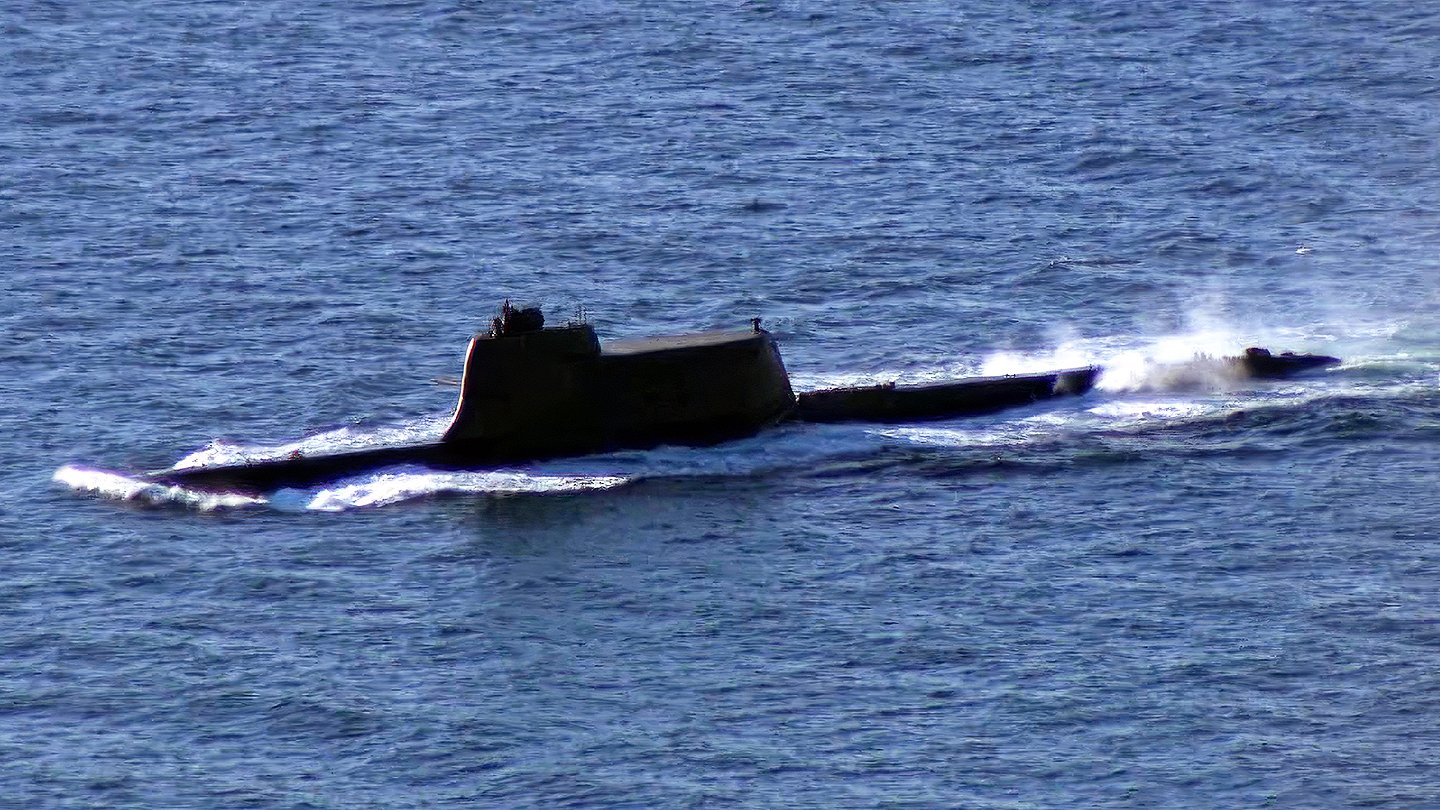
North Korea said it test-fired two types of submarine-launched strategic cruise missiles off its east coast on Wednesday, October 14, in an event that may mark the first publicly documented appearance at sea of the Hero Kim Kun Ok submarine. State media released a photograph of the vessel underway alongside images of the missiles. The submarine’s role in the tests has not been confirmed, and its operational status and capabilities remain uncertain.
The Korean Central News Agency (KCNA) reported the tests earlier today, saying they were intended to assess the readiness of underwater combat systems, improve the Navy’s ability to carry out strategic missions and demonstrate the reliability of the country’s deterrent. KCNA did not identify the submarine involved or provide the missiles’ ranges, flight paths or performance details. The agency published imagery of a cruise missile apparently being fired from a vertical launch tube and of another missile launching while submerged.
South Korea’s Joint Chiefs of Staff (JCS) said it detected and tracked the launches from before firing through the cruise and terminal phases. A JCS spokesperson said one missile type was launched from a vertical launch system and the other from a torpedo tube. South Korea’s military assessed that the weapons had been launched from a submarine but did not initially name the vessel.
The JCS assessment adds support to the possibility that the Hero Kim Kun Ok was the launch platform, since the described launch methods fit the submarine’s known configuration. It does not settle the question. North Korea has previously used underwater platforms for missile tests and paired test imagery with photographs of a submarine for propaganda purposes, so the released image alone cannot establish that the vessel shown fired the missiles.
If the Hero Kim Kun Ok did launch the weapons, the tests would be its first confirmed weapons trials and could indicate that North Korea is validating its combat systems before deployment. At minimum, the photograph confirms that the vessel is sailing. South Korean and U.S. intelligence services would be closely monitoring its movements, but the available information does not show whether it has been undergoing sea trials for years or only recently went to sea.
North Korea unveiled the submarine in September 2023, describing it as its first “tactical nuclear attack submarine” and one of the Navy’s main offensive platforms. At the unveiling ceremony, leader Kim Jong Un was quoted as saying that arming the Navy with nuclear weapons “brooks no further delay.” The vessel is a diesel-electric submarine with hull number 841 and is known as the Hero Kim Kun Ok.
Despite Pyongyang’s claims, the boat is understood to be a heavily modified version of the Cold War-era Romeo-class diesel-electric submarine, rather than a purpose-built guided missile submarine. That design is nearly antique by current standards. Images released previously show 10 missile launch tubes concealed in the prominent raised section, often called a “turtle back,” behind the sail, in addition to torpedo tubes. The exact arrangement, usable capacity and operational state of the systems have not been established.
The four forward tubes are larger than the six aft tubes on the raised section. That arrangement could allow the submarine to carry more than one kind of missile, possibly including a mix of shorter-range and longer-range submarine-launched ballistic missiles (SLBMs) and submarine-launched cruise missiles (SLCMs). The tests involving both a vertical launch system and a torpedo tube would be consistent with efforts to validate more than one part of the vessel’s weapons architecture.
The two launch methods have different features and constraints. A vertical launch system provides dedicated space for certain weapons, potentially including larger missiles, and may allow faster launches or larger salvos than a boat relying only on torpedo tubes. Torpedo tubes offer another way to fire missiles, subject to limits on weapon size, handling and firing procedures.
Launching a missile while submerged is more demanding and more relevant to operations than firing one from the surface. A successful firing, however, demonstrates only one part of a submarine’s capability. To operate effectively, the vessel would also need to deploy reliably, avoid detection, maintain its weapons and carry out missions under realistic conditions.
Analyst Shin Jong-woo of South Korea’s Defense and Security Forum told Reuters that the latest launches suggested combat-system testing was underway ahead of operational deployment. He said North Korea may have addressed technical problems and could also test an SLBM from the submarine before it enters service. A successful SLBM test would be a likely milestone towards a credible sea-based nuclear deterrent, but no such test was reported in Wednesday’s activity.
North Korea has displayed SLBMs of increasing size, including missiles identified as Pukguksong-5 at a January 2021 parade, but it has lacked a suitable submarine from which to launch them. The Hero Kim Kun Ok has a larger hull and more vertical launch tubes than the older 8.24 Yongung submarine, though its diesel-electric propulsion is dated. It brings different limits on endurance, acoustic signature and operations compared with nuclear-powered submarines and modern diesel-electric boats.
North Korea has used the 8.24 Yongung in earlier reported missile tests. In March 2023, it said it tested a submarine-launched cruise missile from that older vessel. In January 2024, Pyongyang said it fired Pulhwasal-3-31 strategic cruise missiles from the same submarine. The 8.24 Yongung is in the 2,000-ton class and is understood to have one or two vertical launch tubes. Wednesday’s activity was described in reports as North Korea’s first publicly reported underwater missile test since the January 2024 launch.
Pyongyang’s use of the word “strategic” to describe the cruise missiles does not establish that they can reliably carry nuclear warheads. North Korea has a well-established long-range cruise missile programme and has ambitions to equip such weapons with nuclear payloads, but the maturity and reliability of a nuclear warhead for this application are unclear. Cruise missiles launched from land, surface vessels and submarines form part of the country’s broader deterrent architecture.
The tests are part of a wider sequence of weapons demonstrations. North Korea reportedly conducted hypersonic missile tests on September 20 and October 3, as well as tactical ballistic missile launches earlier in October. Together, the activities are consistent with efforts by Pyongyang to diversify delivery systems and complicate military planning for South Korea, the United States and Japan.
The testing also follows a diplomatic dispute. North Korea has repeatedly said it will not give up its nuclear weapons while the United States maintains what Pyongyang calls a hostile policy. It has rejected the view that changes to U.S.-South Korean military exercises would be enough to alter the underlying relationship. The latest submarine activity came after North Korea rejected an apparent diplomatic opening from U.S. President Donald Trump, following Washington’s effort to ease tensions around a U.S.-South Korean military exercise.
A submarine that can fire missiles from less predictable locations would complicate defensive planning for South Korea and the United States. The challenge includes detecting and tracking the vessel before it reaches a possible firing position, as well as intercepting missiles after launch. Even a submarine with partial weapons capability would add demands for potential adversaries.
At the same time, the Hero Kim Kun Ok’s older Romeo-class design and diesel-electric propulsion impose substantial operating constraints. In a conflict on the Korean Peninsula, a submarine carrying strategic weapons would be a high-priority target for Pyongyang’s adversaries. The vessel could be relatively easy to track from the time it leaves its berth, although the source account ends mid-sentence before giving its remaining explanation of that assessment.
North Korea is also pursuing a separate nuclear-powered submarine project, which it unveiled as under construction in March 2025. The completion date and operational timeline remain uncertain. Nuclear propulsion is a greater technical challenge, but a successfully developed boat would offer considerably more value, especially for a second-strike capability.
The Hero Kim Kun Ok’s development has been followed through public imagery, including a 2019 visit by Kim to the Sinpo submarine yards, when the future vessel was first glimpsed. A satellite image of the Pongdae Submarine Factory on North Korea’s northeast coast has also been presented as showing the centre of the country’s submarine development activity. The latest tests may offer evidence of progress, but the submarine’s actual weapons capacity, readiness and prospects for deployment remain unresolved.