
The War Zone has reported:
The U.S. Army is pursuing a family of modular, scalable laser weapons that could be fitted to vehicles across its inventory, aiming to expand their use against drone threats beyond dedicated air defence units. Army officials and industry representatives discussed the Enduring-High Energy Laser program, known as E-HEL, at a panel Monday during the Association of the U.S. Army’s main annual convention. The War Zone attended the discussion.
The Army is already using high-energy lasers operationally on a limited basis, including near the U.S.-Mexico border. Wider adoption has faced technical and reliability hurdles. The service’s current approach centres on systems that can move between platforms and be used by a range of Army formations.
“We’re focused on any vehicle in the motorpool. I want to try to integrate future capability of high-energy lasers into it,” said Army Brig. Gen. Guy Yelverton, Capability Program Executive for Defensive Fires with the Portfolio Acquisition Executive Office for Fires. “And, so, our E-HEL is on a sled. With that, I can look at integrating it onto multiple different vehicles.”
In September, AeroVironment received the first E-HEL production contract, to supply examples of its 30-kilowatt-class LOCUST X3 laser directed energy weapon. The Army had acquired earlier LOCUST variants through more experimental programs, including vehicle-mounted and palletized versions. Systems from those efforts are now deployed along the southern border.
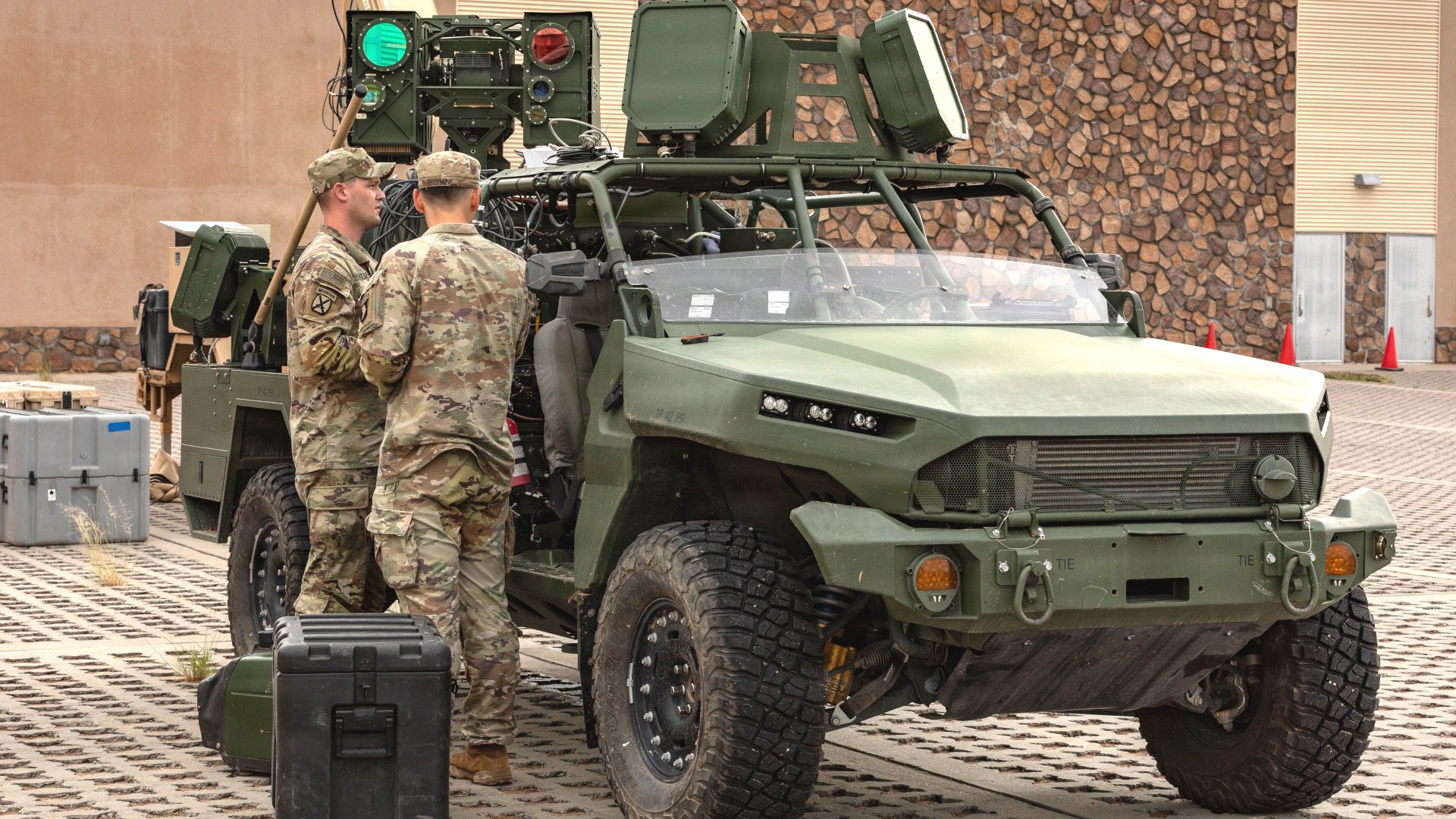
The U.S. Navy has also tested a containerized LOCUST version for shipboard use as part of its broader laser ambitions. The Army’s existing LOCUST systems include versions mounted on 4×4 Joint Light Tactical Vehicles, or JLTVs, and Infantry Squad Vehicles, or ISVs, along with palletized types. They appear to be fielded on an ad hoc basis to units at forward locations.
Yelverton said the Army wants the system to be usable by soldiers beyond air and missile defence organizations. “And then, as I think about vehicle agnosticness, if I open up my aperture to MOS [military occupation speciality] agnostic, and ensure that it’s easy to train, easy to operate, I can not just focus on air and missile defense organizations,” he said. “I can now look at any formation type to be able to put a high-energy laser capability into it for the counter-UAS [uncrewed aerial systems] fight.”
He said that broader approach could give senior leaders more choice about where the equipment is assigned and which soldiers operate it. “That gives me even more opportunities to share this capability across all Army formations, and give our senior leaders [the] maximum amount of thought process and input into where the system goes, who the soldier is that’s operating it, and I’ve given them quite a solution,” Yelverton said. “It’s a great dilemma to have of where do I put all this capability.”
LOCUST is built around a turret containing the laser beam projector and electro-optical and infrared video cameras for finding and tracking targets. Sensors on the host vehicle, including small-form-factor high-frequency radars and passive radio-frequency signal detection systems, can cue the turret. Off-board radars and other capabilities positioned elsewhere can also provide cues.
The Army’s earlier effort to field laser weapons on Stryker vehicles illustrates the obstacles facing the technology. In 2022, the service reactivated the 4th Battalion, 60th Air Defense Artillery Regiment, or 4-60th ADA, at Fort Sill, Oklahoma, as part of plans to field Directed Energy Maneuver-Short Range Air Defense systems based on the 8×8 Stryker light armored vehicle. Reliability and other problems with the DE M-SHORAD vehicles led the Army to shift its focus, and the battalion has since taken on a more traditional air defence role.
Those difficulties reflect wider challenges for laser directed energy weapons across the U.S. military. Several programs have been sharply curtailed or cancelled in recent years. Yelverton said at Monday’s panel that laser weapons are no longer a matter of “science fiction” but have become “science reality.” The U.S. military says laser systems positioned along the border with Mexico have downed real targets, though questions remain about those deployments.
Kirk Williams, chief engineer at the Army’s Directed Energy Project Office and another panelist, said the technology can engage targets, but soldiers need systems they can trust. “Lasers are real. We can do it. We can go out. We can shoot things,” Williams said. “But what we got to do now is make these systems reliable enough so that the soldiers have the faith in them when they need them, and that’s really the main point that we’re trying to go after right now.”
The Army also needs systems that can be maintained and repaired in battlefield conditions. “We’re getting to the point where the systems are reliable enough, but we still have to make them maintainable and repairable because this is an Army system,” Williams said. “It’s going to be on a battlefield. Things are going to break. We can break things in very creative ways, right? So if it’s not reliable, or if it’s not maintainable, if it’s not repairable, that’s a problem.”
Size, weight and power are another concern, particularly for smaller vehicles. “We’re also looking to reduce size, weight, and power,” Williams said. “JLTV has a lot better payload capacity than ISV. So we really need to be able to get something smaller if we want to have the same effectiveness on an ISV. So that same modular architecture will allow us to go in, take some of those components, make trade-offs.”
Modular and open system designs are intended to support improvements in reliability and performance, allow new technology to be added to existing systems and help lower vendor prices. Williams said the Army wants to avoid tying a laser’s availability to routine maintenance of the vehicle carrying it. “By going after the modular architecture, that gives us the flexibility to not only go after increases in reliability, but also increases in performance,” he said. “It gives us the way to inject new technology into existing systems, and then hopefully it also gives us a way of getting better prices out of some of our vendors.”
“In addition, “one of the things we learned is you can have a really cool integrated system, and then when that truck needs an oil change, well, then your laser weapon system is down for the count,” Williams said. “So, trying to make it so that you can just pull it off of any vehicle, put it on any other vehicle is really one of the things that we’re trying to go after.”
The 30-kilowatt LOCUST X3 is at the lower end of the power spectrum for laser weapons, and all LOCUST versions to date are designed specifically to counter small drones. The Army could field other types of laser weapons through E-HEL in the future. It is also working with other U.S. military branches on separate designs with substantially higher power ratings.
Lasers could add a layer of defence against drones while reducing the cost per interception compared with conventional anti-aircraft interceptors. Their potential for a functionally unlimited magazine depends on having enough power and cooling capacity. That can be useful against drone threats, which need not be large or expensive to pose a danger.
Smaller, ruggedized systems could be distributed across a wide area or concentrated depending on operational needs. A convoy with several laser-equipped vehicles could gain protection against sudden attacks. Mobility also allows light-vehicle systems to be repositioned as battlefield conditions change or transported to forward locations beneath helicopters. Palletized and containerized versions offer other options for point defence at land sites and for ships.
Army personnel assigned to Joint Task Force-Southern Border prepared to sling-load a LOCUST-equipped ISV beneath a CH-47 Chinook during training for an Air Assault Sustainment Course at Fort Bliss, Texas, on July 16, 2025. The Army also released an image it said showed a drone engagement by a laser weapon near the Mexican border on August 25, 2026.
The Army faces physical limits even if it can make the systems more portable. A laser can engage only one target at a time, and its beam loses power as it travels through the atmosphere. Weather, smoke and dust can affect performance, while longer-range effectiveness requires more power and cooling capacity. Adaptive optics can help address some of those effects, but laser weapons remain very short-range systems overall.
Yelverton said the Army needs enough energy on a target to destroy it quickly and move on to another threat. “That’s why it’s important to us to get enough energy on the target to kill it as quickly as possible and move on to the next threat. Speaking about the magazine, you know I have b