
The War Zone has reported:
The U.S. Army made the Merops interceptor drone a formal program in 142 days, faster than the service’s usual 180-day process for deciding whether an emerging capability should become an Army program. The system, developed to counter one-way attack drones, moved from evaluation to use by NATO partners and later to mobile firing teams in another theatre. Army officials have pointed to the effort as a model for getting combat-tested equipment to troops while establishing a plan for its future funding and support.
Col. Christopher Hill, director of the Army’s Global Tactical Edge Acquisition Directorate, or G-TEAD, discussed the effort at the Association of the U.S. Army’s annual convention in Washington, D.C. He described the acquisition as “an example of how we can move fast when we need to.”
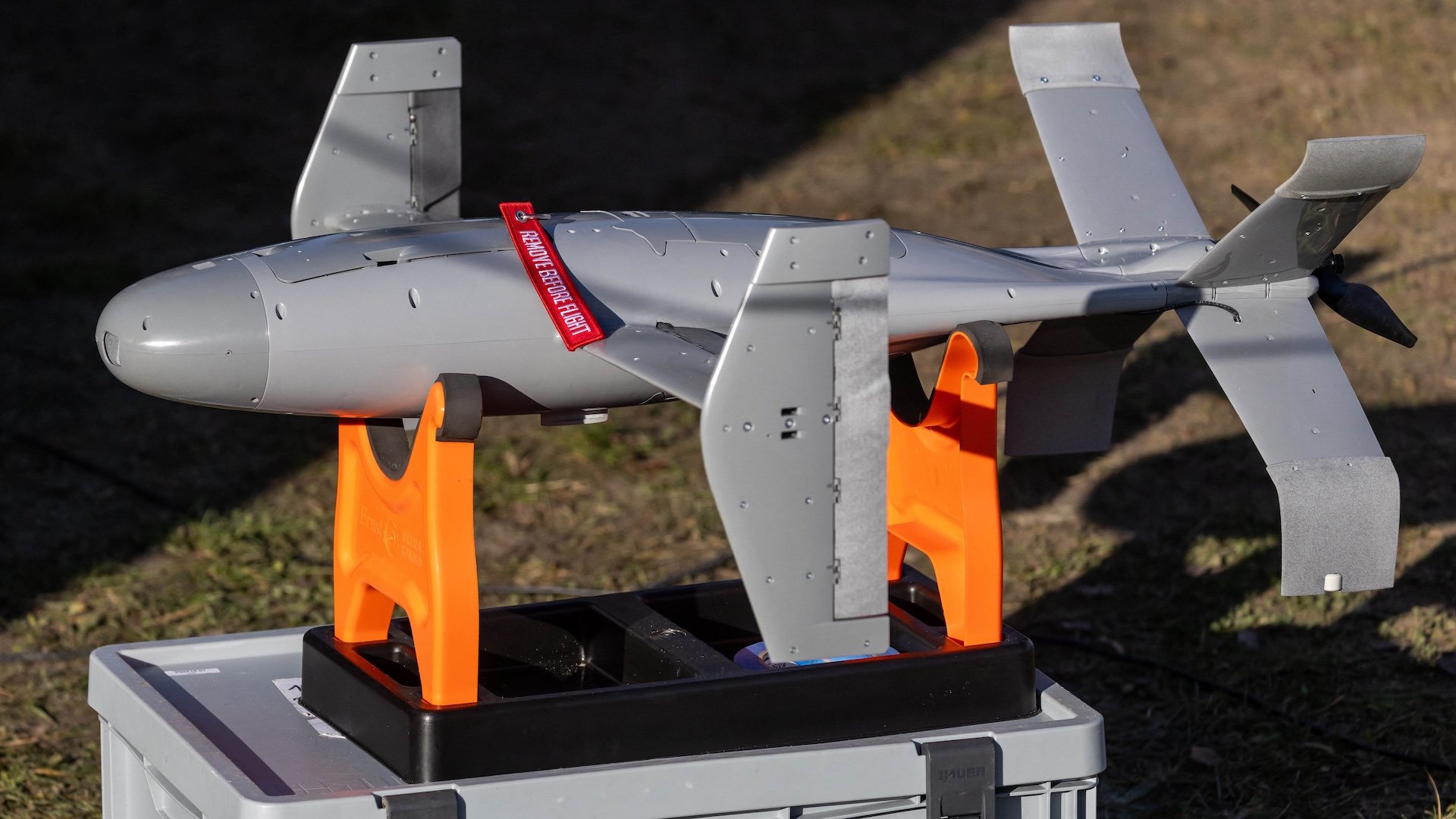
The Merops is a small, relatively low-cost counter-unmanned aircraft system designed to intercept long-range attack drones in flight. It was developed under Project Eagle, a U.S.-backed initiative that included contributions from Swift Beat, a company associated with former Google chief executive Eric Schmidt.
The system uses Surveyor drones as airborne interceptors. Onboard sensors track targets, and the aircraft can operate autonomously or under remote control. An interceptor can destroy an enemy aircraft by striking it directly or by using a proximity-detonated explosive warhead.
The Army first considered Merops after drone incursions involving two NATO partners led a senior commander to demand an urgent response. Hill said the system was not part of the commander’s original acquisition plan, but its demonstrated performance in Ukraine made it a strong candidate.
“He said, ‘I want this capability in the hands of our partners within 14 days,’” Hill recalled. “Everyone looked around the room, and he looked over at me, and I nodded my head like, ‘We’ll figure it out.’”
The Army did not meet the 14-day target. Acquisition staff and soldiers went into the theatre to assess the system, and it reached NATO partners in about 21 or 22 days, Hill said. The effort later expanded beyond the initial delivery.
The Army acquired more Merops systems in partnership with the Joint Interagency Task Force, which procured 13,000 interceptors. The Army also moved from providing the capability to NATO partners to supplying mobile Merops firing teams in a second theatre. The source identified that theatre as presumably U.S. Central Command, or CENTCOM.
In CENTCOM, U.S. forces have faced Iranian Shahed-136 and other one-way attack drones used in barrages against American and allied forces and installations across the Middle East. Army Secretary Daniel Driscoll has described Merops as a particularly appealing option against these threats because it is relatively inexpensive and can be acquired quickly.
In congressional testimony, Driscoll said the Army bought 13,000 Merops interceptors in about eight days after the conflict with Iran began. He put the cost at roughly US$15,000 per interceptor, with the possibility that the price could drop below US$10,000 as production increases. In a separate interview with Bloomberg, he said larger orders could eventually lower the price to between US$3,000 and US$5,000.
Shahed drones have been estimated to cost tens of thousands of dollars each, while conventional air-defence interceptors can cost much more. Using a lower-cost drone to defeat an attack drone can improve the economics of air defence and preserve more sophisticated interceptors for threats that require them. The approach is not intended to replace every layer of air defence, but can offer another option when forces face large numbers of relatively inexpensive targets and would otherwise expend missiles worth hundreds of thousands or millions of dollars per target.
Ukraine has used Merops alongside interceptor drones produced domestically to counter Russian Shahed and Geran one-way attack drones. The system’s battlefield use has helped demonstrate the potential of a class of air-defence weapons designed to counter such aircraft without relying only on costly surface-to-air missiles.
Hill cautioned that a system’s performance in Ukraine does not guarantee it will work equally well in other operating conditions. “On the Merops, it absolutely was influenced by [Ukraine]. I mean, that’s where it came from. That’s where we saw the capability,” he said. “But that’s one of the things where the employment of the system really matters.”
He said effectiveness can vary by location, including between desert environments and the urban settings where Merops has operated in Ukraine. The Army’s aim is to bring the system into its inventory so commanders can decide where it is useful and how to deploy it.
“Once we get it into our hands, now we can make a decision in Europe. Where does it go? Do I even need it?” Hill said. “It’s getting it in our hands. So that was the key for the Merops. The speed of getting it, then we can make the decision of how we employ it.”
The acquisition reflects a broader Army effort to speed up the handling of emerging technologies while giving them a route to lasting funding, production and support. Hill said G-TEAD involves organizations that may eventually take responsibility for a capability from the start of its assessment. Program acquisition executives, known as PAEs, participate early, while the Army’s test and evaluation community and soldiers provide feedback.
The process is intended to identify a transition partner upfront, rather than wait until after an initial fielding to decide which organization will own the system. “We want to make sure that we’re giving commanders capability that we know works,” Hill said.
G-TEAD’s standard process is designed to take 180 days and reach a decision on whether a capability should become an Army program. Merops reached that point in 142 days. The process also aims to address what acquisition officials call the “valley of death,” the gap between placing an emerging system with operational units and a program office taking over with the funding and contracting structure needed to expand it.
“We will work to fill that valley of death gap between the time that we put capability into the hands of units and the time that the PM picks it up and actually [provides funding],” Hill said. “There’s a gap there. So we can do that intermediate scaling portion before it fully transitions.”
The work supports the Army’s wider push to streamline acquisition, which Driscoll has also emphasized. The Army secretary has described an older process with 16 decision-making steps, each of which could veto a proposal and send it back through the system. Under that process, the service could wait two to seven years to buy a capability.
The Merops experience indicates that delays can be reduced when acquisition professionals work directly with operational units and the organizations that evaluate and sustain equipment. The Army still needs to establish where the interceptor offers the greatest value, how it fits into existing air-defence systems, and how to produce and maintain enough units to meet demand.
The system is serving two purposes for the Army: adding an option against the growing threat from one-way attack drones and demonstrating a faster path from an emerging battlefield capability to a formally supported military program. Its performance and cost make it a potential tool against mass drone attacks, while decisions about deployment and long-term production remain part of the work ahead.