
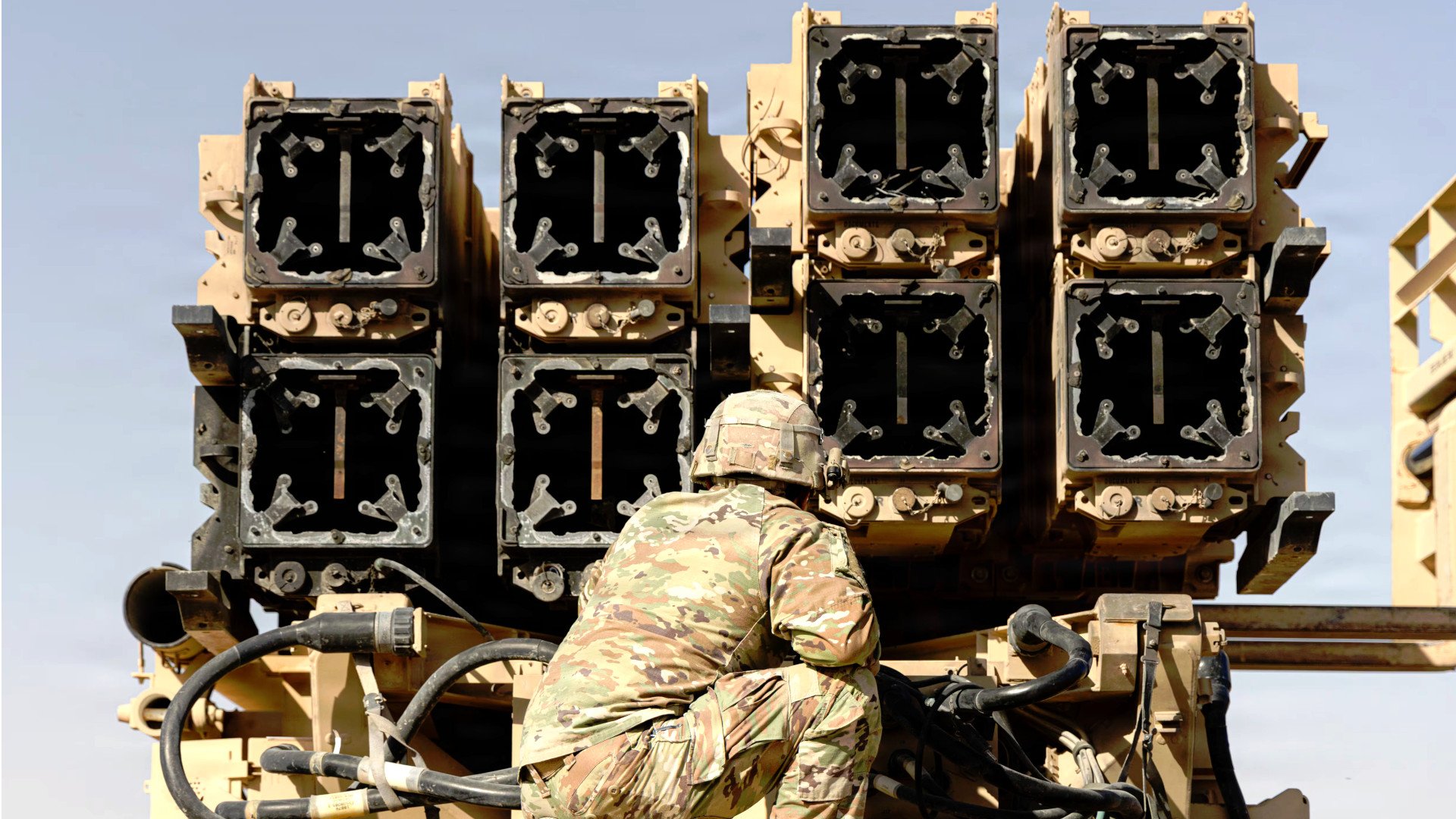
The War Zone has reported:
The U.S. Army is pursuing a wider range of air defence interceptors, with at least five named programmes aimed at threats spanning advanced hypersonic missiles and small weaponized drones. The effort reflects a shift away from relying on a single interceptor type for each air defence system, as the Army seeks a mix of capabilities, more suppliers and munitions that can be replenished at scale.
Army Lt. Gen. Frank Lozano, the service’s Portfolio Acquisition Executive for Fires, discussed the direction at a panel at the Association of the U.S. Army’s main annual convention. The remarks came as the effects of the war with Iran, along with other crises in the Middle East and the ongoing conflict in Ukraine, have sharpened attention to the size, diversity and sustainability of weapons stocks.
Most of the Army’s ground-based air defence systems currently use only one type of interceptor, with Patriot as the exception. Even for Patriot, procurement of new interceptors had increasingly focused on the PAC-3 Missile Segment Enhancement, or MSE. Production of the earlier PAC-3 Cost Reduction Initiative, or CRI, missile ended in 2023.
Earlier this year, the Army placed its first order in decades for new PAC-2 Guidance Enhanced Missile-Tactical, or GEM-T, interceptors. The older Patriot missile has continued in production mainly for U.S. allies and partners. The Army is considering whether to buy more while GEM-T production remains available.
“We have the capabilities we need to have to fight and win, but it’s our job to ensure that victory is achievable in the future inside of any dynamic environment scenario fight we might find ourselves in,” Lozano said. “So, it’s incumbent upon Mr. Ingraham [ Assistant Secretary of the Army for Acquisition, Logistics and Technology Brent Ingraham] and I to continue to be creative and looking at, well, should we buy GEM-Ts because they’re being produced?”
“GEM-Ts are a really good missile in the battlespace within they operate. I mean, they’re being employed today by air defense brigades around the world,” he said. “So if we have the opportunity, it’s probably something we should take advantage of, and we’re looking at doing that.”
The Army’s plans include the Low Cost Interceptor, or LCI, programme, which seeks a lower-tier Patriot interceptor priced at no more than US$1 million per unit. PAC-3 MSE missiles have averaged about $4 million each in recent years. Lozano said the Army has aimed to reach annual PAC-3 MSE production of 2,000, while weighing how to build a larger overall supply through different weapons.
“We’ve had a lot of discussions about even more interceptors. From a PAC-3 MSE perspective, our goal has always been to get to 2,000 [per year],” he said. “Why we’re running programs like LCI [Low Cost Interceptor], and NGSRI [Next-Generation Short-Range Interceptor], and NGCM [Next-Generation C-UAS Missile], and Second Interceptor, is because I think the easy button answer is just buy more of a great missile. We’re going to buy more [PAC-3 MSEs], but when we start talking about overall missile output, we start looking at numbers like is it 4,000, is it 6,000, is it 8,000, we’re looking at a diverse set of capabilities.”
The Next-Generation Short-Range Interceptor, or NGSRI, is intended to replace the Stinger. The new missile must work with existing vehicle-based and man-portable launchers. Lockheed Martin and Raytheon, the Stinger prime contractor, have been competing directly in the programme.
The Army plans a new shoot-off for NGSRI in the fourth quarter of Fiscal Year 2027, open to other vendors. The Army has also chosen AeroVironment to provide its Freedom Eagle-1 interceptor for the Next-Generation C-UAS Missile, or NGCM, programme, which is focused on countering drones using launchers already fielded for the Coyote interceptor.
The Army issued a request for information in August seeking other NGCM options. It aims to conduct an initial evaluation in the fourth quarter of Fiscal Year 2027, with a deeper operational assessment potentially following in Fiscal Year 2028.
Another competition, known as Second Interceptor, is for Enduring Shield, the Army’s middle-tier air defence system. Enduring Shield, also called the Indirect Fire Protection Capability Increment 2, or IFPC Inc 2, is designed to accommodate multiple interceptor types, though the Army is currently buying only AIM-9X Sidewinders for it. The Second Interceptor effort aims to improve defence against incoming cruise missiles compared with the AIM-9X.
The programme has moved into its second phase, with Lockheed Martin competing against Boeing, which is teamed with Anduril. Lozano said the Army wants a faster acquisition schedule and an opportunity for additional companies to demonstrate their systems.
“On ‘second interceptor, obviously, we just moved into phase two of that program. We’ve got Lockheed Martin competing with Boeing, who was teamed with Anduril,” Lozano said. “But we wanted to turn up the heat on that program. I constantly get frustrated when a funding profile emerges over the FYDP [the Future Years Defense Program], and then magically we lay in a five-year program.”
“I’m like, no, I actually need that capability now,” he continued. “So, have we thought maybe what if we ran a 24-month program or a 36-month program, right? And so, in that vein, what we have decided to do is, while those two companies continue to compete, we’re going to create a shoot-off opportunity in [the] fourth quarter [of Fiscal Year 20]27, and I want to run an in-parallel, what I call an in-stride competition.”
The Army recently held an industry day and invited firms that did not advance from the first phase but continued to invest in IFPC Second Interceptor to come to a range, receive range time and be presented with targets. Lozano said those companies would be allowed to compete again for a place in the programme.
“We just held an industry day, and we basically just said, hey, if there’s any other company who didn’t make the first cut in the phase one, but, oh, by the way, who continued to invest in the IFPC Second Interceptor capability, we’d love for you to come out to the range,” he said. “We’ll give you range time, we’ll present targets, and we’ll allow you to recompete with an opportunity to get back into the program folder.”
A separate Future Interceptor effort is also aimed at Patriot. Unlike LCI, it is intended to acquire a new missile with improved capability against hypersonic missiles and other upper-tier threats. Taken together, the Future Interceptor and LCI efforts mean the Army is pursuing at least two new Patriot interceptor options.
Historically, Army competitions of this kind tended to end with one missile design selected. The current plans point to a greater willingness to keep multiple options in play, invite new participants and match interceptors to threats and costs.
“We have to address the threat, and we need to address the threat in a complementary way, meaning we need to fight on a cost curve that’s affordable for the U.S. Army to maintain and sustain that warfighting capability abroad,” Lozano said.
That approach addresses both the need for enough weapons at the start of a conflict and the ability to replenish them as they are used. Lower-cost weapons are part of the answer, but they must also be produced in quantity on reasonable timelines. Lead times for high-end munitions can run for months or years, and relying on a single supplier can become a national security risk during a conflict.
The Army’s work is part of a broader U.S. military push to increase munitions production and bring in a wider range of suppliers, including newer companies working with established defence contractors. Boeing and Anduril’s Second Interceptor partnership is one example. In May, the Pentagon announced framework agreements with new entrants for planned purchases of thousands of lower-cost cruise missiles.
The Department of War’s chief technology officer posted on May 13, 2026, that the department had reached framework agreements with new entrants to expand U.S. military strike capabilities involving lethal cruise missiles and hypersonic missiles. The post identified the Low-Cost Containerized Missiles, or LCCM, programme and listed Anduril among the companies.
Lozano also described a distinct feature of LCI: the Army is seeking both companies able to supply complete rounds and firms that can provide components. He said: “LCI has ‘a unique twist to it because we’re looking for companies who have all-up rounds, but I’m also asking for companies to come in at the component level,’ he explained. ‘We typicall”