
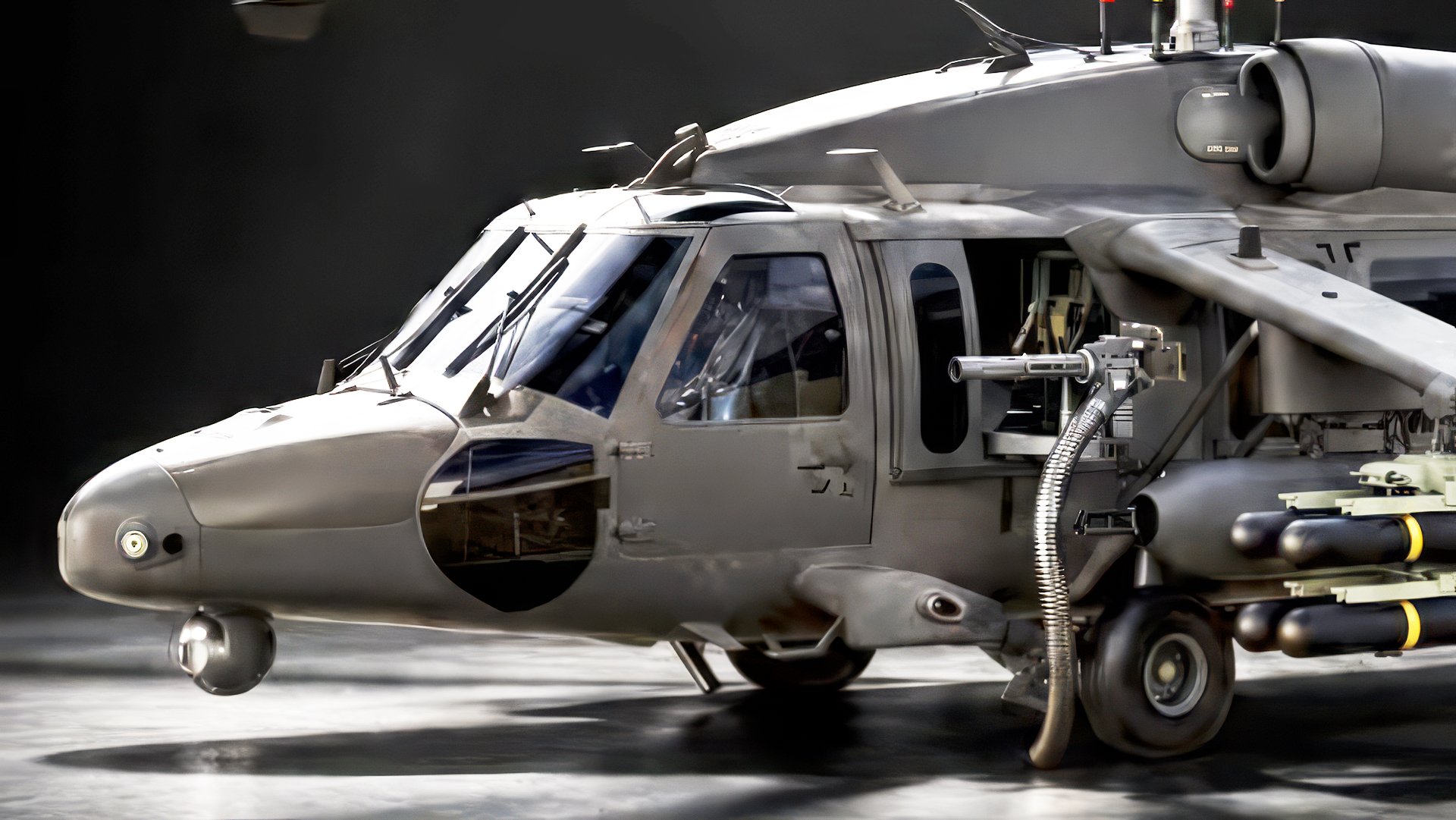
The War Zone has reported:
Sikorsky expects its new modular nose for the H-60 Black Hawk family to be available for new helicopters and retrofits within about a year. The interchangeable structure is designed to let operators adapt aircraft to different missions, from carrying cargo to serving as gunships, while creating more room for sensors, communications equipment and other systems.
Jason Wrigley, Sikorsky’s director of business development for Black Hawk, described the schedule at the Association of the U.S. Army’s main annual convention. “The nose is a good one, and it’s one that’s on a pretty accelerated timeline. Within the next, I would say, year or so, the nose will be available to be retrofitted or to be coming off the line,” he said. “We’ve gone through a design cycle with it.”
Sikorsky, a subsidiary of Lockheed Martin, is developing the nose as one part of its broader Black Hawk 2070 vision, intended to keep the helicopter design operationally relevant into the 2070s. That effort also includes uprated engines and greater total payload capacity. The company has been discussing the new nose with the U.S. Army as part of the longer-term plan.
The proposed structure would provide roughly twice the physical space of the standard nose on current-generation H-60s. Sikorsky has made 3D-printed versions so engineers, operators and maintainers can handle the design and assess access to equipment. Wrigley said the physical models help the team consider how to make systems easier to reach and maintain.
“We’ve done the design. We then 3D-printed the noses, and we did that so that we can physically interact with it, because the whole point of this is for maintainability and access to be able to integrate these different sensors and comms gear,” Wrigley said. “We’ve gotten some feedback from the engineers, from operators, from maintainers, and that goes back into the next cycle of the design.”
Accessibility was a major focus of the test print. A scale model displayed on the convention floor this week shows a design that opens from the top. The team is also considering how to keep equipment inside the nose sufficiently cool, and whether maintainers can reach all the areas they need to access.
“Overall, we just are kind of confirming, can we reach everywhere we need to? What are the different configurations?” Wrigley said. He added that Sikorsky has done “a lot of work with the [U.S.] Army around what do you envision potentially could go in here?”
The design grew from broad mission goals rather than a detailed Army specification, Wrigley said. “This is one of those cases also where our whole engineering team gets more comfortable. It’s not something where the Army came to us and said, ‘this is exactly what I want. Here’s my spec,’” he said. “It was more, ‘here’s what I want to achieve. Here’s what I want to be able to do.’ And so we went off and designed that.”
Wrigley also described the work as part of a change in Sikorsky’s design and delivery process. “I like to highlight this, because it’s part of the way we’re also changing the way we design and deliver the Blackhawk,” he said. “So we’re very much in a model-based environment.”
Sensors and communications gear are among the possible payloads, but Wrigley said the nose is intended to accept equipment according to the mission. “It’s using the old term, but it’s open architecture, and so the whole point is whatever the mission requires” can be installed, he said. “There’s always a demand for real estate up front.”
Specialized H-60 variants already demonstrate the need for more room at the front of the aircraft. MH-60 helicopters flown by the U.S. Army’s 160th Special Operations Aviation Regiment often carry modified noses filled with radars, sensors and other systems. The U.S. Air Force’s new HH-60W Jolly Green II rescue helicopters are another example of H-60s equipped with distinctive noses and mission gear.
Wrigley earlier described the larger Black Hawk 2070 effort as emphasizing open architecture and equipment that can be connected quickly. “There’s a big focus on open architecture and that ability to quickly plug-and-play,” he told The War Zone earlier this month. “The new modular nose will change the look of the Black Hawk up front to provide even more space for equipment that will work directly with the new digital architecture.”
Sikorsky has not yet determined exactly how operators would remove and install the modular noses, or how long a change would take in practice. Wrigley said the company still has to develop retrofit documentation, but does not expect the work to be highly invasive. “Part of the design process is to also write up the documentation for the retrofit, but we don’t see this one as very invasive,” he said.
A shared pool of noses could give even relatively small H-60 fleets more ways to perform different tasks. For example, cargo helicopters could be converted into gunships and later returned to cargo service, using noses equipped with the required sensors, laser designators and other gear. Sharing and swapping equipment could also affect sustainment and logistics costs while giving operators more flexibility.
The model Sikorsky brought to the convention is configured as a gunship. The company has also previously discussed using the nose to adapt H-60s for search and rescue, airborne drone control and other roles. Operators could install a radar for one set of missions, then switch to an electro-optical wide-area surveillance system or another sensor for later sorties. Defensive systems could also be moved between aircraft and upgraded more quickly when required.
The added space may also support autonomy equipment. Sikorsky has spent years developing different levels of autonomous capability for the H-60 family, including artificial intelligence-driven copilots intended to reduce human crew workload and improve safety margins. Autonomous flight needs additional sensors, including LIDAR and cameras, for navigation and situational awareness, and some of that equipment could fit inside the new nose.
More extensive autonomy could require larger changes to the aircraft. Sikorsky is developing a fully uncrewed H-60 and has said it is considering how older Black Hawks could be converted to that configuration when they retire from service. The modular nose is one potential element in the broader modernization of existing fleets.
Wrigley said Army discussions have included “targeted modernization,” in which upgrades would be selected according to unit missions instead of applied across the entire fleet. “There’s a daunting task that says there’s 1,000-1,500 Black Hawks in inventory. If you literally tried to upgrade every one of them, it’s a very expensive proposition, and it probably takes a long time,” he said.
“I don’t think that’s the way they’re thinking about it. I think they’re thinking about it more on a battalion basis or a unit basis,” Wrigley continued. “Like, what’s the mission, and maybe certain Black Hawks get upgraded with autonomy, and other Black Hawks get upgraded with sort of the expanded launched effects capability, the engine, the structural upgrades, the [stub] wings, stuff like that.” He added: “Maybe some of them become ‘Superhawks’ or whatever, [and] get the whole package.”
Development and integration work remains before the modular nose enters service. Sikorsky’s early design work and its conversations with the Army indicate interest in the feature, which could create new options for both new-production aircraft and H-60s already in service.