
Responsible Statecraft has reported:
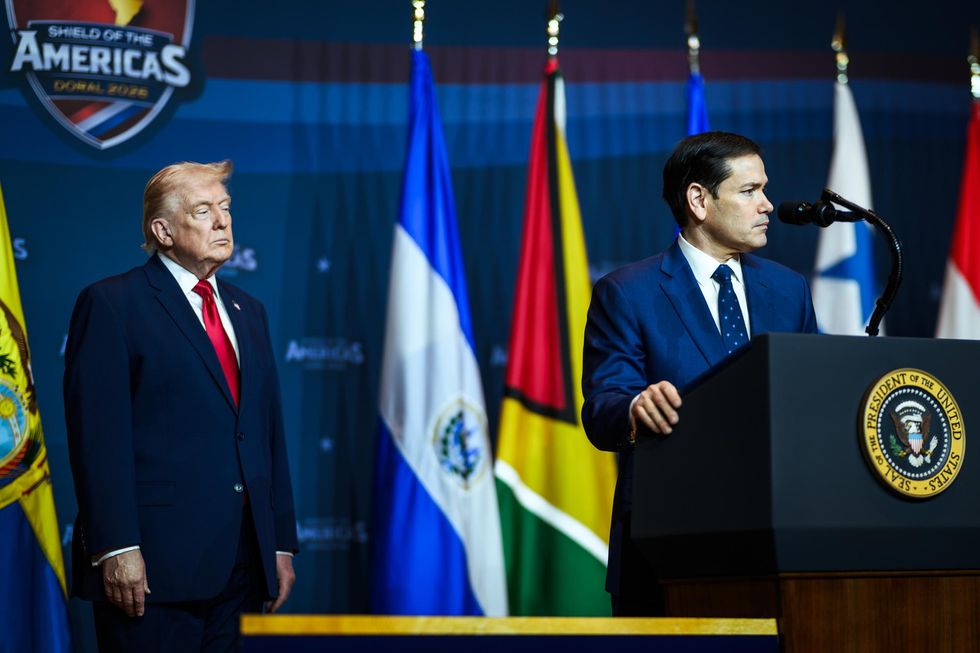
President Donald Trump’s Shield of the Americas security coalition is confronting weak public support in many of its member countries, even as governments expand military operations, prisons and emergency powers. In eight of the 11 coalition countries measured in the 2026 round of LAPOP’s AmericasBarometer, more respondents said they would vote for an opposition party than for the president’s party or candidate. In seven countries, the opposition lead was at least 20 percentage points.
The survey was fielded from October 2025 to June 2026, under the current administrations in the 11 countries. Peru and Colombia were surveyed under earlier governments and are excluded from the vote-intention figures. Estimates are weighted and exclude “don’t know” and “no answer” responses.
The findings arrive as Trump promotes his record of backing winning candidates in Latin America and the Caribbean. He has said he is “nine for nine,” and Brazil’s Oct. 25 runoff could bring that tally to ten. Senator Flávio Bolsonaro led the first round on Oct. 4, and a government under his leadership could seek to join the Shield, which Washington launched in March and presents as evidence that the hemisphere has shifted toward the United States.
Survey results suggest voters are judging governments on crime and the cost of living, while people who had been lukewarm but still supported incumbents have begun to turn away. El Salvador and Costa Rica, where voters have rewarded hard-line security policies, stand out as exceptions. Honduras is another exception; it was surveyed in the first months of President Nasry Asfura’s term.
Governments across the coalition have responded to public demands for tougher policing by strengthening security institutions. Their measures include more military operations, expanded prison systems and broader emergency powers, approaches associated with El Salvador’s mass incarceration and emergency law.
The United States is helping finance the security response. On Sept. 15, the State Department told Congress it would redirect $52 million in foreign military financing, previously budgeted for allies in Europe and the Middle East, to Colombia, Ecuador, Panama and Peru. The funding was intended to fight what the department called “narcoterrorism in our backyard.”
Washington had announced plans in August to provide $1 billion in security assistance to Colombia’s new president, Abelardo de la Espriella, whom Trump calls a “worthy champion.” U.S. forces also began supporting Ecuadorian military operations in March against groups Washington designates as terrorist organizations.
Several countries are adopting or extending security measures modelled on El Salvador. Costa Rica is opening a maximum-security prison for 5,100 inmates on Oct. 14. It cost $35 million and follows the design of Salvadoran President Nayib Bukele’s CECOT prison. Bukele helped lay the first stone in January.
At Asfura’s request, Honduras’s Congress approved El Salvador-style prison measures in September, including isolation for prisoners considered high-risk. In Chile, José Antonio Kast sent Congress a reform in August that would have created a new state of exception for “grave alterations to public security.” It would have allowed armed forces to deploy in affected areas and created separate prison regimes for organized crime. Kast withdrew the proposal in October after it failed to win enough Senate votes.
Ecuadorian President Daniel Noboa has governed under an “internal armed conflict” declaration since 2024. On Sept. 16, he decreed another 60-day state of exception across eight provinces, suspending the inviolability of the home and imposing the year’s third curfew.
Ecuador’s interior minister said that of the 5,023 people arrested during a May curfew, only 717, or about 14 per cent, had ties to organized crime. The survey also found that 35 per cent of Ecuadorians had been crime victims in the previous year, the highest rate among Shield members. Another 63 per cent said they felt unsafe in their own neighbourhoods, while only 17 per cent said they would vote for Noboa’s side.
Five of the eight presidents whose countries showed opposition leads, in Panama, Guatemala, Paraguay, Chile and the Dominican Republic, are barred from consecutive terms. Their policies and institutional changes may therefore be inherited by successors. In March, Paraguay’s Congress ratified a status-of-forces agreement placing U.S. military personnel under U.S. criminal jurisdiction. In January, Guatemala’s Bernardo Arévalo declared a 30-day state of siege, suspending the right to protest and allowing detentions without a judicial order.
Bukele is the only leader described as having consolidated power around himself. He secured indefinite re-election in 2025 after running for a second term despite a constitutional ban. His state of exception has led to about 92,000 arrests without judicial warrants since 2022.
Public confidence in Washington has also declined. LAPOP has asked about trust in the U.S. government in nine Shield countries each year since 2012, and the average has shifted with the occupant of the White House. In 2012, 72 per cent called the U.S. government very or somewhat trustworthy. That share fell to 45 per cent during Trump’s first term, rose to 60 per cent under Joe Biden and has returned to 45 per cent in the latest round.
The trust figures average Colombia, Costa Rica, the Dominican Republic, El Salvador, Guatemala, Honduras, Panama, Paraguay and Peru, the nine Shield members included in every round since 2012. Some of the largest declines since that year were recorded in countries counted among Washington’s reliable partners: Panama fell from 87 per cent to 40 per cent, while El Salvador dropped from 71 per cent to 36 per cent.
In Panama, support for Washington fell 18.5 points since 2023, a change specific to the United States. Over the same period, trust in the National Assembly, the presidency, the Supreme Court and elections remained stable or rose slightly. Trust in police was the other measure to decline, dropping by about six points.
The decline in confidence in Washington spans political groups in Panama. Trust fell from 57 per cent to 34 per cent among people on the left, from 62 per cent to 43 per cent among those on the right, and from 66 per cent to 44 per cent among people who approve of President José Raúl Mulino.
In Argentina, Chile and Bolivia, trust in Washington is also divided by views of national leaders: 60 to 69 per cent of people who approve of their president trust the U.S. government, compared with about 10 per cent of those who disapprove. Across the 16 Latin American countries surveyed in 2026, 40 per cent consider the U.S. government trustworthy. The administration is treating allied election victories as a mandate while public confidence in Washington is as low as it was at the trough of Trump’s first term.
The next governments in many of these countries will be selected by voters who distrust Washington and are already looking beyond incumbents. In November 2025, when Noboa asked Ecuadorians to approve foreign military bases, about 61 per cent voted no. Emergency decrees also increase the armed forces’ role in policing, and militaries rarely surrender powers once civilian governments grant them.
Future leaders could try to reverse the security policies they inherit or retain prisons and emergency powers for their own purposes. Keeping those measures would risk making states of exception a routine form of government. Washington is tying its hemispheric strategy to commitments made by governments whose citizens are preparing to replace them, while millions of Latin Americans will continue to live within the security apparatus those administrations leave behind.