
Global News Edmonton has reported:
Canadian astronaut Joshua Kutryk says the view of Earth from the International Space Station has been among the most remarkable experiences of his first two weeks in orbit. The 44-year-old is adjusting to life in microgravity while beginning research into how long-duration space travel affects the human body.
“It’s one of the most amazing things I’ve ever seen,” Kutryk said of looking back at Earth. He grew up in northern Alberta and was familiar with the northern lights, but said seeing them from above gave him a different perspective. “To see the whole Earth, the curvature of the Earth, just embraced by this blanket of dancing fluorescent oranges and yellows and pinks - magical,” he said.
Kutryk launched on Oct. 1 as part of NASA’s four-person Crew 13 and reached the station in just under eight hours. A former CF-18 fighter pilot, he is serving as a mission specialist on a six-month mission involving scientific experiments, research and critical maintenance work.
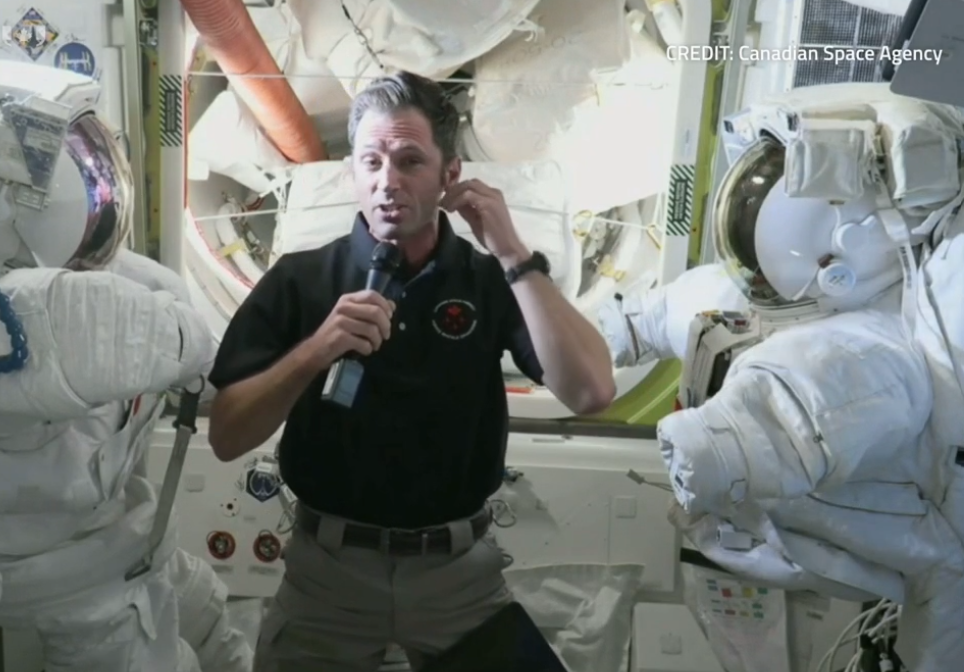
On Tuesday, Kutryk answered questions from Canadian journalists in Longueuil, Que. He said the launch was exhilarating and spectacular, and that training could not fully prepare him for it. “Everything about being here for the first couple weeks is very special,” he said. “You just feel so lucky and fortunate to be living this experience.”
Daily life in orbit also involves learning familiar routines again. Kutryk said eating, sleeping and moving around take practice in microgravity. “You have to sort of learn to do everything again, almost like you’re a child,” he said. “How you eat, how you move around, how you sleep, how you fall asleep, what do you do with your neck when you’re sleeping, what do you do with your hands.”
He has started experiments related to the physical effects of extended spaceflight and said he has lost five pounds since arriving. “Humans on a six-month mission lose a lot of bone, a lot of muscle and come back to Earth, frankly, a lot older physiologically and not very healthy,” Kutryk said. “So it’s a big concern of ours.”
The mission includes Canadian-led studies of the effects of space travel and microgravity on human health. During Tuesday’s orbital press conference, Kutryk wore equipment for the AstroFit research project, which monitors his health and aims to find ways for people to spend longer periods in space.
His surroundings are far removed from the Alberta cattle farm where he grew up, but he has a family keepsake nearby. A pocket watch carried by his relatives when they immigrated to Canada from Ukraine four generations ago was sent to the station before him. Kutryk said it rests near where he sleeps. Holding it prompts him to consider how technology has changed over the past century and how his ancestors could not have imagined his journey.
Travelling to space had been a lifelong goal, and Kutryk said it was difficult to describe his first sight of Earth from orbit. “It’s just one world. It’s one thing hanging in the blackness of space and you don’t see all the countries and the problems and all the challenges,” he said. “You just see this little bit of perfection that we should really, really be trying to protect.”
Kutryk said Canada’s participation on the station shows what the country can accomplish by pursuing ambitious goals and taking risks. He said the presence can also encourage Canadian industry, academia and commercial interests to take part in space exploration. “That’s how we innovate, that’s how we develop new technologies, that’s what we want to be doing,” he said.
His mission comes in the same year Canadian astronaut Jeremy Hansen travelled aboard the Artemis II mission in April. The 10-day lunar fly-around was humanity’s first journey to the moon in more than 50 years. Kutryk said Canada benefits from space missions and hopes the country can continue to participate. “It is important for Canada to be here,” he said Tuesday. “We take a lot of benefits from these missions and it’s something that we hope we can continue.”