
The War Zone has reported:
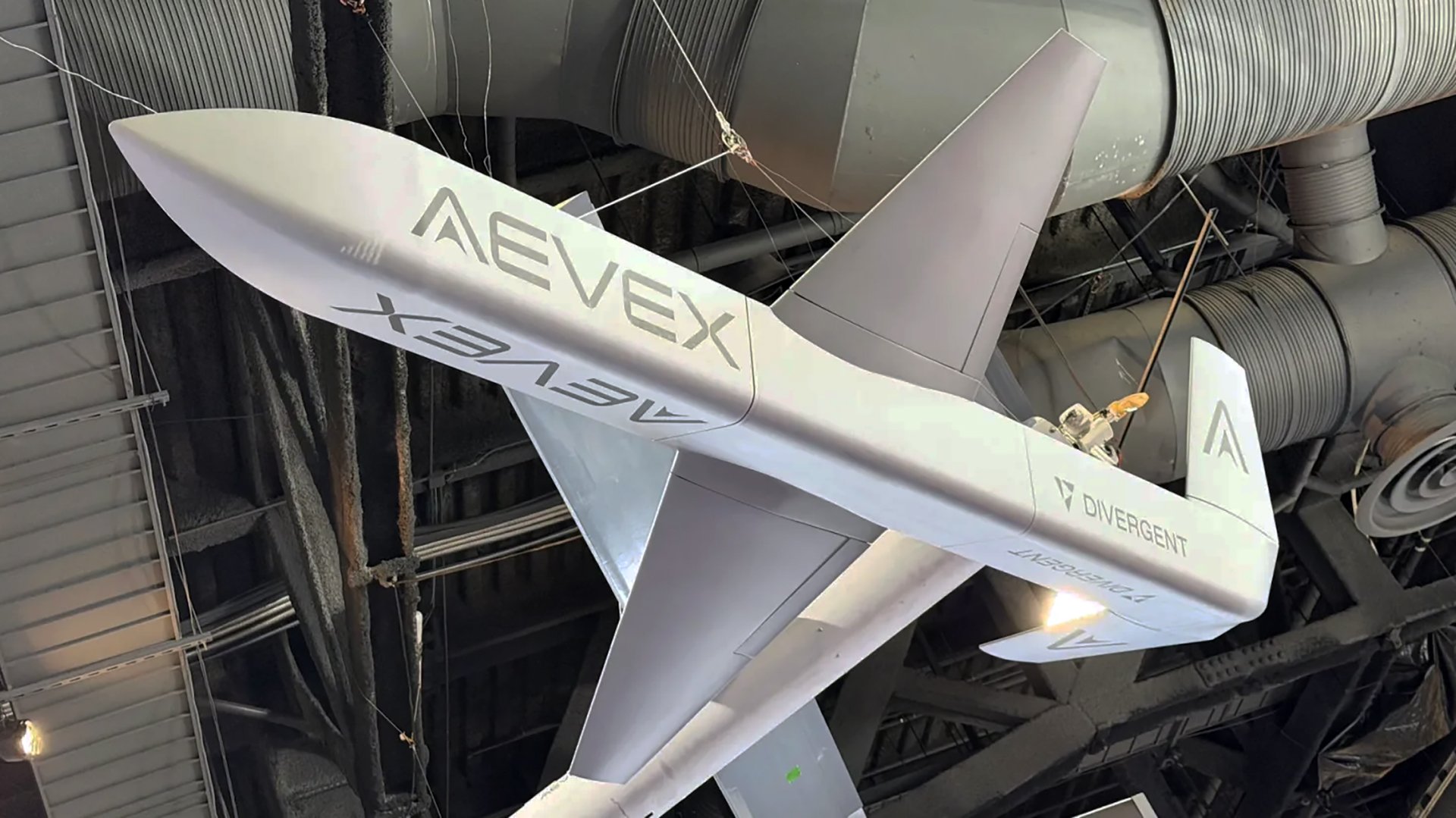
AEVEX Corp. has publicly displayed its Specter jet-powered drone for the first time at the Association of the U.S. Army’s annual meeting in Washington, D.C. The company is developing the aircraft as a high-speed, lower-cost autonomous platform for high-risk operations, with a modular design intended to support several mission types. Specter remains in development, and its first flight is planned for December 2026.
AEVEX announced the aircraft in September. It plans ground-launched and air-launched versions, each based on an architecture that allows the nose section to be changed for different payloads. Those options include kinetic warheads, electronic warfare equipment, intelligence, surveillance and reconnaissance systems, and other capabilities that could be added in the future.
The company is pitching Specter as adaptable across operational needs while affordable enough for use in combat as a cruise missile-like weapon. Its design includes a prominent V-shaped lower fuselage, high-mounted unswept trapezoidal wings, a v-tail and rear-mounted conformal engine intakes. The exterior suggests that low observability was among the design considerations, but AEVEX has not publicly described the drone’s low-observable characteristics.
AEVEX has also not released key performance and technical information, including Specter’s range, payload capacity, communications architecture, terminal targeting methods or the extent of its autonomous capabilities. Those details will affect how the aircraft can be used and whether its projected mix of speed, cost and mission flexibility can be achieved.
Craig Anders, an AEVEX representative, described the turbine engine and performance goals in comments to The War Zone at the meeting. “We’re really excited to kind of really up our stats on range and speed,” he said. Specter is being designed to fly at sub-Mach speeds, Anders said.
The aircraft is intended to carry payloads beyond a conventional warhead. “This thing is going to have the ability to carry cameras and different types of non-kinetic effect payloads,” Anders said, calling Specter a “multi-mission, multi-domain fighter.” The camera and other non-kinetic options could support missions that do not rely on striking a target with a warhead.
AEVEX is also designing the drone to be attritable, meaning commanders could accept its loss during operations. Anders said a relatively low price would allow it to be sent farther into dangerous areas without risking more expensive capabilities. The concept combines one-way attack missions with potential reconnaissance and other effects, depending on how the aircraft is configured, while aiming for economical production at scale.
AEVEX is working with Divergent, an engineering and manufacturing company known for digital production methods and metal additive manufacturing. The partnership is intended to support production at scale and make it easier to change the aircraft’s design and configuration. Anders said Divergent works with AEVEX engineers on the digital design and manufactures the fuselage.
AEVEX is responsible for Specter’s internal systems, mission integration, flight characteristics and navigation science, Anders said. The company says Divergent’s Digital Manufacturing and Production System, or DAPS, is being used to support manufacturability and scalable production. Neither company has disclosed a projected unit cost or shown that it can yet make the aircraft at the volumes and prices envisioned for the concept.
The company is also drawing on its CompassX autonomy architecture and experience delivering thousands of autonomous systems. AEVEX says Specter’s open interfaces and software-defined capabilities should allow the platform to change as operational needs evolve, rather than locking it into one mission. The company has not publicly detailed how much autonomy the aircraft will have in practice.
The planned first flight in December 2026 is expected to be a basic test. Anders said early test aircraft will have landing gear so they can be recovered and reused while engineers study flight characteristics and handling. It remains unclear whether AEVEX envisions a gear-equipped operational version that could be reused. Further testing could include adjusting the aircraft’s dive profile.
The initial configuration is planned to launch from the ground with a rocket-assisted takeoff system, known as RATO. An air-launched version is also on the roadmap, Anders said, and that capability is expected to follow in the relatively near term. The company has not provided a specific timeline for the air-launched version.
AEVEX is pursuing several possible military uses. Anders identified the U.S. Army’s Family of Affordable Mass Missiles effort, or FAMM, as a primary focus, while noting that the Army has its own high-speed requirements. He also said AEVEX is examining opportunities connected to Rapid Dragon and other programs. His comments describe potential applications the company hopes to pursue, not a selection of Specter for any of those efforts.
A social media post from Air-Power | NatSec Ledger, dated April 22, 2026, stated that in fiscal year 2027 the U.S. Air Force was requesting $55 million in discretionary funding and $300 million in mandatory reconciliation funds for FAMM. The post said the requested funding would procure 1,000 All Up Rounds across the Palletized, or FAMM-P, and Lugged, or FAMM-L, variants. The post did not say that Specter had been selected for the effort.
AEVEX’s record in one-way attack drones provides context for the new aircraft. The company played a significant role in U.S. military one-way attack drone efforts and built the secretive Phoenix Ghost family, which was rushed to Ukraine in 2022. The company’s experience with fast fielding and autonomous systems may help establish its credentials as it develops Specter, although the aircraft’s performance and costs still need to be demonstrated.
The broader challenge is to provide enough speed, range and flexibility across roles while keeping costs low enough to support procurement in large numbers. Specter is positioned between more advanced, costly autonomous aircraft and cruise missiles, and lower-end one-way attack drones. Other concepts with similar aims have emerged amid a wider push toward low-cost cruise missile-like weapons, but Specter’s eventual value will depend on its performance, price and ability to meet specific requirements.