
The War Zone has reported:
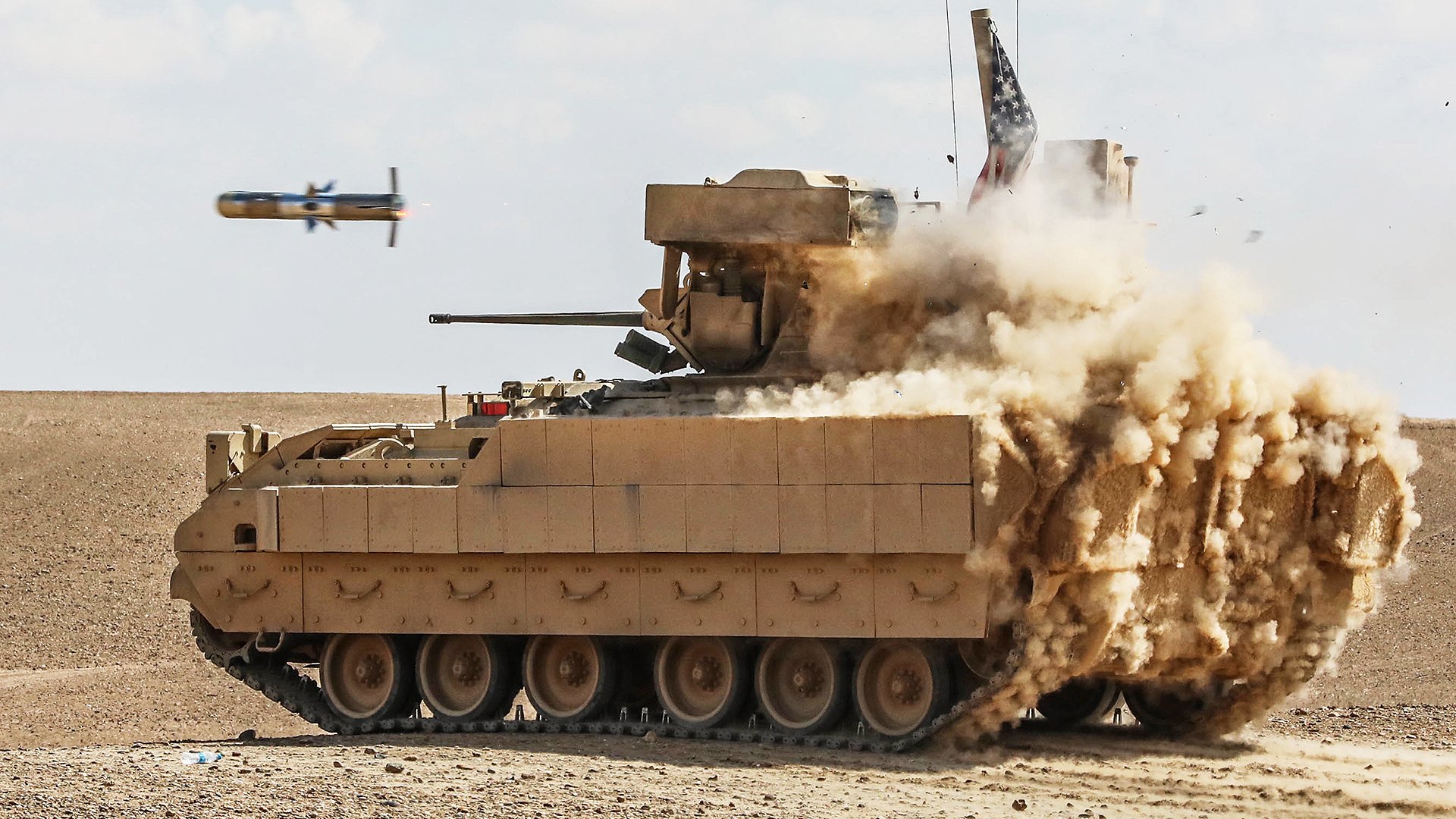
Rafael USA and Leonardo DRS have presented an adapter designed to let fighting vehicles equipped with legacy Tube-launched, Optically tracked, Wire-guided (TOW) launchers fire Rafael’s Spike LR2 anti-armour missiles. The system is intended to add the Israeli-made missile to existing platforms while limiting changes to their launchers and vehicle systems. The companies’ presentation marks a more developed stage of work first demonstrated in 2021.
Roman Palaria, Rafael’s vice-president for marketing and business development in its land and naval division, discussed the system in an interview at the Association of the U.S. Army’s (AUSA) main annual convention. He said the earlier demonstration took place during Project Convergence 2021 and used an adapter version that had not yet reached its final configuration. Leonardo DRS, Rafael’s U.S. partner, later developed the mechanical and electrical components needed to connect Spike LR2 with the TOW launcher and the vehicle’s existing systems.
The design seeks to avoid replacing the launcher or making a major overhaul to the gunner station. The adapter supplies a mechanical interface for loading the Spike LR2 and electrical connections for communication with the vehicle, while additional electronic components are installed inside the vehicle to support the missile’s functions. Palaria described the design goal as limiting disruption to the vehicle: “We’re doing minimum changes to the vehicle,” he said.
The Bradley infantry fighting vehicle is a prominent possible application, though the companies say the system could be adapted to other platforms that use TOW launchers. The U.S. Army has operated vehicles equipped with TOW systems for decades, leaving a substantial installed base of launchers that could potentially use the adapter. The Army has spent years pursuing a replacement for the Bradley’s TOW missiles, but that effort has yet to produce real results.
The adapter is intended to preserve a vehicle’s TOW capability while adding the option to use Spike LR2. That could give commanders another missile choice without requiring wholesale replacement of installed launcher equipment. Whether individual vehicles can use both missile types will depend on the completed integration and applicable qualification requirements.
During Project Convergence 2021, two Spike missiles were fired from a TOW launcher, and both reportedly hit their intended targets. The adapter now being presented incorporates subsequent work by Leonardo DRS to refine the mechanical interface and integrate the system with vehicle electrical equipment. A reported test also described a successful Spike LR2 firing from an M2A4 Bradley equipped with the Multi-Purpose Missile Launcher (MPML), developed by Rafael and DRS. Adapters allow the system to remain compatible with existing TML/UTML launchers, and Spike LR2 has also been proposed for the CCMS-H and XM30.
After a missile is fired, its launch tube stays in the launcher and can be removed to make room for another missile. The system’s central premise is to combine existing launcher infrastructure with Spike LR2’s engagement capabilities. The companies have presented it as a potential way to add a new missile option to Army vehicles while limiting changes to launcher hardware and the crew interface.
Palaria cited a maximum Spike LR2 range of about 5.5 kilometres, or 3.4 miles, and highlighted its day-and-night imaging seeker, which sends video to the operator during flight. The longest-range versions of TOW reach about 4.5 kilometres, or 2.8 miles. The Spike’s imaging capability can support attacks on targets beyond the operator’s direct line of sight and allow observation of the target area as the missile approaches.
Depending on the engagement, an operator can acquire a target through the missile’s seeker, adjust the attack or select a different target while the missile is in flight. Traditional TOW uses semi-automatic command-to-line-of-sight (SACLOS) guidance: the gunner tracks the target through the launcher’s observation system and guides the missile throughout its flight. Spike LR2’s onboard imaging offers different options when direct observation is limited or conditions change after launch, including the ability to strike targets behind cover.
Palaria also outlined two warhead choices for the LR2. One is a tandem-charge anti-tank warhead that Rafael says can penetrate any modern main battle tank. It uses a precursor charge designed to penetrate reactive armour, followed by a main charge intended to penetrate the tank’s main armour.
The other option is a multi-purpose configuration with a programmable fuze, allowing the missile to be used against different target types. Depending on the selected mode, the warhead can produce direct-impact or timed-detonation effects. For an anti-personnel mission, it could detonate above the ground; against a building, the first charge could open a hole in a wall and the second could enter and explode after a short delay.
The operator would need training to use the added functions. The gunner would continue using the vehicle’s existing console and displays, but Palaria acknowledged that Spike LR2 brings additional functions, controls and engagement procedures. The adapter is intended to keep the familiar launcher architecture while adding a missile with greater range, onboard imaging and options that go beyond line-of-sight tracking.
Whether the system becomes a fielded upgrade will depend on Army requirements, testing, integration decisions and procurement plans. The Spike missile series has been widely adopted around the world, and the large existing base of TOW operators could make the adapter relevant to customers beyond the U.S. Army. The presentation describes a possible route to combining the systems, but decisions about fielding remain with prospective customers.