
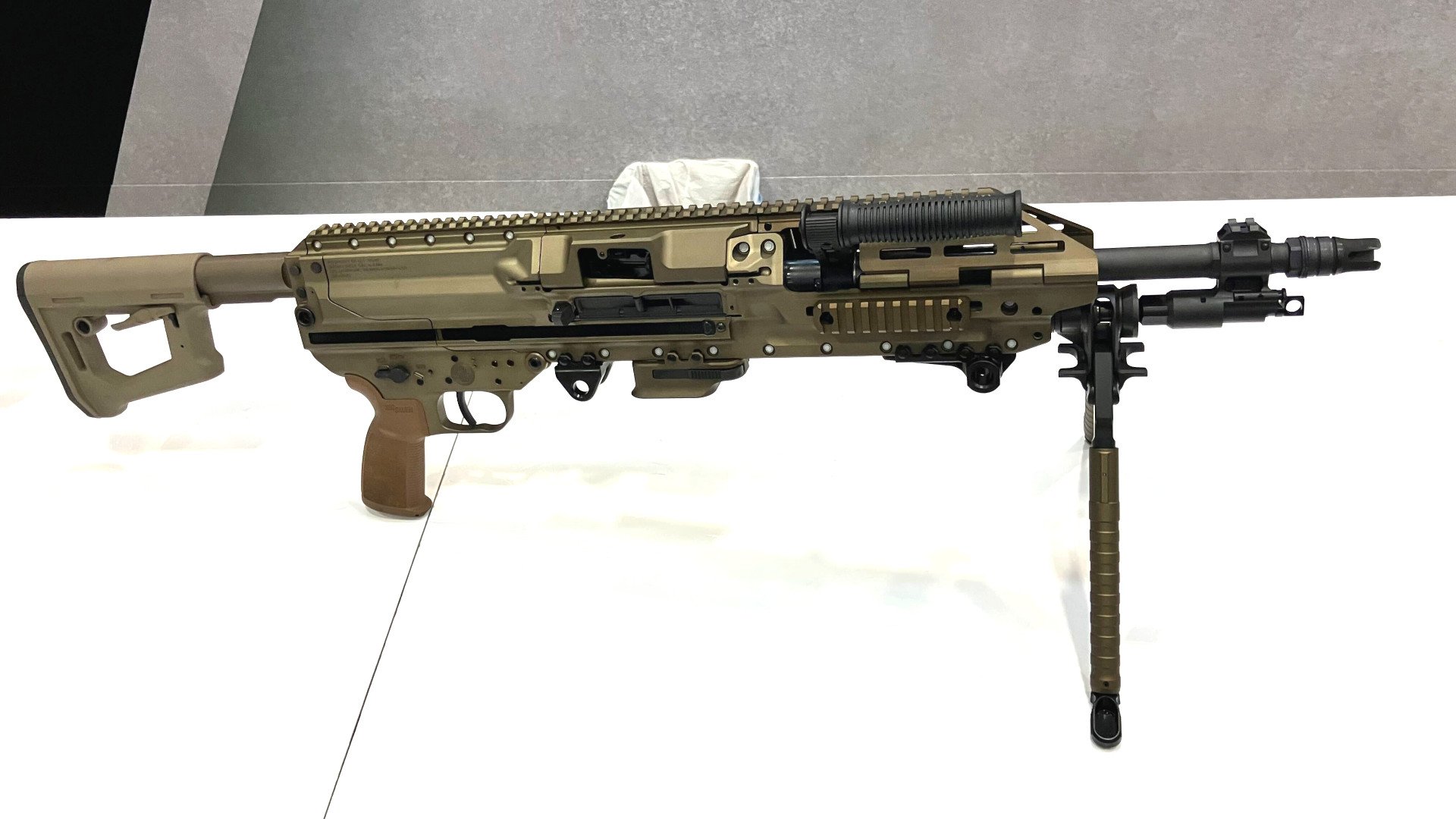
The War Zone has reported:
Sig Sauer has developed an updated version of the U.S. Army’s M250 light machine gun after receiving feedback from soldiers and the program office. The M250A1 has a shorter, lighter barrel, a revised buttstock and changes to improve reliability and ease of use. The Army is still assessing the configuration and has not formally adopted it.
Jason St. John, senior director of strategic products for Sig Sauer’s Defense Strategies Group, discussed the M250A1 with Howard Altman at the Association of the U.S. Army’s main annual convention. The Army is already acquiring and fielding baseline M250s as part of its Next Generation Squad Weapons program, or NGSW. Sig won the NGSW competition in 2022.
The NGSW family includes the M250 machine gun and Sig’s M7 rifle and M8 carbine, all chambered for the 6.8x51mm round. The Army remains in the early stages of fielding the weapons as replacements for a substantial portion of its existing 5.56x45mm M4A1 carbines and M249 Squad Automatic Weapons, also known as SAWs.
The M250A1’s most visible change is a 13-inch barrel. M250s now entering Army service have barrels about 16 inches long, while the Army’s official fact sheet says the gun was originally expected to have a 17.5-inch barrel. Sig is making the 13-inch and 16-inch barrels available, giving the Army options for different tasks.
“We shortened the barrel to 13 inches, but the Army’s also buying the 16-inch barrel,” St. John said. “So in some ways, you could consider it mission-configurable, whether they want to utilize a 13-inch barrel or a 16-inch barrel, to what they’re doing.”
St. John said the shorter barrel offers greater manoeuvrability while retaining the basic ballistics of the M7 rifle’s 13-inch barrel. The 16-inch option provides the length the Army originally required for its lethality goal. He acknowledged that shortening a barrel reduces projectile velocity, but said the Army had determined the 13-inch configuration met its ballistic and lethality goals without changing the ammunition.
“You’re going to maintain the same basic ballistics that you had with the M7 [rifle’s] 13-inch barrel, and then you’re going to have more maneuverability because you’re going to have a shorter weapon system,” he said. “You add the 16-inch barrel, and you get that lethality requirement with the length of barrel that they originally required. So you have some flexibility there.”
“You shorten the barrel, you’re going to lose velocity,” St. John said. “We did not change the ammo. The Army had determined with the barrel change that they were meeting their ballistic and lethality goals with that length of barrel.”
He said the current 6.8x51mm ammunition operates at pressures in the mid-70,000 pounds per square inch range, while the cartridge case has a potential capacity of 125,000 psi. If future battlefield conditions created concerns about lethality or a need for additional performance with a shorter barrel, increasing cartridge pressure could compensate, he said.
“We didn’t do that. The Army said it wasn’t necessary, but you know, as the battlefield evolves and defensive postures change, If that becomes necessary, one of the great things about the NGSW program is the ability for the weapon systems and the ammunition to grow in their performance capacity,” he said. The 13-inch barrel is also tapered to reduce weight.
The M250 weighs about 13 pounds when empty and without optics or other accessories, according to the Army fact sheet. Sig has been asked for fuller M250A1 specifications, including total weight and overall length with each barrel option. The M7 rifle also became shorter and lighter during its development before the Army moved to the M8 carbine. The M8, with a 10-inch barrel, weighs close to one pound less than the M7 with a 13-inch barrel.
Barrels could be swapped on the baseline M250, but the earlier arrangement was not designed for quick changes and did not include a handle or insulation for handling a hot barrel. The A1 changes the quick-change barrel system and related parts. St. John said the earlier design did not require that capability and that adding it would have imposed extra weight if it was not going to be used.
“It was interchangeable before, but it didn’t have a quick-change barrel handle. It wasn’t meant to be changed, and therefore it didn’t need the insulation of [sic; for] a hot barrel like you get with a barrel with a quick-change barrel handle,” he said. “I think initially with the [M]250 program, it wasn’t necessary, and potentially might not have been desired initially. And why put that weight burden on there if we weren’t going to utilize it, right?” St. John did not explain further why the features were initially considered unnecessary.
The top cover on the forearm has also been changed. It was previously loose and could come off fully during a barrel change; it is now captured so it remains attached. Sig based the approach on a similar design used on its .338 MMG, or Medium Machine Gun.
“When you look at the top cover of the forearm, that used to be loose, and now it’s captured, meaning that when you change the barrel, it actually came off completely in your hand,” St. John said. “We utilized a similar design to our .338 MMG [Medium Machine Gun], and then we make it captured now, so you’re not going to lose it.”
Sig added a funnel to guide the gas piston into position during barrel changes. St. John said it is intended to make alignment easier when soldiers are working under stress. The M250A1 also has changes to the gas system aimed at reliability and durability, including measures to reduce its exposure to carbon.
The trigger guard has been enlarged to fit Arctic gloves as well as regular tactical gloves. Army officials have highlighted the challenges of operating standard equipment in harsh cold-weather environments. The Arctic region is also of increasing strategic importance to the United States amid growing competition with Russia and China.
The buttstock and its connection to the receiver have been revised after training and operations showed that some stocks could loosen and develop play. St. John said soldiers preferred the new stock, a commercially available Magpul design, over the Magpul stock used on the initial gun.
“We improved the buttstock, and we improved the interface … to the receiver,” he said. “We’ve made the interface between that more robust because through IMTing, and over time, and the buttstock getting slammed on the ground, and just normal military training and operations, we noticed that we had a tendency for some of them to loosen up and have some play in them.”
“The entire buttstock is a different buttstock than they had,” he added. “They [Army soldiers] preferred that buttstock over the buttstock that we had on it. So we just put soldiers’ preference on there. … It’s just a commercially available [design from] Magpul that they thought was better than the other Magpul that day one we were using.”
Sig also reinforced the points used to attach the M250 to ground tripods and vehicle pintle mounts. The earlier system used an M-LOK-style connection, with a steel nut on an aluminium receiver. Sig said vibration over the weapon’s service life could cause wear. Cross-bolts now redirect force, while a saddle screw locks the assembly down to improve durability in pintle-mounted and traverse-and-elevation, or T&E, tripod configurations.
“We put cross-bolts through the receiver to provide more durability,” St. John said. “Initially, it was like an M-LOK type of lockup, and you can just think of a steel nut on an aluminum receiver being vibrated over a life cycle of the weapon system, it has some unfortunate wear characteristics. So, putting these cross pins redirects that force, and the way we lock it down with a saddle screw prevents that from happening and provides long-term durability to the receiver in the pintle and T&E [traverse and elevation] tripod-mounted configuration.”
The M250 has undergone changes before. Sig discussed revisions to its bipod and top cover at the AUSA convention the previous year, and those changes were already making their way into the design. The updated weapon follows the Army’s effort to reduce the weight and bulk of the M7 rifle, which was ultimately developed into the M8 carbine.
The Army has not yet formally adopted the M250A1 configuration, and additional changes remain possible before it decides whether to acquire an improved version. Sig has recently finalized acceptance of the M8, and the Army is moving into acceptance of the M250s. St. John said Sig expects most or all of the A1 changes to be accepted, based on feedback from the program office.
“This is likely to be the accepted configuration. We anticipate that acceptance,” he said. “We just finalized the acceptance on the M8, and they’re moving into the acceptance of the [M]250s. We anticipate right now, with the feedback that we’re getting from the program office, that the majority, if not all, of these changes are likely to be accepted.”