
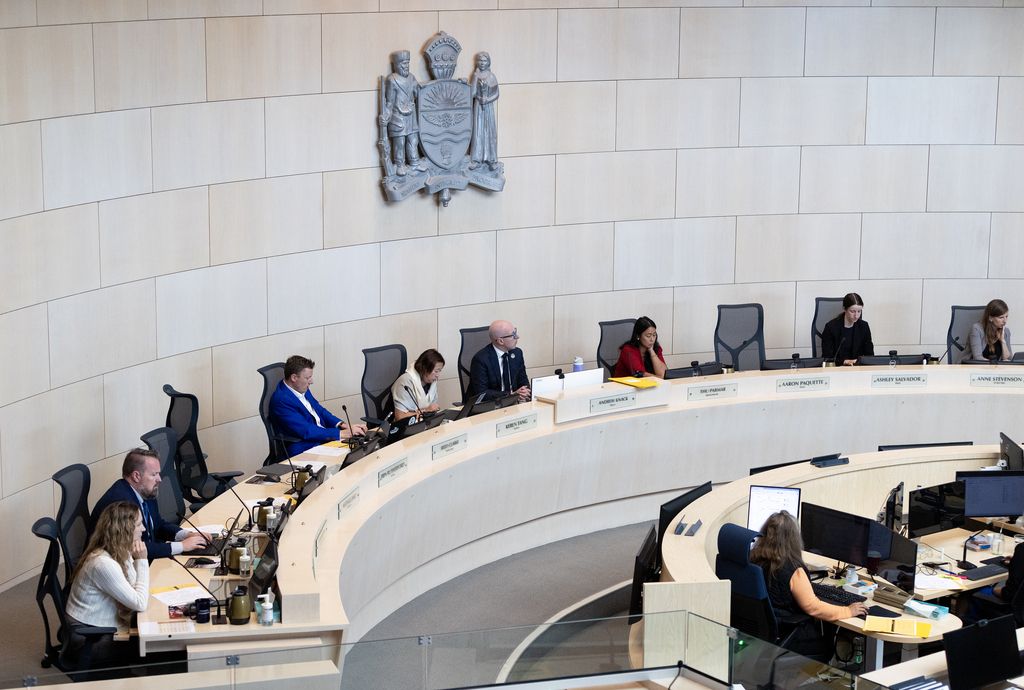
Edmonton Journal has reported:
Edmonton Mayor Andrew Knack was on the winning side of 93 per cent of non-unanimous council votes since the current city council was elected or re-elected nearly 12 months ago. Coun. Karen Principe had the lowest win rate, at 28 per cent, according to an analysis of councillor voting records from the city’s open data site.
The review covers roughly one-quarter of the 1,150 votes held since the council began its term. Its figures describe voting patterns, but do not explain why members voted together or opposed a motion. Win rates also do not measure a councillor’s effectiveness, since members may vote against a majority to reflect their constituents’ wishes.
Five returning councillors joined Knack on the winning side more than 85 per cent of the time: Aaron Paquette, Anne Stevenson, Michael Janz, Ashley Salvador and Keren Tang. Six other councillors had win rates ranging from 81 to 69 per cent. Principe, who was also the most outspoken opponent on most votes during the previous year’s council, remained the member least often aligned with the majority.
The records show a five-member voting bloc made up of Knack and Couns. Salvador, Stevenson, Janz and Wright. Those five voted the same way at least 79 per cent of the time. The strongest three pairings were Salvador and Stevenson at 93 per cent, Stevenson and Janz at 89 per cent, and Janz and Salvador at 88 per cent.
Tang, Morgan and Paquette formed a middle voting group, often joined by Coun. Erin Rutherford. Newcomers Couns. Reed Clarke, Thu Parmar and Michael Elliott generally voted with the main group of five on between 66 and 55 per cent of votes. The records do not indicate the reasons behind those alignments.
Principe remained an unofficial opposition figure. She voted with members of the five-person bloc as little as 20 per cent of the time, matching Wright and Janz for the weakest recorded pairings; Principe and Stevenson voted together 21 per cent of the time. She voted with Parmar and Elliott a slim majority of the time, and with Clarke on just under half of council votes.
Council recorded 20 close votes, each decided by a 7-6 passage or a 6-7 defeat. The 13 motions that passed by one vote included a report on LRT fare gates, a $2-million reduction to the corporate services budget, and motions concerning specific properties and areas, including Kettle Lakes Neighbourhood and the Dunluce school site.
Among the motions defeated 6-7 were proposed changes to property tax reporting, playground budget funding and an application concerning the River’s Edge development. Another failed motion sought an analysis of whether sponsorship of city services could extend beyond naming rights to include snow removal, waste collection, recreation programs and infrastructure renewal.
A separate housing motion concerning the MacEwan neighbourhood failed when the 12 councillors present split evenly, 6-6. That vote was not among the 7-6 or 6-7 decisions counted in the total of 20 close votes.
The current council will mark one year since the election on Oct. 20 and one year since its inaugural meeting on Oct. 29. The voting analysis captures the first year’s non-unanimous decisions and the patterns that have emerged among the mayor and councillors.