
The War Zone has reported:
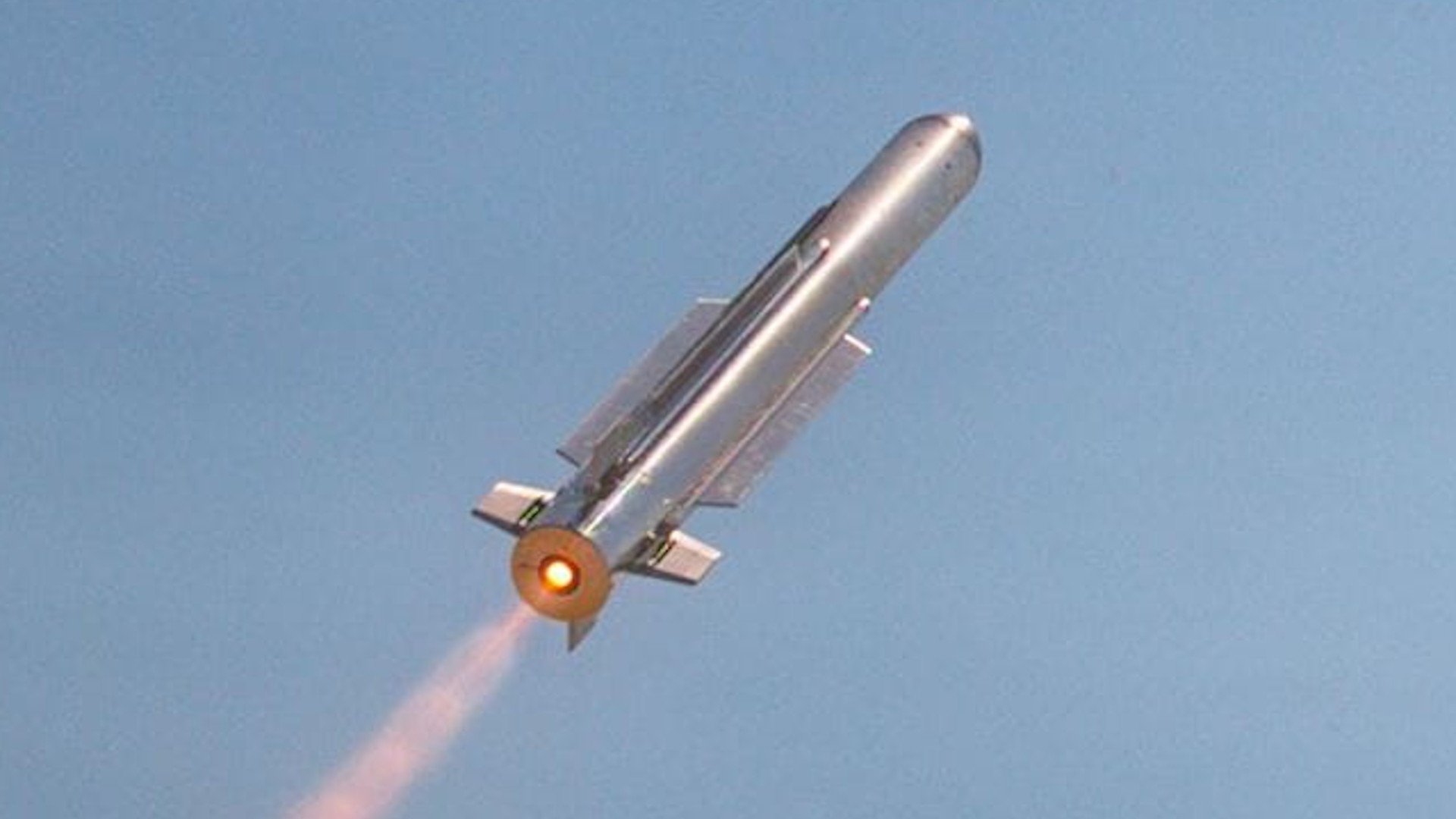
Raytheon has unveiled a rocket-powered version of its Coyote Block 2 counter-drone interceptor, adding a solid rocket motor, a new seeker and a new warhead as the company works to meet evolving threats from one-way attack drones. The Block 2C+RM is still in development, and its eventual entry into service and procurement arrangements have not been settled.
The announcement came around the opening of the Association of the U.S. Army’s main annual convention. The War Zone was attending the event. Raytheon has worked on the new variant for about 15 months and has completed three successful live test launches, following static firings of the motor and other testing.
The new motor changes how the interceptor is propelled. Existing Coyote Block 2 models use a small rocket booster to launch, then rely on a turbojet engine for the rest of their flight. The Block 2C+RM instead uses a solid rocket motor, moving it closer to a surface-to-air missile in the spectrum of interceptors.
Tom Laliberty, president of Land & Air Defense Systems at Raytheon, discussed the change during a press call last week ahead of the unveiling. “you get upgraded propulsion for faster launch and higher velocity flight,” he told The War Zone and other outlets. “In terms of range and so forth, I can’t really get into any specifics about that, for obvious reasons.”
He said the difference in range and the interceptor’s performance near its target would be significant, while declining to provide figures. “What I would just say is it’s significant in terms of the range difference, and in the [sic] what I call end-game capabilities of the missile, where velocity might come into play,” Laliberty said. “Then with the seeker [and] warhead [upgrades], it really gets after the sort of more cutting-edge drone capabilities that we’re seeing from the adversary.”
Laliberty did not describe the specific changes to the seeker or warhead. Existing Block 2-series Coyotes use onboard radio-frequency seekers to locate targets in the final phase of flight, after ground radars and other sensors cue them. They carry blast-fragmentation warheads.
The Pentagon and U.S. Army have been working with Raytheon, now formally known as RTX, on the Block 2C+RM. It is unclear whether the U.S. military has signed formal contracts to buy this version. Raytheon has invested in its development, and Laliberty said government sponsorship had begun as the effort moves toward becoming a program of record. The structure of that transition is still being worked out with the Department of War.
“We’ve got additional tests scheduled into the first half of next year, and we’re working with the Department of War,” Laliberty said last week. “We’ve got an ongoing investment from Raytheon, but now essentially received some government sponsorship as it kind of transitions into the program of record, and that’s still kind of ongoing with the Department of War in terms of how all of that is going to be structured. Certainly, in follow-on contracts for Coyote, this can be cut in.”
The U.S. Army is the largest known operator of Coyote Block 2 interceptors. It has previously outlined plans to purchase at least 6,000 between fiscal years 2025 and 2029. The Army uses the interceptors in vehicle-based and palletized versions of its Low, Slow, Unmanned Aircraft Integrated Defeat System, or LIDS. The U.S. Air Force has also been involved in operating fixed-site LIDS at forward-deployed locations.
The U.S. Navy has fitted Coyote Block 2 launchers to several Arleigh Burke-class destroyers. An eight-cell launcher on the USS Carl M. Levin is a newer naval configuration that first appeared earlier this year. The Coyote system can use existing four-cell and eight-cell launchers, which can be mounted on vehicles, placed at fixed sites or installed on ships.
During last week’s call, Laliberty was asked whether faster jet-powered one-way attack drones had driven development of the new version. Examples raised included Iran’s Shahed 238 and Russia’s Geran-4 and Geran-5 derivatives. He was also asked whether the interceptor could defeat conventional cruise missiles.
“Unfortunately, I can’t get into the specific threats, but I can tell you the intention is to have this cover all types of Class 3 drones,” Laliberty replied. “If you think about the Class 3 drone kind of ‘spectrum,’ there’s a pretty good overlap there with the capabilities of cruise missiles, as well, right? So it all depends on the specific[s] of the cruise missile.”
The U.S. military defines Group 3 drones as aircraft weighing from 56 to 1,320 pounds, capable of flying up to 18,000 feet and reaching speeds no greater than 250 knots. The Shahed 236, a combustion-engine-powered predecessor to the jet-powered Shahed 238, is an example of a Group 3 kamikaze drone. Claimed speeds for jet-powered derivatives, at about 270 to 320 knots, push beyond the upper edge of that broad middle-tier category.
The War Zone has described how jet-powered kamikaze drones such as the Shahed 238 and Geran-4 and Geran-5 can be harder to intercept, and how the boundary between longer-range one-way attack drones and cruise missiles is increasingly blurred. The rocket-powered Coyote also sits between a drone-like interceptor and a more conventional surface-to-air missile. Radio Free Europe/Radio Liberty published a video on Sept. 25, 2026, showing its examination of a Russian Geran-4, including its turbojet engine, camera, and foreign-made communications and navigation components.
Recent conflicts underscore the threat posed even by slower Group 3 kamikaze drones. The conflict with Iran, other Middle East crises in recent years and the ongoing war in Ukraine have featured dangers that grow when drones are used in large numbers or combined in complex attacks with ballistic and cruise missiles. Raytheon says the new version has a faster overall response time than its predecessors, which could provide more flexibility against incoming waves of drones.
Coyote has generally been described as a lower-cost interceptor. Its unit price has previously been reported at about US$100,000, while the estimated cost of a Shahed 236 is about US$50,000. The price of the rocket-powered Coyote compared with existing versions is unknown. The cost of interceptors relative to the targets they engage has become an increasingly important consideration for the U.S. military and other users.
Raytheon has not said when the Block 2C+RM could enter operational service. The company also has no current plans to stop producing jet-powered Block 2 models. Contractors have been arranged to supply those interceptors to Qatar and Jordan.
Block 2 is one branch of the broader Coyote family. The separate Block 3 series developed from the original Block 1 design, which used an electric motor and pusher propeller, and continues to expand. Block 3 versions include loitering munitions and counter-drone interceptors carrying unidentified non-kinetic payloads. The U.S. Army is acquiring Block 3 types as well as Block 2 interceptors.
One Block 3 variant, the Block 3NK non-kinetic interceptor, uses a pusher propeller and can be launched with a rocket booster. Coyote Block 3 is also relevant to the U.S. Army’s XM30 Mechanized Infantry Combat Vehicle competition. American Rheinmetall, the U.S.-based subsidiary of Germany’s Rheinmetall, is competing with a Lynx-based design capable of employing Block 3. Its launchers would also fire TOW and Javelin anti-tank guided missiles.
General Dynamics Land Systems is also competing for the XM30 contract with its Wolf design. The Army is pursuing several new lower-tier anti-air interceptors to expand its ability to counter Group 3 drones, other uncrewed threats and cruise missiles. The Block 2C+RM is entering a rapidly expanding global market for lower-tier, lower-cost counter-drone interceptors, amid continuing demand for more systems to address longer-range and increasingly capable one-way attack drones.