
The War Zone has reported:
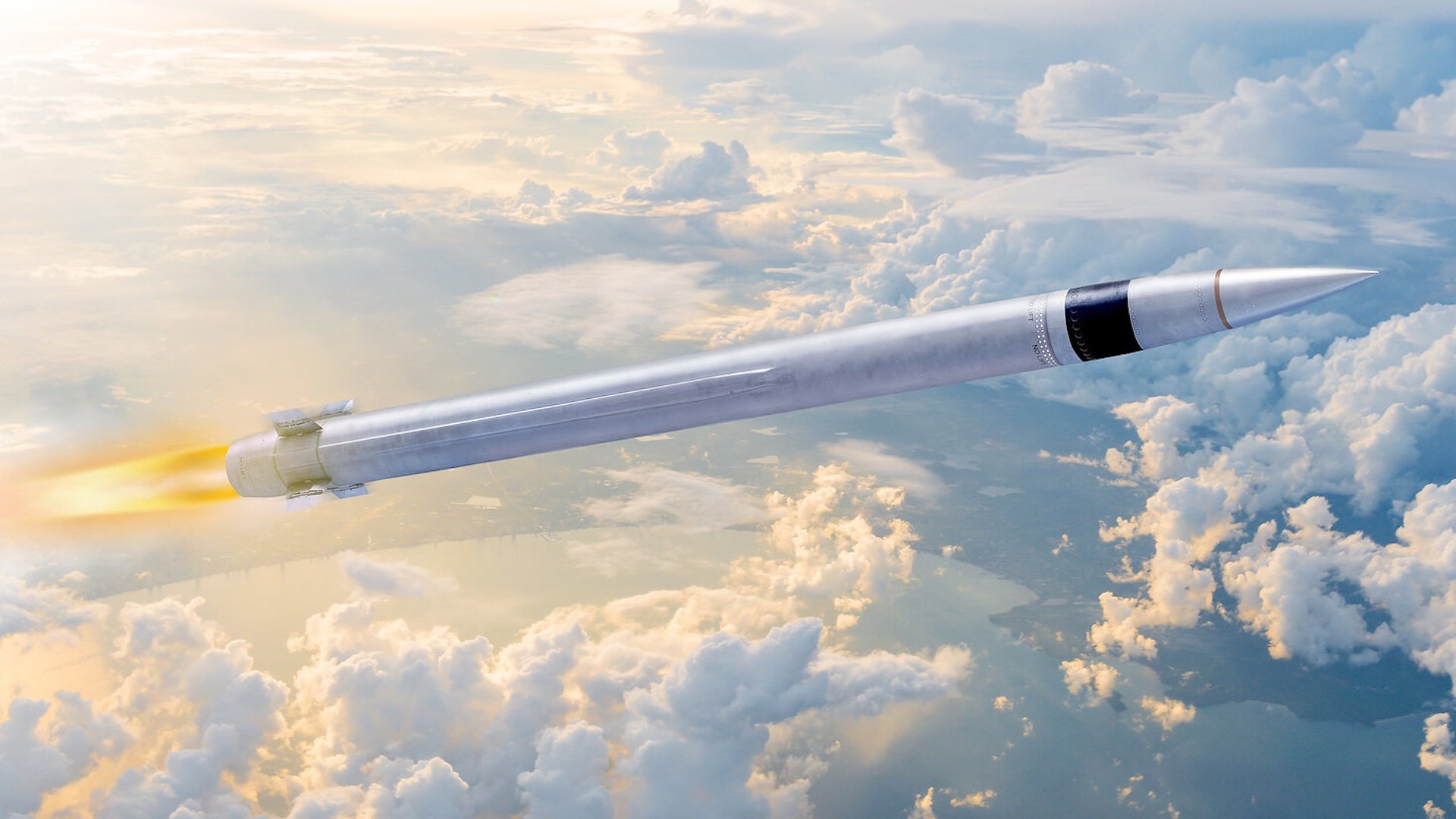
Lockheed Martin has unveiled PAC-3 Edge, a new interceptor intended to become the most capable member of the U.S. Army’s Patriot air defence missile family. The company says the missile is being designed to improve on the current PAC-3 Missile Segment Enhancement, or MSE, particularly against advanced ballistic and hypersonic threats. It combines technology from the MSE with a new seeker, an upgraded control system and a more advanced solid rocket motor developed with Northrop Grumman.
The announcement comes as the Army advances a competition for its next-generation interceptor. On October 9, Lockheed said it had been selected to move to the next phase of the Army’s Future Interceptor program. Company officials expect testing to begin in 2027, with initial deployment targeted for 2031. The Army has also selected another competitor, whose identity was not disclosed.
The PAC-3 Edge was displayed at the Association of the U.S. Army’s main annual convention. Its exterior differs markedly from the PAC-3 MSE: the new design removes the MSE’s mid-body strakes and lacks the tapered section that transitions from the narrower front of that missile to its wider rear. Lockheed has also presented an overview of improvements in the PAC-3 MSE compared with earlier versions of the interceptor.
The Future Interceptor competition follows the Army’s decision to abandon its Lower-Tier Future Interceptor program in 2024 over cost concerns. The service then emphasized incremental improvements to the existing PAC-3 MSE. The new competition signals renewed interest in a more substantial capability increase. The Army’s choice of Lockheed and a second, unnamed company marks a step in its effort to improve Patriot’s ability to handle more sophisticated threats.
Lockheed says PAC-3 Edge is meant to retain the strengths of the PAC-3 family while engaging targets at longer distances and higher altitudes. One of its central changes is a new seeker being developed at Lockheed Martin’s Strigo Product Center. The company says the seeker should improve target detection and tracking, though it has not released technical details.
A dual-mode or multimode seeker is one possible approach, but that has not been confirmed by Lockheed. Combining different sensing methods could help an interceptor track targets in difficult conditions, including manoeuvring targets, and distinguish real threats from decoys or other countermeasures. These are possible advantages of such a configuration, not disclosed specifications for PAC-3 Edge.
Tim Cahill, president of Missiles and Fire Control at Lockheed Martin, told The War Zone that the seeker technology planned for PAC-3 Edge could also be used in future offensive and defensive systems. “So it isn’t just a one single seeker solution, but it will be a family of seekers that will operate across a number of regimes,” Martin explained. He added: “Frankly, I’d like to not tell everybody exactly what we’re doing, but it is it is clearly different from what is out there right now,” Martin said, adding that hardware assemblies and components are being tested in the lab and that seekers have flown on aircraft testbeds.
The missile is also slated to use a three-pulse solid rocket motor designed by Northrop Grumman, compared with the two-pulse motor described for the PAC-3 MSE. A multi-pulse design can provide thrust at separate points in flight instead of concentrating most of it in one sustained burn. That approach can preserve energy for the final engagement, when an interceptor may need to manoeuvre aggressively to reach its target.
Lockheed says the seeker, propulsion and control system changes together will improve manoeuvrability and performance at greater ranges and altitudes. Jason Reynolds, vice-president and general manager of Integrated Air and Missile Defense at Lockheed Martin, said the new interceptor adds a greater number of more capable attitude control motors than the PAC-3 MSE. These small thrusters are arranged around the missile’s forward body and are intended to increase agility.
Those changes could be relevant against manoeuvring ballistic missile warheads and hypersonic weapons, whose speed, altitude and shifting flight paths make interception difficult. PAC-3 Edge has not yet demonstrated its performance in flight tests. Lockheed’s announcement also gave no detailed figures for maximum engagement range, speed or the specific targets the missile is designed to defeat, and did not establish how much better it would perform than the PAC-3 MSE in operational conditions.
It remains unclear how the proposed interceptor might overlap with or supplement the Army’s Terminal High Altitude Area Defense system, known as THAAD. THAAD is designed to intercept ballistic missiles at higher altitudes and longer ranges than Patriot, in an area where the midcourse phase of a missile’s flight approaches the terminal intercept window. If PAC-3 Edge substantially extends the MSE’s engagement range and altitude, it could potentially provide some additional coverage for THAAD, but the announcement did not establish that capability.
The Army is seeking to improve its air and missile defences while increasing the number of interceptors available to its forces. In July 2025, The War Zone reported on an Army plan to expand the Patriot force by roughly one-quarter, adding four battalions in response to growing operational demands. The outlet has also described the difficulty of replenishing interceptors after intensive combat, including U.S. missile and drone engagements in the Middle East and transfers of weapons to Ukraine.
The push for a more capable Patriot interceptor comes amid increasingly sophisticated threats and adversaries adapting through years of combat. Russia has improved its ballistic missile tactics to penetrate Patriot’s protective coverage. Iran has demonstrated ways to exploit gaps in layered missile defences, including the use of extremely high-speed ballistic missiles and cluster warheads that open at high altitude.
A Patriot system delivered to Ukraine was shown at an unspecified Ukrainian airbase on August 4, 2024, during the Day of Ukrainian Air Force. The photograph was credited to Vitalii Nosach of Global Images Ukraine via Getty Images. PAC-3 MSE remains the most advanced operational member of the PAC-3 family. It is designed mainly to destroy targets through direct impact, a method known as hit-to-kill, and also carries a small explosive charge called a lethality enhancer.
Lockheed intends PAC-3 Edge to operate within the Army’s existing and future integrated air and missile defence architecture. That includes the Integrated Battle Command System, or IBCS, and the M903 Patriot launcher. The company has also named containerized launchers and HIMARS Flex as systems it intends to integrate with the interceptor. A Lockheed graphic compares loading configurations for the M903 with those of the previous M901 and M902 launchers.
Compatibility with existing equipment could let the Army retain much of its current infrastructure while improving the weapons used within it. The actual extent of that compatibility depends on development, testing and integration work still to come. Lockheed has not said the full integration effort is complete.
Production capacity and cost are also central to the program’s prospects. Lockheed is developing PAC-3 Edge while the company and Pentagon work to expand production of the existing PAC-3 MSE. In January, Lockheed announced a seven-year agreement with the Pentagon to more than triple annual MSE production capacity, initially aiming to increase output from roughly 600 interceptors to 2,000 a year.
In July, the U.S. government added funding through a contract modification worth up to $53.86 billion, bringing the multiyear contract’s total value to $58.62 billion. Lockheed says the effort aims to more than triple production by the end of 2030, while expanding its workforce and investing in manufacturing infrastructure and its supply chain. The company says PAC-3 Edge would be built on its existing PAC-3 production line in Camden, Arkansas, with factory modernization intended to support a future transition. PAC-3 MSE is already in production in Camden.
Lockheed has highlighted substantial internal investment in PAC-3 Edge and its seeker technology. That investment could reduce development risk and give the company more control over critical components, though the program’s final cost and production schedule remain unknown. If the interceptor completes development and enters service, the expanded production base could help support its manufacture.
The broader challenge is to produce an interceptor with improved performance at a price and pace that allow forces to procure and maintain adequate numbers. Advanced missiles can be expensive, while sustained combat can quickly use up available stocks. Production rates and the ability to replace expended interceptors remain key considerations as the Army pursues the next phase of the program.