
The War Zone has reported:
The U.S. Army’s XM30 infantry combat vehicle prototypes will undergo soldier evaluations and field testing at Fort Hood, Texas, under a revised program that no longer includes a planned rotation at the National Training Center in California. General Dynamics Land Systems and American Rheinmetall each are to provide seven of the eight prototypes required from each competitor, with the Fort Hood evaluations potentially concluding in February or March 2027.
The companies’ vehicles are intended to replace the Army’s Bradley Fighting Vehicle fleet. Both firms displayed their designs during the Association of the U.S. Army’s main annual symposium this week, as the vehicles moved into testing at two locations. The Army had previously planned to test a number of the prototypes during a regular rotation at the sprawling National Training Center at Fort Irwin next spring.
The seven vehicles from each competitor are headed to the 1st Brigade Combat Team, 1st Cavalry Division, at Fort Hood. The Army will conduct a soldier touchpoint and field evaluations there. No rotation to Fort Irwin is now envisaged.
Geoffrey Norman, General Dynamics Land Systems’ director for U.S. Strategy & Growth, said three of the company’s prototypes are already at Fort Hood for safety checks before soldiers begin evaluating them. The company’s entry is called Wolf. It developed from the Griffin III, which was itself derived from the ASCOD 2 infantry fighting vehicle.
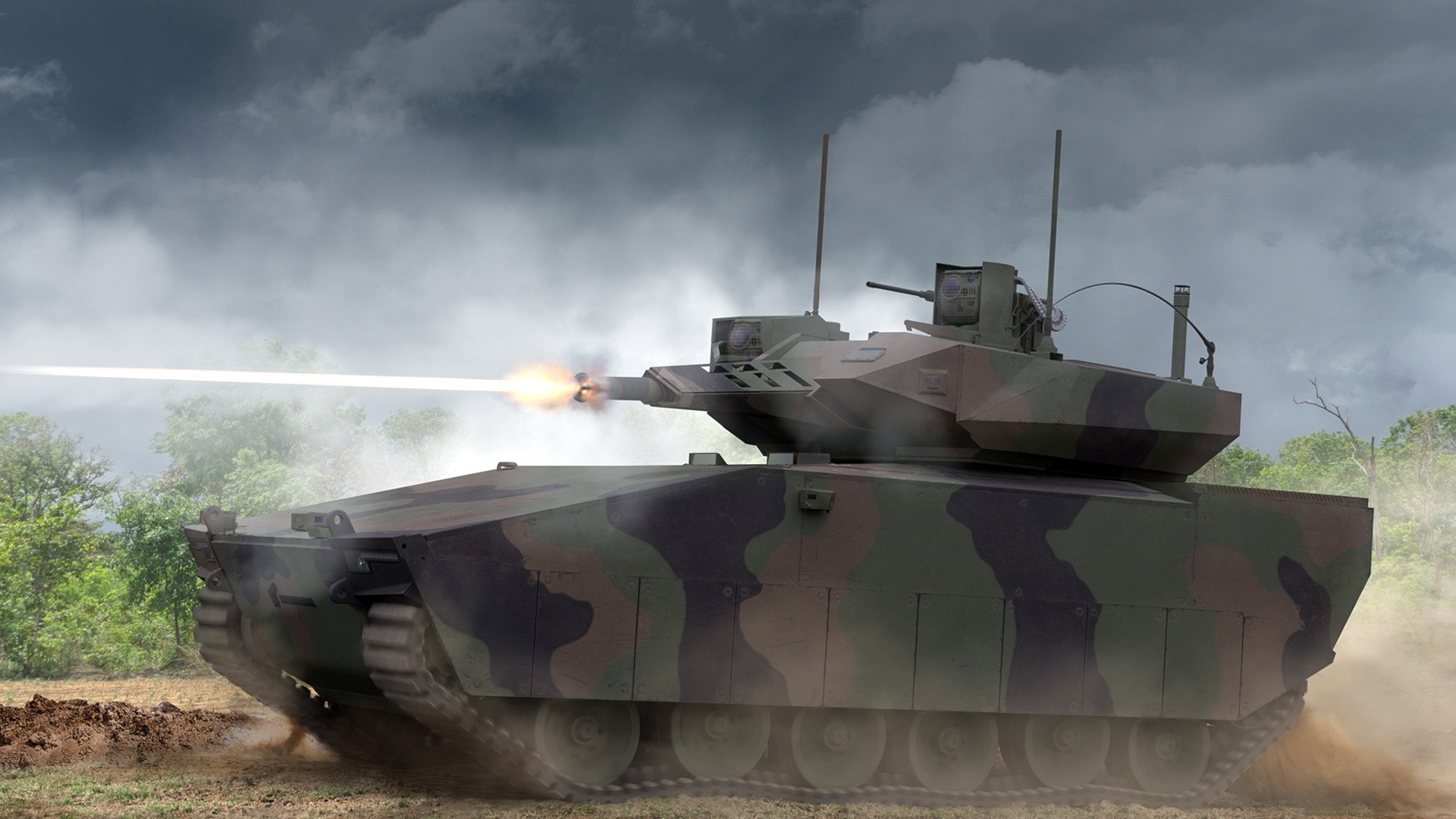
American Rheinmetall, the U.S. subsidiary of Germany’s Rheinmetall, is offering a version of the extended Lynx family. Jim Schirmer, the company’s senior vice-president of programs, said one prototype has arrived at Fort Hood. A second is at the Army’s Joint Forces Training Center at Camp Shelby, Mississippi, for company-run internal testing, while the remaining vehicles are being assembled in Slidell, Louisiana.
Both companies first delivered XM30 prototypes to Aberdeen Proving Ground in Maryland in late August. Each also provided an additional hull and turret for ballistic testing. During the month and more since, the Army has gained preliminary experience with the vehicles at Aberdeen.
The Wolf has fired its 50-millimetre cannon on Aberdeen’s live-fire range and completed some automotive functional testing, Norman said. He said General Dynamics was receiving “good feedback” on both. The company’s 32-speed SAPA transmission and composite rubber track have also been well received, with ride quality and comfort favourably compared with the Bradley.
Schirmer said the Lynx had also received positive early feedback, particularly during a late-September demonstration at Aberdeen for congressional staffers and Army VIPs. Passengers praised the two-person crew station arrangement, the space in the six-person squad compartment and the air-conditioning system.
Schirmer described the effect of heat on Bradley crews in Iraq as a reason to value improved environmental comfort. He recalled, “When it was 125 degrees outside in Iraq with additional solar loading, inside the Bradley the temperature got to 138 degrees. It actually felt refreshing to step out into the Iraqi air.”
The Wolf and Lynx are both larger than the 40-tonne Bradley and have combat weights in the 50-tonne range. Each uses an XM913 50-millimetre automatic cannon as its main weapon, compared with the Bradley’s 25-millimetre M242. Schirmer said American Rheinmetall found minor problems in its first Lynx prototype at Aberdeen and made adjustments before the demonstration. “We spent a fair amount of time swapping hardware and making adjustments to make sure it was ready [for the VIP event].”
Both competitors say their designs can operate more efficiently and accommodate more weapons and sensors than the Bradley. Each has a two-person crew, compared with the Bradley’s three. XM30 commander-gunners work from below the turret, rather than inside it as in the Bradley, placing greater demands on situational awareness and task management.
The Wolf and Lynx put the commander and driver in side-by-side stations, an aviation-style arrangement intended to support coordination. Both companies have focused on user interfaces with multiple displays and menus, purpose-designed symbols and text, and controls arranged for crew ergonomics. Their prototypes also provide higher-resolution, longer-range gunsight displays and a 360-degree view outside the vehicle for crews and carried squads through cameras positioned around the hull.
Norman said the reduced crew size requires more efficient task execution. “Because we have a reduced crew from the Bradley [which has a commander and gunner in turret] there has to be greater efficiency in how those soldiers execute their tasks. The software and menu logic are very intuitive,” he said.
The Wolf’s left and right crew positions are identical, allowing either crew member to perform the same functions. The driver usually sits on the left and the commander on the right. General Dynamics applied lessons from soldier touchpoints involving early M1E3 Abrams tank prototypes, for which it is the prime contractor; Norman said the M1E3 and Wolf share a graphical user interface.
The Lynx has three configurable displays, including a large central screen showing a common operating picture and map, along with video feeds from airborne uncrewed aerial systems. “You can shoot the gun from the left or right, you can drive the vehicle from the left or right,” Schirmer said.
The Lynx crew can also view the camera from the commander’s independent weapons station, which is mounted atop the vehicle and has its own sight and machine gun. Crews can switch between that camera and the main weapons sight, and can disable selected information on their displays to concentrate on a task.
Last week, General Dynamics Land Systems announced a partnership with Primordial Labs to bring artificial-intelligence voice control to its combat vehicles, including the M1 and XM30. Schirmer said American Rheinmetall has developed an AI assistant for Lynx crews as well. He described it as a “third crewman” that helps two soldiers perform the work of three. A video accompanying the report showed Primordial Labs’ voice-control technology being used to operate a quadcopter-type drone.
Cooling and thermal management are also design concerns. The Bradley, like other armoured vehicles, encloses its engine and electronics with limited airflow, and heat from its drivetrain creates a detectable thermal signature, especially at the right-front exhaust outlet.
The Wolf and Lynx both use hybrid-electric drivetrains with silent-watch capability, which can temporarily reduce thermal signatures. Both route exhaust to the rear, easing heat plumes at the front quarter of the vehicle.
Schirmer said the Lynx’s cooling stack sits next to the powerplant in the forward hull. It provides additional cooling for the engine and battery packs, improves conditions for heat-sensitive electronics, and supports systems growth and higher power consumption. The Wolf’s engine cooling is at the rear, behind the track; Norman said the placement was engineered so that rearward cooling paths do not intrude on passenger space. He added that the Wolf’s systems are designed with a 10 per cent growth margin.
The hybrid drives and electronics will also face testing against directed-energy and electromagnetic threats. These include tactical electromagnetic pulse attacks, lasers aimed at external sensors and apertures, and weaponized electromagnetic interference, which can threaten weapons systems and basic mobility.
Both contractors expect rigorous Army testing of electromagnetic vulnerability. “I think they’ll nail our vehicles with the best [electromagnetic attack] that adversaries have and if they identify any weaknesses, we will correct those,” Norman said. He pointed to Aberdeen’s large, sophisticated anechoic chamber as a facility where both vehicles will eventually spend considerable time.
Schirmer said American Rheinmetall has its own electromagnetic-interference requirements for vehicle sensors and communications, and that the Army understands the threats and has explicit requirements. “We’re pretty comfortable that our system meets those, but actual EMI testing will take place later in the test program,” he said.