
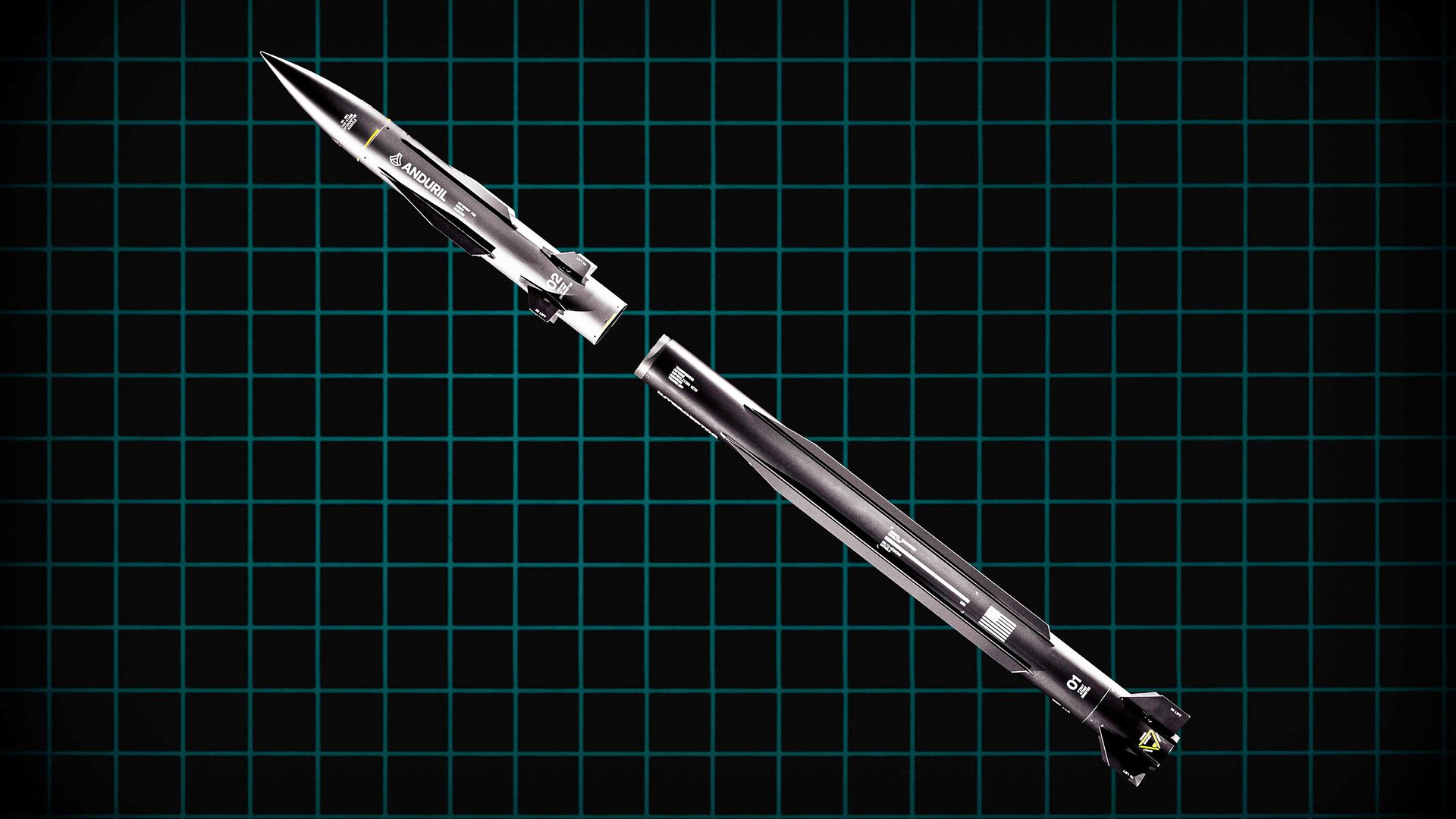
The War Zone has reported:
Anduril has unveiled Steelfin, a family of surface-to-air interceptor missiles designed around a shared architecture and manufacturing process. The company says different configurations could serve air and missile defence missions ranging from point defence to upper-tier ballistic missile defence, while common production methods could help it make the weapons in high volumes at substantially lower cost than existing systems. It has not released prices or detailed performance specifications.
The announcement comes as the U.S. military seeks to increase its air defence inventories to address a widening range of threats. These include inexpensive drones, cruise missiles, ballistic missiles and advanced manoeuvring weapons, including hypersonic missiles. Recent conflicts in Ukraine and the Middle East have demonstrated the difficulty of both intercepting such targets and producing enough weapons to sustain operations without rapidly using up costly stocks.
Using high-end interceptors against relatively inexpensive threats can consume limited inventories quickly. That has been especially apparent in the Middle East, where engagements have been needed to protect personnel and critical infrastructure. A wider selection of defensive weapons matched to different threats and engagement requirements could reduce reliance on the most expensive interceptors.
Steelfin is built around a two-stage design. Its first stage is a booster, while the second is a terminal interceptor that Anduril says will share a baseline airframe, avionics, software, flight control system and interfaces across variants. Different boosters and terminal-stage components would allow the company to configure missiles for distinct missions without developing an entirely new weapon for each one. Anduril says it plans to offer both hit-to-kill and blast-fragmentation terminal interceptors.
Christian Brose, Anduril’s president and chief strategy officer, described the architecture as open and adaptable. “It is an open system, so the ability to fly it with different rocket motors, different seekers, to be able to swap these components out, to be able to reconfigure the system for a range of different threats is a feature that we built into this,” he said. Brose spoke with media, including The War Zone, before the official unveiling.
Anduril says the family is intended to cover missions from point defence and lower-tier integrated air and missile defence through to upper-tier ballistic missile defence. It names cruise, ballistic and hypersonic missiles among the threats the broader family is designed to address. The company has not said which variants would engage particular threats, or published engagement envelopes and performance figures that would allow those claims to be assessed.
Brose said variant range would depend on booster size. “Right now, we’re looking at integrating on 10-inch, 18-inch, and 21-inch boosters, but we’re also looking at quad pack and dual pack for the Mk 41 Vertical Launch System as well for different installations, which imply different range and altitudes.”
The company’s commonality strategy is also aimed at easing manufacturing constraints. Conventional missile programmes can rely on specialized tooling, processes, suppliers and facilities, which can make it difficult to shift production quickly as operational needs change. Anduril says Steelfin variants would use shared production lines and equipment, with mission-specific boosters and terminal components added during final assembly. It says production capacity could then be redirected towards the variant in greatest demand.
Anduril is planning near-term production on the order of several thousand missiles annually, with capacity intended to expand or shift according to requirements. That remains an ambition: the company has not provided a detailed production schedule or contracted quantities showing how quickly it could reach that level.
The company says Steelfin is designed to work with existing land- and sea-based launch infrastructure. Listed systems include the M903A2 launcher used by newer PAC-3 series interceptors, the Navy’s Mk 41 Vertical Launch System, Typhon and emerging containerized launchers. Anduril also cites compatibility with established fire-control systems, including AEGIS and the Army’s Integrated Battle Command System, or IBCS.
Steve Milano, Anduril’s lead for Air Dominance & Strike, described the company’s cost and capability aims for several configurations. He said the “more exquisite version” would sit above the PAC-3 MSE and below THAAD in cost, while accomplishing “100 percent of the THAAD mission at a fraction of the cost.” For a configuration tailored to a PAC-3-type mission, Milano said Steelfin would accomplish 80 per cent of that mission for less than 50 per cent of the cost.
THAAD is designed to intercept short-, medium- and intermediate-range ballistic missiles during the terminal phase of flight. PAC-3 provides high-altitude, hit-to-kill air and missile defence against tactical ballistic missiles, cruise missiles and aircraft. Milano also positioned Steelfin as a lower-cost option for engagements now handled by weapons such as the Navy’s SM-2.
“Looking at the lower end of the the spectrum, as far as low-cost interceptors are concerned, I just saw an article on the [aircraft carrier USS Abraham] Lincoln coming back with all of the Shahed markings on the side, and I was contemplating the number of SM-2s that were fired against those assets. When I think of that cost exchange, the Steelfin enters into that market and provides greater than 80 percent of the capability of an SM-2 for a third of the cost,” Milano said.
For comparison, a THAAD interceptor costs about $15.5 million, while a PAC-3 MSE costs approximately $5.3 million, according to the Army’s latest proposed budget for fiscal year 2027. A single SM-2 Block IIIC, the most advanced version currently in service, costs around $2.5 million. Anduril has not published a Steelfin unit price, so its comparisons remain company claims rather than independently verified cost figures.
Steelfin joins other U.S. military efforts to expand the supply of lower-cost interceptors. In May, the Army sought industry proposals for a Patriot-compatible interceptor with a target unit cost below $1 million. The effort aims to reserve higher-end weapons for engagements that justify their cost and capabilities. The solicitation also set component-level cost targets and encouraged supplier competition for rocket motors, seekers and guidance systems.
Lockheed Martin has offered a separate response with its PAC-3 Adapted Capability Effector, or ACE, a lower-cost interceptor intended to operate within the Patriot ecosystem. Unveiled in July, ACE is intended to cost less than half as much as PAC-3 MSE, according to Lockheed. Given the MSE’s approximately $5.3-million unit price in the Army’s fiscal 2027 budget request, that comparison implies an ACE price of about $2.5 million if it holds. That would remain well above the Army’s separate sub-$1-million target, reflecting different objectives and requirements.
The Navy is pursuing a broader modular-interceptor approach through its Naval Modular Missile initiative. The plan envisions a family of surface-to-air weapons built around a common Terminal Stage Interceptor, with different boosters and canisters producing configurations for varied missions and platforms. Proposed variants include weapons intended to fit multiple missiles in a Mk 41 launcher cell and one designed for Virginia-class submarines equipped with the Virginia Payload Module.
The Navy’s longer-term vision is to replace its existing Standard Missile family with modular variants, although the effort remains in development. Smaller interceptors could allow ships to carry more weapons, while other configurations could retain longer-range capabilities. The Navy has also set out an ambition to reach production of 1,000 missiles annually within five years of a contract award.
Both the Navy initiative and Steelfin reflect a move towards common architectures that can support multiple interceptor configurations without requiring a separate missile for every mission. Anduril’s stated scope spans several tiers of air and missile defence, but the company has not yet provided the variant-specific details, performance data, prices or production commitments needed to establish how its proposed family would meet those goals.