
Responsible Statecraft has reported:
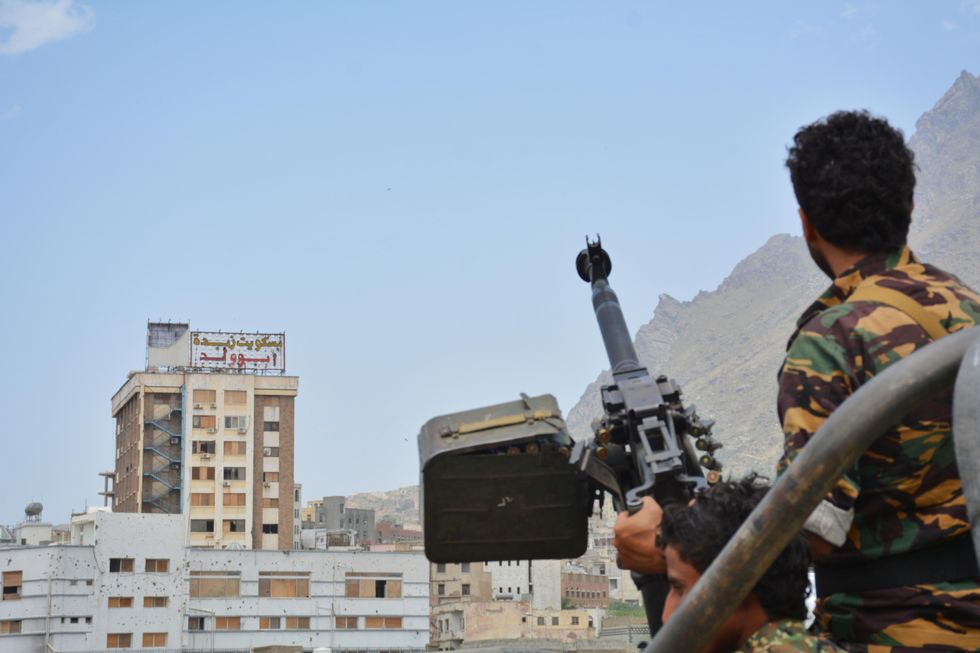
Saudi-backed government forces began retaking parts of Yemen’s Red Sea coast in early October, and Saudi Arabia launched a punishing air assault on Houthi positions after the group seized coastline and strategic islands in the Bab al-Mandab Strait on September 10, 2026. France, Pakistan and the United States have sent personnel to assist Saudi Arabia in countering the Houthi offensive. The fighting has renewed a conflict that had been largely held in check by a truce since April 2022.
Some observers outside the region have framed the Houthi advance as another front in the wider US-Israeli war on Iran. The Yemen war is a separate conflict, rooted in the Houthis’ takeover of the capital, Sanaa, in September 2014 and Saudi Arabia’s decision to lead a coalition against them in March 2015. The two conflicts are interacting, however: the Houthis’ recent escalation appears to draw momentum from Iran’s ability to withstand American and Israeli attacks, while the wider war is aggravating the violence in Yemen.
Ansar Allah, commonly known as the Houthis, is allied with Iran and has benefited from weapons and other support covertly supplied by Tehran since at least 2009. The group also has its own political aim: consolidating control over Yemen. It would pursue that goal even if Washington and Tehran reached an agreement to end the war launched by US President Donald Trump, according to the analysis of the conflict.
The immediate sequence leading to the current fighting began on July 13, 2026. An Iranian civilian aircraft carrying a Houthi delegation back to Yemen had attended the funeral of Iran’s assassinated Supreme Leader, Ayatollah Ali Khamenei. When it tried to land at Sanaa International Airport, the runway was bombed.
Yemen’s internationally recognized government, led by the Presidential Leadership Council (PLC), took responsibility for the airport attack. The Houthis blamed Saudi Arabia, which supports the PLC. The damaged runway forced the aircraft to land in Houthi-controlled Hodeidah.
On July 20, the Houthis announced a blockade against Saudi Arabia, saying they would target the kingdom’s oil exports through the Bab al-Mandab Strait in retaliation for the attack and continuing restrictions on Houthi-controlled territory. The group later struck Saudi petroleum facilities and oil tankers in the Red Sea. The attack on Sanaa airport formally ended the truce that had largely held between Saudi Arabia and the Houthis since April 2022.
Signs of preparation for renewed fighting predated the airport strike. The Houthis had been mobilizing fighters and moving materiel into position. In a June 16, 2026, speech, leader Abdul Malik al-Houthi said the group was ready to fight and called for official and grassroots action to end what he described as more than 11 years of Saudi aggression and blockade.
That message shifted attention from the Houthis’ support for Palestinians, which had become central to their domestic legitimacy during Israel’s assault on Gaza, launched after October 7, 2023. In the following months, the Houthis struck Israeli ships in the Red Sea in retaliation for violence against Palestinians. Those actions increased the group’s credibility at home, helping to obscure its repression and its failure to improve daily life for Yemenis under its control. Support for Palestine also helped recruitment and raised the Houthis’ profile internationally.
The group faced costs for its actions. The United States and Israel carried out deadly air strikes on Houthi areas. In August 2025, Israel assassinated several Houthi cabinet ministers, including the prime minister. After Israeli Prime Minister Benjamin Netanyahu stated a commitment to a Gaza ceasefire in October 2025, the Houthis indicated they would pause their campaign against Israel.
Israel has continued daily violations of that ceasefire, but the Houthis have kept their attacks on Israel limited, suggesting they may want to avoid open conflict with Tel Aviv. Their focus instead moved to Riyadh’s restrictions on Houthi airspace and seaports, as well as Saudi support for competing groups opposed to Houthi rule.
Over the past four years, the Houthis have strengthened their military capabilities. They can increasingly manufacture weapons inside Yemen, while a network of providers, including Iran, supplies raw materials and other components. Analysts have said the group has brought in large shipments of military material, equipment and weapons. Reports also say the Houthis used Claude, Anthropic’s artificial intelligence tool, to develop guided weapons.
The group experimented with a drone boat as early as 2017 and has since remained at the forefront of using emerging technologies to threaten opponents with greater resources and firepower. Its ability to seize the Red Sea coast quickly was also aided by the United Arab Emirates’ departure from Yemen in January 2026, which came under Saudi pressure.
Until early 2026, the UAE had provided significant support to Yemen’s southern secessionist movement, the Southern Transitional Council (STC). STC chairman Aidarous al-Zubaidi was also a member of the PLC. In December 2025, STC forces abruptly captured large areas in eastern Yemen, including territory along the Saudi border in the provinces of Hadramawt and al-Mahra.
Saudi Arabia responded by bombing Emirati ships carrying weapons to the STC and demanding a full UAE withdrawal from Yemen. Under pressure from Riyadh, the STC leadership announced the group’s dissolution, and al-Zubaidi fled to the UAE. The PLC removed al-Zubaidi and another STC ally, former Hadramawt governor, from the council and replaced them with two new figures.
The Saudi effort to suppress the STC did not end demands for southern independence. It appeared instead to alienate separatists who had backed the PLC in the hope that doing so would help bring about an independent southern Yemen. In the current conflict, the PLC’s initial failure to repel the Houthi advance along the Red Sea coast, even with Saudi support, was seen as evidence of the government’s broader ineffectiveness.
Saudi Arabia helped bring the PLC to power. After Arab Spring protests forced President Ali Abdullah Saleh to step down in 2012, ending his more than 33-year rule, Abdrabbuh Mansur Hadi led the internationally recognized government that replaced him, initially with Saudi backing. Hadi’s role was meant to last two years but continued for ten. His rule ended after Saudi Arabia withdrew its support and transferred authority to the PLC.
The PLC initially had eight members: four primarily aligned with Saudi Arabia and four with the UAE. Those competing ties created deep divisions within the council. It has also faced accusations of corruption and of failing to improve living conditions for people under its authority. Yemeni critics have called for reforms that would make it more accountable and representative of the country’s population. In January 2025, PLC chairman Rashad al-Alimi announced a corruption crackdown in response to such criticism.
Saudi Arabia’s calculations in Yemen have also been shaped by the cost and risks of the conflict. From 2015 to 2022, the Houthis built their military strength in a war against Saudi-backed forces, relying substantially on covert Iranian assistance. A turning point came in March 2022, when the Houthis attacked Saudi Arabia during the Formula One Saudi Arabian Grand Prix in Jeddah.
That strike demonstrated the group’s ability to deter tourists and investors from visiting the kingdom and to threaten Crown Prince Mohammed bin Salman’s Vision 2030 plan to transform Saudi Arabia’s economy and society. Saudi Arabia agreed to a two-month United Nations-brokered truce in April 2022 only after the attack.
By March 2023, Saudi officials were reportedly eager to reach a longer-term agreement that could end the kingdom’s costly and ultimately futile involvement in Yemen. Riyadh held direct talks with the Houthis over the next few months, with Oman mediating. Those discussions led to a broader United Nations-brokered roadmap agreement in December 2023.
Under the reported terms, Saudi Arabia would pay public-sector salaries, including in Houthi-held areas, and ease restrictions on airports and seaports. The agreement would also allow oil exports to resume and begin an inclusive political settlement led by Yemenis under United Nations auspices. In effect, it would weaken the PLC, which relies heavily on Saudi support.
When the Houthis began attacking Israel in late 2023, the United States responded with Operation Prosperity Guardian. Saudi Arabia stayed out of that confrontation, unwilling to risk renewed cross-border attacks. The Houthis’ flights between Yemen and Tehran in July 2026, however, appear to have crossed a Saudi red line. Riyadh feared that showing