
Edmonton Journal has reported:
Alberta has directed Edmonton to return high-density infill projects to the approval process used before 2024 and to reinstate parking minimums for infill. Premier Danielle Smith and Municipal Affairs Minister Dan Williams announced the order on Thursday, giving the city three months to develop a new zoning formula. The province rarely intervenes in local regulations, although it has ultimate oversight of municipal governments.
The order reverses parts of the city’s approach under its omnibus zoning bylaw. Since that bylaw was approved, the city limited lengthy public hearings for infill applications and expedited mid-block projects of up to eight units. Edmonton’s plan is for mature neighbourhoods to accommodate half of all new construction by 2050, reducing pressure to expand south of 41 Avenue SW or west of Anthony Henday Drive.
The dispute has centred on how quickly those neighbourhoods should change, and how much say residents should have over new development. Pro-infill group Grow Together Edmonton says redevelopment has been modest: over the past three years, it says, one per cent of Edmonton’s residential stock was redeveloped, and only half of those projects involved more than four units. The group argues infill is helping repopulate neighbourhoods such as Glenora, Parkview and Crestwood, which have lost residents over time.
Many of the large homes in those areas were built for families with four or five children, the group says, while families are now smaller. Inner-city schools are under pressure as their enrolments shrink, even as more families live beyond the Henday. Speaking in Chinatown on Thursday evening, Mayor Andrew Knack suggested that the province had been influenced by a few thousand vocal residents and advocates.
Neighbourhood groups have argued that multiplex construction is changing mature communities too quickly. Residents in Crestwood and Grovenor pledged to place restrictive covenants on their land titles to prevent buyers from building multiplexes on those lots. In Glenora, the Carruthers Caveat has existed in much of the neighbourhood for more than a century, restricting basement suites and multiplexes.
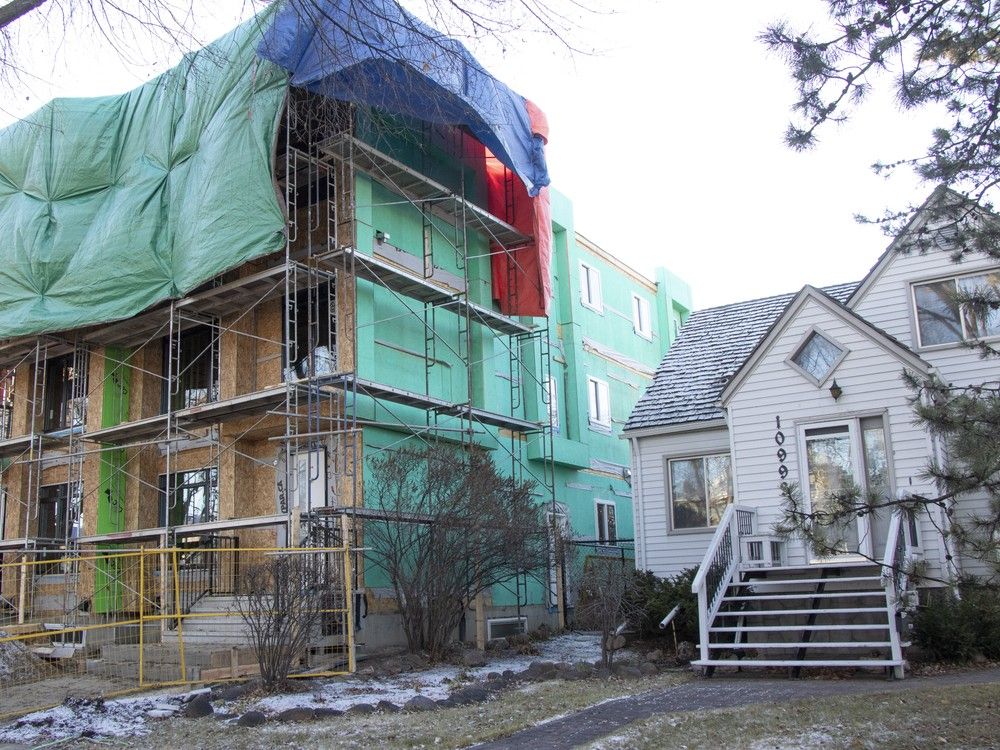
That caveat faced a challenge in February, when the Court of King’s Bench ruled in favour of a multi-family development in Glenora. The ruling stripped the caveat of what had been considered bulletproof status. Protests also took place in communities across Edmonton, where residents shared photographs of single-family homes beside larger multiplexes under construction.
Residents raised concerns about overflowing garbage and pressure on street parking. They also warned that ageing infrastructure might not be able to handle increased use from additional toilets, washing machines and dishwashers. Modern appliances use less water than earlier models, although low-flow toilets have been linked to sewer backups.
In 2024, after Grovenor residents complained of sewer smells, Epcor said: “Low-flow appliances help customers conserve water and, therefore, can reduce flows in the system compared to less efficient appliances.” The utility’s statement addressed the relationship between water conservation and sewer flows, while neighbourhood advocates continued to raise concerns about local infrastructure capacity.
When advocacy groups felt city hall was not listening, they took their campaign to the legislature, writing letters and staging protests on provincial grounds. Smith said sustainable growth had to take priority over approving multiplex after multiplex. She said the province’s intervention was intended to change how the city planned for new housing and infrastructure.
“The goal should not simply be more housing, but more housing that is planned and integrated in a way that works for both existing residents and future families,” Smith said. “When growth outpaces the infrastructure and services that support a neighbourhood, residents feel it.”
The Residential Infill Working Group, a coalition of neighbourhood advocacy groups, said the provincial announcement could support more deliberate development. “It is not a path to a housing crisis, but rather an opportunity to ensure the growth happens in the right places, at the right scale, and within the city’s capacity to manage it,” the group stated.
Tegan Martin-Drysdale, who founded the Infill Development in Edmonton Association, or IDEA, more than a decade ago, also said the pace of change in mature neighbourhoods had become excessive. In an open letter, she criticized what she called an “infill at all costs” approach and called for developers, the association and the city to respond to residents.
“It has become an ‘infill at all costs’ proposition that I think communities need to push back on,” she wrote. “The industry needs to smarten up. IDEA needs to step up and clearly bring more of the community voice to their board. The city needs to listen to the community feedback they are receiving. The contextual designs and ‘quiet infill’ we worked so tirelessly on 10 years ago to achieve is getting replaced with maximizing revenues, compromising design integrity and not being good neighbours to the existing community. Edmonton - do better.”
The events that preceded the provincial order included a council vote in 2025, shortly before the summer break. Coun. Michael Janz, one of council’s strongest advocates for urban density, proposed reducing the maximum number of units in mid-block developments from eight to six. His motion also proposed architectural controls, including requirements for enough front-facing windows and limits on side entrances.
Public hearings on the proposal lasted a week, with hundreds of residents appearing before council, many angry about the existing bylaw. The summer break was approaching, and Tim Cartmell was campaigning to become mayor, as was then-Coun. Andrew Knack. Early in the week, Cartmell positioned himself as a voice for residents opposed to the rules and proposed a moratorium on all infill. The city’s lawyers warned that a complete halt would violate the Municipal Government Act.
The volume of public speakers prolonged the debate, and it became clear the vote might not happen before the scheduled break. Council voted to extend its session. Cartmell and Coun. Sarah Hamilton were absent because of earlier vacation plans, and the motion failed by a 6-5 vote. Cartmell later apologized: “I’m sorry that I’ve let down people that were counting on me to be there,” he said.
Had the motion passed, it would have imposed greater limits on infill, although the account of the vote leaves open whether that would have prevented the later provincial intervention. Cartmell’s absence also disrupted his mayoral campaign. Two weeks later, former city councillor Michael Walters entered the race, making it no longer a contest between Knack and Cartmell.
Knack, the pro-infill candidate, won with just under 38 per cent of the popular vote. Cartmell received just under 30 per cent. Walters and Omar Mohammad, who both pledged to reopen the infill file, placed third and fourth and together received about 22 per cent. The results could be read as Knack consolidating support among voters, while many incumbent councillors who backed the zoning bylaw also returned to office.
Karen Principe was a notable exception among those incumbents. Jennifer Rice, another councillor who opposed the zoning bylaw, lost her re-election bid. Turnout was only slightly above 30 per cent of eligible voters. The protests did not lead to a large surge in voting, a result that helps explain Knack’s suggestion that a minority of angry voices prompted the province to act.
The provincial order followed that sequence of neighbourhood campaigns, political debate and election results. Edmonton now has three months to prepare a replacement zoning formula under the direction announced by Smith and Williams.