
The War Zone has reported:
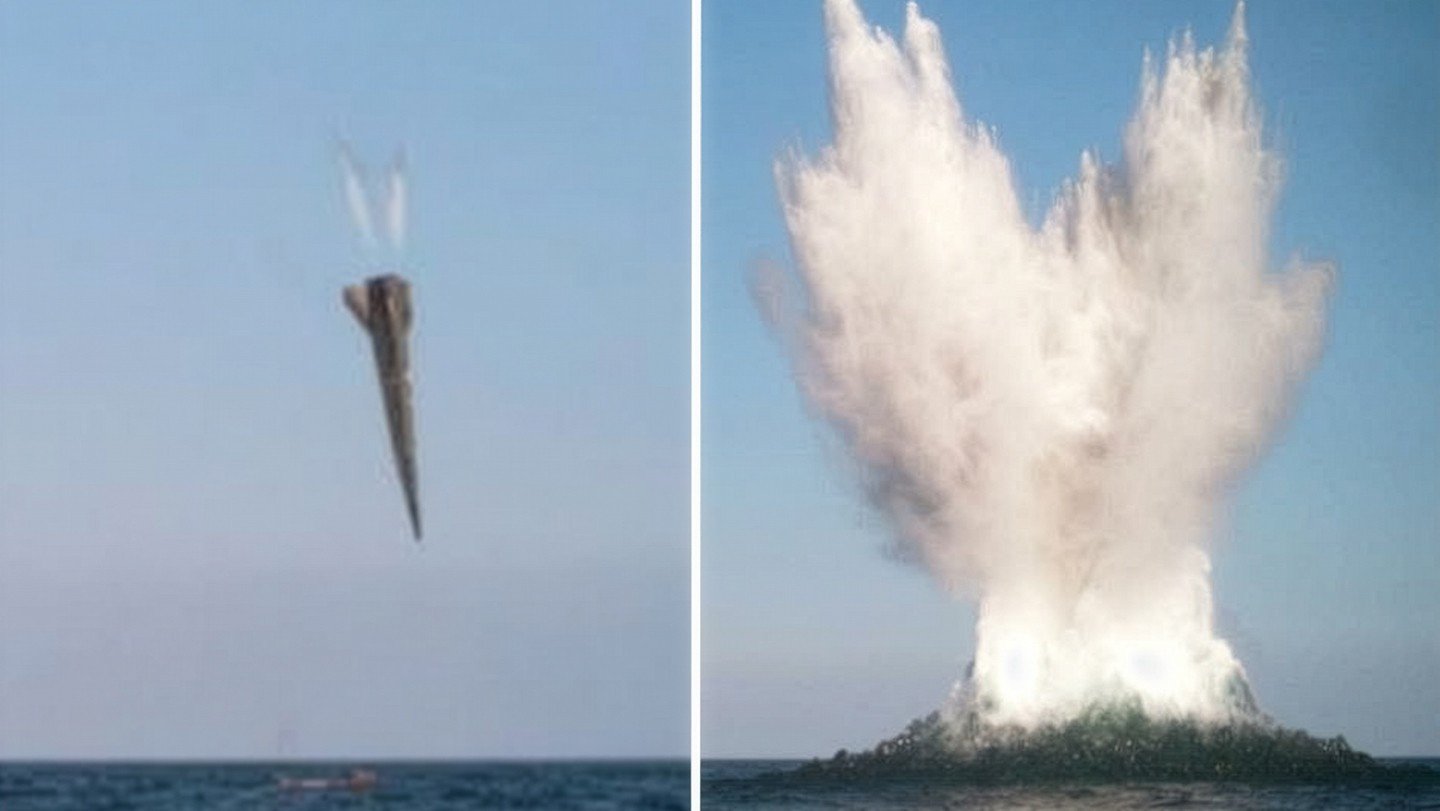
South Korea has released images from the first successful test of a domestically developed hypersonic boost-glide vehicle, showing its launch and its impact in the water at the end of the flight. The test took place on October 8, 2026, at the Anheung Proving Ground in South Chungcheong Province on the country’s western coast. A weapon of this kind could give South Korea a new way to threaten targets in North Korea as an arms race on the Korean Peninsula continues to expand.
The Presidential Office, commonly known as Cheong Wa Dae or the Blue House, announced the test in a Korean-language press release. It first posted video of President Lee Jae Myung and others watching from a conference room at Anheung. South Korea’s Agency for Defense Development, or ADD, manages testing at the site. Still photographs from the flight were later added to the Blue House website.
The images show a missile, whose formal name has not been disclosed, launched from a wheeled transporter-erector-launcher, or TEL, on a platform just off the coast. Other photographs show the missile after launch and the vehicle striking the water. Their low resolution makes it difficult to determine whether the missile or its launcher uses an existing South Korean design or is based on one.
The boost-glide vehicle appears broadly conical in some views, with stabilizing fins near its base. At least one fin seems to be truncated. Closer examination of the available images also suggests the vehicle may instead have a wedge-like form, with distinct upper and lower surfaces, though the photographs are not clear enough to settle its shape.
Conical boost-glide vehicles are generally considered easier to design than wedge-shaped examples. Developing any hypersonic boost-glide vehicle into a viable operational weapon has proved technically difficult, including for countries with extensive experience in the field. The South Korean vehicle’s apparent survival through its flight and into the water impact is therefore a notable result, though the released images do not establish its performance across a complete operational profile.
The Blue House said the test was designed to verify technologies in a hypersonic flight environment. “This test launch was conducted to verify, for the first time, the vehicle’s core technologies in a hypersonic flight environment: the performance of ultra-high-temperature heat-resistant materials, guidance and control capabilities, and the ability to perform irregular flight maneuvers at low altitudes,” the office said in its release, according to a machine translation from Korean. It added: “The HGV [hypersonic boost-glide vehicle] successfully separated after ascending to the target altitude and executed its planned flight path within the hypersonic environment without any issues.”
South Korean authorities had not disclosed how far the vehicle travelled before hitting the water or what peak speed it reached. Guidance during the middle and terminal portions of flight also remains an open question. The test announcement described guidance and control among the technologies assessed, but the specific methods used in those phases were not made public.
A boost-glide vehicle without its own propulsion must first be carried to a suitable altitude and speed. A rocket booster typically provides that acceleration, and existing ballistic missile designs can serve as a starting point. After separation, the vehicle glides through the atmosphere on a relatively shallow path and can manoeuvre, sometimes unpredictably, while travelling at hypersonic speeds, generally defined as about Mach 5 or faster.
That flight profile differs from a traditional ballistic missile, including one with advanced manoeuvring capability. Ballistic missiles follow a broadly arcing trajectory towards their targets, while a boost-glide vehicle can remain within the atmosphere on a flatter course. The speed, path and ability to manoeuvre can make such vehicles difficult to detect and track, complicate interception and leave defenders less time to react.
Those characteristics make hypersonic boost-glide weapons attractive for attacks on valuable targets that must be struck quickly. The Blue House described the vehicle as a “key strategic asset capable of changing the game on the battlefield,” saying its unpredictable trajectory and speed could enable surprise attacks on strategic targets during contingencies. The high speeds reached during the terminal phase may also give such vehicles bunker-busting potential, in addition to their other claimed advantages.
South Korea has a range of domestically produced ground-launched ballistic missiles that could provide possible launch platforms for an unpowered boost-glide vehicle. President Lee was shown a TEL for the country’s newest Hyunmoo-5 ballistic missile at Anheung on October 8. Officials have not drawn an explicit connection between the Hyunmoo-5 and the hypersonic test.
The Hyunmoo-5 entered service around the end of 2025 and remains a comparatively recent development. It is officially classified as a short-range ballistic missile despite a gross weight of 35 tons. Reports have attributed its size in large part to its 17,000-pound warhead, and have raised the possibility that it could reach intermediate ranges if that payload were reduced.
Short-range ballistic missiles are defined as having ranges from 190 to 620 miles, or 300 to 1,000 kilometres. Intermediate-range ballistic missiles can reach between 1,864 and 3,418 miles, or 3,000 to 5,500 kilometres. Medium-range ballistic missiles fall between those categories.
With its large unitary warhead, the Hyunmoo-5 gives South Korea another means of holding deeply buried and hardened North Korean targets at risk. That role aligns with the country’s Korea Massive Punishment and Retaliation policy, known as KMPR. Earlier reporting has described the missile as a potential future pillar of KMPR and said its ability to strike hardened command-and-control facilities and missile storage areas could also support elements of a pre-emptive “kill chain” aimed at North Korea’s launch capacity.
The boost-glide test forms part of a broader South Korean effort to develop new missile capabilities. The country is also working on an air-breathing hypersonic cruise missile and new air- and sea-launched ballistic missiles. The sea-launched weapons are intended for future surface warships and submarines.
North Korea has continued to announce missile developments, although the maturity and operational viability of its designs remain uncertain. In recent weeks, it has conducted two separate test launches of what it described as new hypersonic designs. Missile tests by either side are not unusual on the peninsula, but the timing of a South Korean test involving an emerging technology cannot, by itself, establish that it was arranged as a direct response to a North Korean launch.
Relations between North and South Korea have been especially tense following an incident on September 21, 2026, in which three South Korean troops were injured along the Demilitarized Zone. South Korea’s Joint Chiefs of Staff and the United Nations Command on the peninsula said a North Korean landmine placed in violation of the Armistice Agreement caused the injuries. South Korean authorities demanded an apology and raised the possibility of taking some form of action in response, while President Lee later sought to play down the incident.