
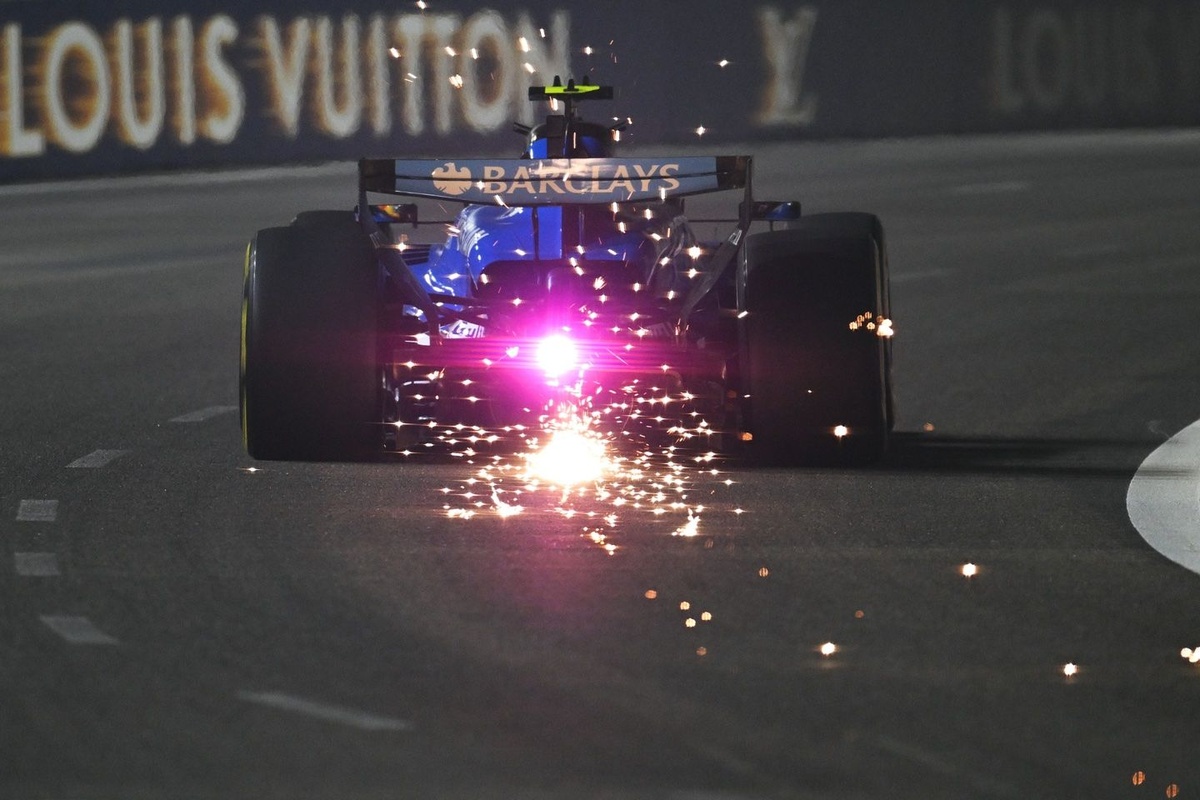
Autosport and RaceFans have reported:
A Race Control human error temporarily left Formula 1’s Overtake Mode unavailable after a red flag during the first period of sprint qualifying for the Singapore Grand Prix, the FIA said. The governing body said the problem affected the performance of some cars, while a separate fault with the timing system meant some lap times were not displayed and delayed the start of SQ2.
The session was stopped when Sergio Perez hit the barrier at Turn 5. After extracting his car, Perez returned to the pits and lost his damaged front wing along the way, prompting race control to pause proceedings so debris could be cleared.
When SQ1 resumed, drivers reported having less power than expected, and some lap times were not registered by the timing system. Drivers were told that the power issue was the FIA’s responsibility, leading some to suspect it was connected to a software problem that had affected the previous weekend’s Bahrain Grand Prix in Malaysia. The FIA later clarified that the power issue was not caused by software and was unrelated to the timing fault.
“During the first period of Sprint Qualifying there was a human error in Race Control unrelated to the timing issue also encountered in SQ1,” the FIA said in a statement. “This issue in question meant Overtake Mode was not available after the red flag period during SQ1. When it became apparent that Overtake Mode was not active after the restart, it was then activated for a period of 27 seconds before being deactivated again.”
Overtake Mode gives drivers access to an extra half-megajoule of energy. Its availability can affect outright lap time on a push lap and tyre preparation during out-laps, so the FIA said the timing of each car’s run and its position around the lap shaped the impact.
“The FIA acknowledges that this unfortunate human error had an impact on the performance of certain cars based on the timing of their run and their position around the lap,” the statement said. “The second and third periods of Sprint Qualifying were not affected.”
Carlos Sainz, who was eliminated in SQ1, said his session included brake problems and that drivers had not received equal power. “We only got one lap. We had some brake issues,” he said. “But on top of that, half the cars did the lap with an engine half a second quicker than the others. There was another software issue this time around and we were on the bad end of it.”
Sainz criticized the FIA’s response and questioned why the sport appeared to treat drivers differently depending on when they were eliminated. “For whatever reason, the FIA, like Malaysia, didn't decide to sort it quickly and were happy to do half of the cars in quali with higher power than the other half of the cars,” he said. “So a bit confused why the sport keeps doing different things depending on who is out in Q1 and who is out in lap one.”
Kimi Antonelli, Charles Leclerc and both Aston Martin drivers were also understood to have been affected by the Overtake Mode problem. The episode followed a separate high-profile technical failure at the previous weekend’s Bahrain Grand Prix, which was paused after a single formation lap when cars lost electrical power in wet conditions.
The timing system fault delayed the beginning of SQ2, but the FIA said it was not connected to the Overtake Mode error. RaceFans published its report on Oct. 9, 2026, at 15:08, with an update at 15:39. The outlet said its article would be updated.