
Edmonton Journal has reported:
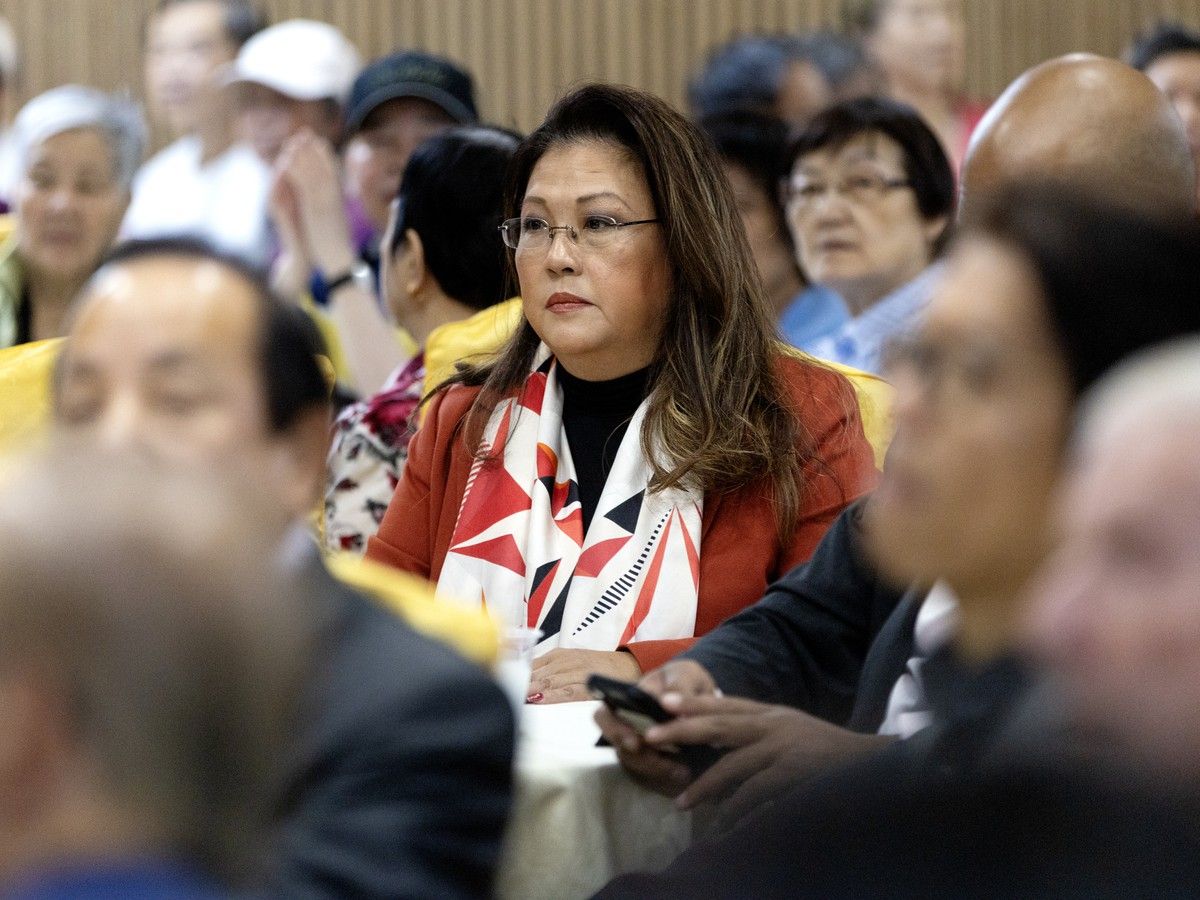
About 200 people gathered Thursday night at a restaurant inside Pacific Mall to discuss detainees being dropped off in Edmonton’s Chinatown and what could be done in response. Community leaders said no federal MPs or United Conservative Party MLAs accepted invitations, prompting frustration that elected officials were absent from a discussion affecting the neighbourhood.
Sandy Pon, chair of the Chinatown Transformation Collaborative Society and co-lead of the Chinatown Safety Council, said officials may view the issue as political, while residents see it as a community concern. “They feel political, and we try not to be,” Pon said. “We’re not trying to be political. We’re trying to be community-minded, right? If you’re elected officials, who are your voters? Show them that you care, not just care for one or two important people.”
Pon said community organizations have not received replies or made headway with officials. She said leaders expected a difficult conversation, but believed ministers would not hear it if they did not attend. “But I’m sure they want to do a great job for the people in the constituency and for the province, right? But, yes, we do need a little care right now, more than ever.”
The meeting followed the emergence of security-camera images showing detainees being left in the neighbourhood on multiple occasions. Pacific Mall cameras captured provincial officers dropping off a detainee on Sept. 3. On Sept. 11, a camera at Kim Fat Market, at 9905 107 Ave., recorded a van dropping off eight detainees.
Community members witnessed three other alleged drop-offs between Sept. 28 and Oct. 4. An image has also surfaced from December 2023, taken by a Pacific Mall security guard, that appears to show seven detainees being dropped off. The latest material has intensified discussion about how people are released and whether they receive help reconnecting with family, transportation or support services.
Chinatown remains affected by the 2022 slayings of Hung Trang and Ban Phuc Hoang. The trial of suspect Justin Bone began in January of this year, but no verdict has been reached. The meeting addressed the drop-offs as a community safety and service issue, as well as the circumstances facing detainees after they leave custody.
Coun. Anne Stevenson, who represents Chinatown, said Edmonton is home to or near five federal and three provincial prisons and remand centres. The Edmonton Remand Centre has 1,952 spaces and holds nearly half of all people remanded by the province, she said.
Stevenson said research by her staff found that 53 per cent of people released from custody are reconvicted within a year. She said the first three weeks after release are a critical period for the risk of reoffending. The figures were raised as part of a broader discussion about what happens when people leave custody without a plan or assistance.
Many detainees are left without a way to get home, Stevenson said. Some are dropped off in Edmonton despite being from elsewhere, and are not transferred to social agencies that help people transition back into society. “We don’t know where folks are coming from … how are we connecting them back to their home, their community?” she said.
Pon said Chinatown residents and service providers feel stretched. The area contains many social agencies and serves as a hub for the city’s transient population, she said, while social workers are burned out. She said detainees are not receiving “warm handoffs,” in which they are transferred directly to social services instead of being released without support onto the street.
“Now we have evidence that is is happening so frequently,” Pon said. “People need to be more accountable, and we want to find out what the gaps are between social agencies and community service providers. We’re here to find solutions so people can get off the street and get help, and get the proper resources that they need. Somebody’s not getting the memo.”
Pon said people arriving after release may have no familiar contacts or nearby support. “When people are dropped off, they are coming into the unknown. There is no next of kin. There is nothing that they’re familiar with. Many are from out of town or out of province. They don’t even have a bus ticket to get home. That is very sad. Put yourself in a situation. You don’t know anybody here, and it’s pitch dark at night. Every place is closed. What do you do? What do you resort to? And this is where we want to stop that, the crime, the houseless, the encampment, any kind of predatory situation. We want to stop it. We want to intercept it.”
Janis Irwin, the NDP MLA for Edmonton-Highlands Norwood, said most of the challenges Chinatown faces fall under provincial responsibility and should be addressed across party lines. “We’ve been clear all along, this is not a partisan issue,” Irwin said. “This is an issue that is completely solvable. We know the solutions. Frontline organizations know the solutions. We just need a provincial government that’s willing to act. And so I’m not making this a partisan issue. I’m making this an issue about people. It’s about the humans who live in Chinatown, and it’s about those who own businesses here, and it’s about those folks who are being dropped off who also deserve dignity.”
Irwin said people released in the neighbourhood should be met by frontline workers who can help them access services. “Having those proper supports for people when they’re dropped off, to make sure they are met with a warm handoff, right? They are met with somebody on the front lines who can work with them, so they’re not dropped off right here - which is where eight of them were dropped off without any support. These are the type of solutions that we know need investment. We need investment from this provincial government to make sure that there are more frontline workers.”
Mayor Andrew Knack praised residents and business leaders for continuing to build the neighbourhood despite difficult conditions. He said the videos were not new information to people in Chinatown, but confirmation of a longstanding practice. He also rejected the province’s suggestion that the videos showed isolated incidents.
“On either side of this building. we’ve got the history of overconcentration of social services in this space,” Knack said. “And, yet, through it all, we have a community that has been tireless in their work to making this the best place it could be.”
Knack renewed his commitment to use city land for more social housing rather than wait for provincial announcements. “We will see further action as soon as the next city budget.” The next city budget was the timing he identified for further action.
Former mayor Bill Smith said there are too many social service agencies in the area and that they do not work together effectively. He said Chinatown’s “No. 1 problem is the government.”
The drop-off issue has also prompted public responses beyond Thursday’s meeting. Related coverage has included Edmonton’s police chief responding to a new video of a detainee drop-off in Chinatown, and video of the accused in the Chinatown killings being transported by police to Edmonton, which was played at the murder trial.