
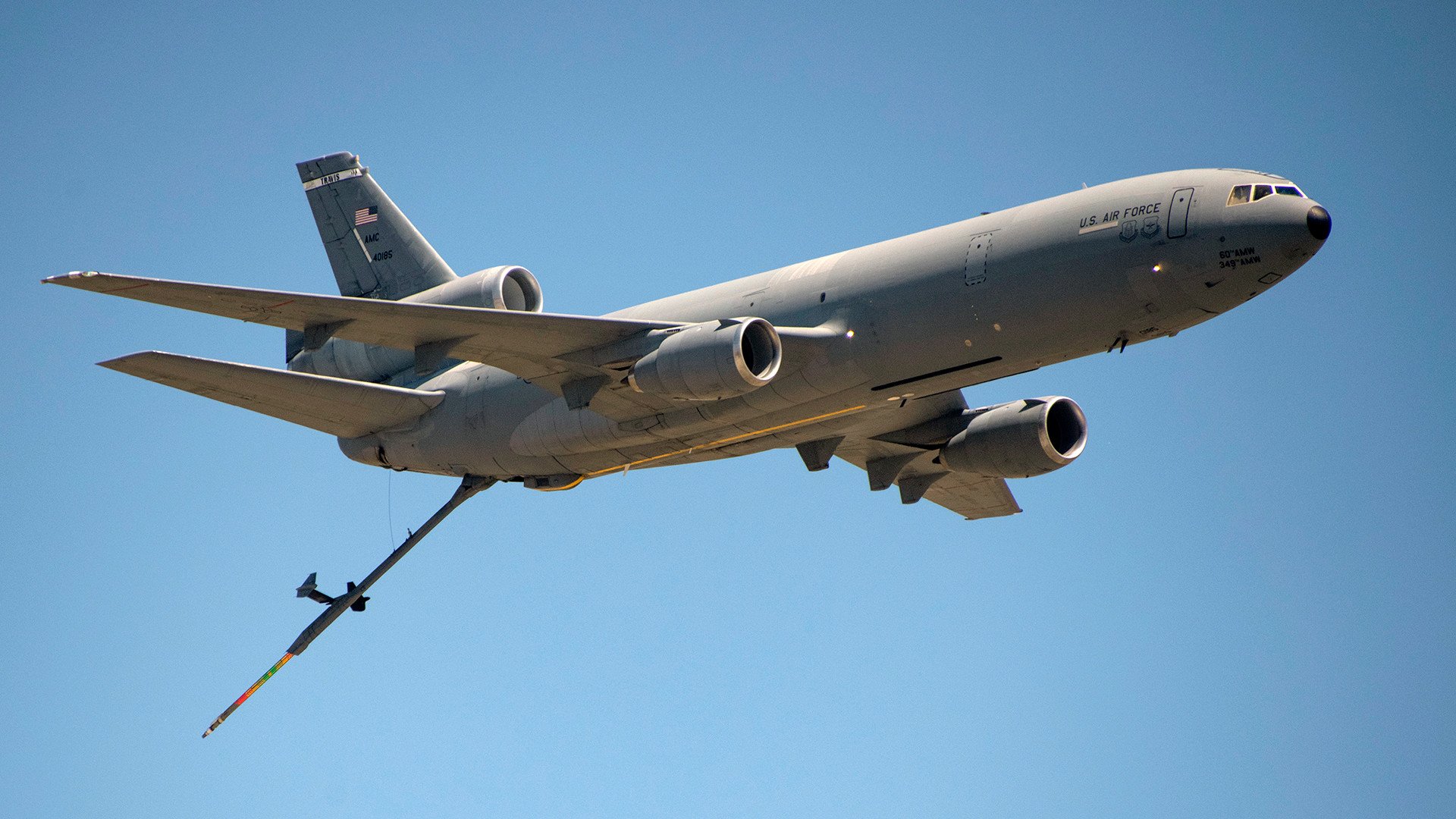
The War Zone has reported:
Four retired U.S. Air Force KC-10A Extender tankers could be prepared for a new role in North Africa, just over two years after the service retired its last aircraft of the type. A notice from the Air Force Life Cycle Management Center (AFLCMC) seeks information about companies able to restore and support as many as four KC-10s, which could be transferred to an unnamed partner nation through the Excess Defense Articles program.
The notice was issued “solely for information and planning purposes.” It says the Air Force wants “to identify potential industry sources that possess the capability, expertise, and facilities to execute the regeneration, one-time flight clearance, depot-level return to service, worldwide ferry delivery, in-country Contractor Logistics Support (CLS), and operational/maintenance training for up to four (4) KC-10 Extender aircraft.”
The aircraft could be “transferred via Excess Defense Articles (EDA) to a partner nation in North Africa,” the notice says, without identifying the country. The notice does not establish that a transfer will take place. The Air Force and State Department were asked for more information; the State Department directed the inquiry to the Pentagon.
The EDA program allows equipment considered surplus to U.S. military needs to be provided to allies and partners, either at a reduced price or as a grant. A recipient country must cover delivery costs and, when necessary, refurbishment. A low initial purchase price could make the aircraft attractive to a buyer, although returning large military aircraft to service can require substantial time, money and work, even when they have been kept in well-maintained storage.
Egypt and Morocco are possible candidates, based on the aircraft in their current and planned inventories, and both are major U.S. allies. Neither country is identified in the AFLCMC notice, and the possibility of either receiving the tankers remains speculation.
Egypt does not currently operate dedicated aerial refuelling tankers. It is acquiring two new C-130J-30 Hercules aircraft for airlift and tanker duties, with fuel delivered using the probe-and-drogue system. Egypt already operates C-130s, but none is specifically configured for aerial refuelling. Its varied fighter fleet includes U.S.-made F-16 Vipers, which can receive fuel in flight only from a tanker equipped with a refuelling boom.
Morocco also operates F-16s and is acquiring additional aircraft. The first new-production Block 72 F-16D for the Royal Moroccan Air Force flew for the first time earlier this week, according to the source report. Morocco already has an aerial refuelling capability through C-130s fitted with probe-and-drogue equipment.
The KC-10 was designed to refuel aircraft using either a boom or probe-and-drogue equipment. Probe-and-drogue tankers are much more common internationally, while the KC-10’s ability to use both systems could let it refuel tactical aircraft in either country’s fleet. Both Egyptian and Moroccan fighters have received tanker support from other countries during exercises. In an exercise in Egypt last month, Chinese YY-20 tankers, also known as Y-20Us, refuelled Egyptian MiG-29M/M2 and Rafale fighters. Footage released by Egyptian authorities from the “Eagles of Civilization 2026” joint air exercise showed the refuelling; a post carrying the footage was dated Sept. 7, 2026.
The KC-10 entered U.S. Air Force service in 1981 and remained in use until 2024. McDonnell Douglas, later absorbed by Boeing, delivered 60 aircraft to the Air Force between 1979 and 1987. The Extender was developed from the three-engine DC-10 airliner, production of which ended in 1989. One KC-10 was lost in an accident in 1987.
Of the 59 aircraft left, 10 were offered for auction in a non-flyable condition last year. Each was missing one engine from beneath a wing, for reasons that remain unclear. The aircraft were among the first KC-10s retired, and their refuelling booms had been removed for use as spare parts for tankers that remained in service through 2024. Private refuelling contractor Omega Air appears to have won the auctions.
Omega operates two former Dutch KDC-10 tankers, broadly similar to the KC-10, as well as a DC-10 converted to carry out probe-and-drogue refuelling only. The company also operates several tankers based on Boeing 707s. The state of the other 49 KC-10s is not clear.
Congress addressed the remaining retired KC-10s in the National Defense Authorization Act (NDAA) for Fiscal Year 2026. The law required the Air Force to preserve them in “the same storage condition” they were in on Sept. 30, 2025. Signed in December 2025, it also allowed the service to “dispose” of the aircraft under existing property management statutes.
The Air Force applied protective coatings to some KC-10s in storage at the Davis-Monthan Air Force Base boneyard in Arizona, where retired tankers were seen in 2025. The preservation provision does not establish that all remaining aircraft are ready to fly, and the condition of the possible four-aircraft group has not been disclosed.
Returning an old aircraft to flight requires more than making it airworthy. The AFLCMC notice’s listed work includes regeneration, a one-time flight clearance, depot-level return to service, delivery to the recipient country, in-country contractor logistics support, and operational and maintenance training. Those requirements indicate the range of work and support the Air Force is seeking information about, without confirming that a contract has been awarded or that an aircraft has been selected for transfer.
The KC-10’s potential value would extend beyond its refuelling systems. During U.S. Air Force service, it also carried cargo, and an aircraft returned to tanker service could continue to perform that role. It is also possible that KC-10s could be restored as cargo aircraft without operating as tankers, although the source report considers that less likely.
The aircraft’s retirement was controversial despite the growing difficulty of operating and maintaining the ageing fleet. The KC-10 was a flexible tanker that could carry more fuel than the KC-46 aircraft that replaced it. For a country that has not operated a boom-equipped tanker, acquiring second-hand KC-10s could provide an entry point to that capability. Aerial refuelling can extend the reach and operating options of an air force, but the notice leaves open whether any North African partner will pursue the aircraft.
The AFLCMC announcement has brought the possibility into view: four retired tankers may be considered for regeneration and transfer, but the recipient, aircraft condition, costs and final outcome remain unknown.