
CTV News Calgary has reported:
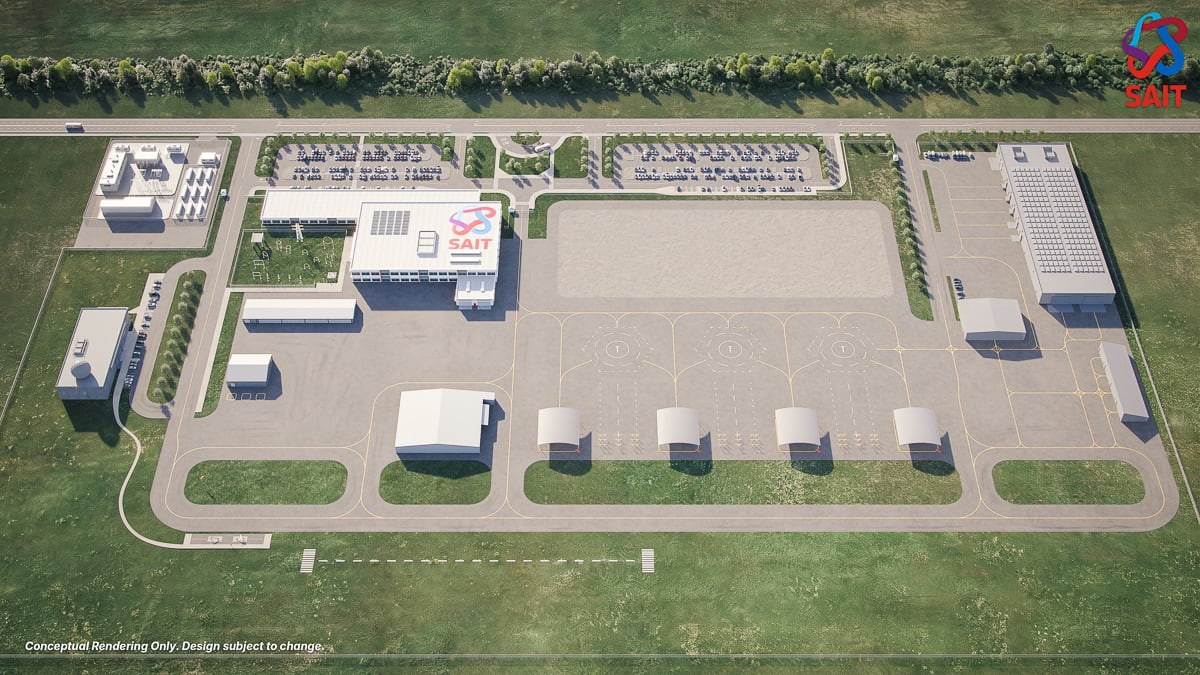
The Southern Alberta Institute of Technology (SAIT) has received a $30-million gift from Calgary philanthropist David Bissett to help build a facility for training workers in autonomous aviation. The proposed Bissett Autonomous Aviation Park would give students and industry partners a dedicated place to train, test and develop remotely piloted and autonomous aircraft in Calgary.
Announced Thursday, the gift is one of the largest investments in SAIT’s aviation programs. It comes as the school expands its offerings in remotely piloted aircraft systems, commonly called RPAS, and forms part of SAIT’s $150-million Real Futures fundraising campaign. Of Bissett’s contribution, $6 million is earmarked for student awards to increase access to RPAS education.
The planned facility would bring together RPAS training, applied research and innovation, and industry partnerships. Students are expected to work with companies on research and field testing, with work-integrated learning and co-op opportunities incorporated into the facility. SAIT has not said the gift covers the park’s full construction cost.
SAIT president and CEO David Ross said the investment would take the school’s existing work in unmanned systems toward a permanent, dedicated facility. “The future centre for us is really the next step,” Ross said. “We’ve now long thought that unmanned systems were, in fact, the next phase of the evolution of what aerospace will be.”
SAIT launched Western Canada’s first professional RPAS certificate program in 2023 and introduced its first RPAS diploma this fall. It also operates the Centre for Innovation and Research in Unmanned Systems, which works with industry on applications for the technology. Ross said the park would bring training, research and industry activity together in one place.
The school says demand for graduates is already strong, with students in its early programs receiving job offers before graduation. “The labour market is robust,” Ross said. “Many of these students are already being offered jobs.”
Troy Jensen, a first-year student in SAIT’s two-year RPAS diploma, said the industry is developing so quickly that some jobs graduates eventually take may not exist yet. “It’s such an emerging and rapidly developing and growing industry,” he said.
Jensen began the program about a month ago. He has already flown aircraft, used flight-planning software and created maps showing where drones will operate. He said a larger facility would give students more room to build and experiment with aircraft, along with access to places where they can legally fly.
“Getting more and more people having the right tools, the right resources to actually go out, start experimenting on building drones, repairing drones, and even having the space to actually go fly them is incredible,” Jensen said. The park is expected to provide more opportunities for students to work directly with industry while completing their education.
Jensen is interested in using remotely piloted aircraft for surveying and monitoring, including in remote parts of northern Canada. He said aircraft could help monitor wildlife populations and reach areas that are difficult for people to access. “If those companies don’t exist, I’d love to help start one up,” he said.
Bissett said he became interested in the technology by following developments in autonomous aircraft and drones around the world. “It’s interesting when you follow on YouTube, there’s all kinds of really interesting things on it,” he said in an interview. He pointed to uses in places such as Ukraine and China, as well as the potential to transport equipment into remote areas.
Bissett prefers the term “autonomous aircraft” to “drone,” saying the technology has applications beyond the recreational aircraft familiar to many people. “We can’t even dream of all of the potential applications,” he said.
SAIT’s existing research has covered agriculture, petroleum, health and safety. Ross gave the example of using drones to monitor agricultural conditions, such as soil moisture and fertilizer applications. Aircraft can also track livestock fitted with RFID tags, potentially reducing the time and money farmers spend monitoring herds across large areas.
“The applied research side is about figuring out what the technology can do,” Ross said, with the aim of ensuring applications are useful to companies and industries. The park is intended to support students learning alongside industry as research and commercial uses continue to develop.
The sector has also drawn interest from governments and economic development organizations. Statistics Canada figures cited by SAIT put Alberta’s aerospace sector contribution to provincial GDP at $3 billion in 2024. Calgary Economic Development has identified autonomous aviation as an economic driver and counted more than 400 aerospace and defence organizations across Alberta.
The sector is projected to reach $4.7 billion and grow employment by nearly 60 per cent by 2030. Calgary Mayor Jeromy Farkas said the investment could help the city benefit from that growth, pointing to possible uses in search and rescue, logistics and defence. “It’s about aerospace, aviation, defence, but it’s also about making sure that we’re future-proofing our local economy,” Farkas said.
The park’s location and construction schedule remain unsettled. SAIT is considering a couple of land options and expects to announce a location in the future. Airspace access is a factor because autonomous aircraft can travel significant distances and at high speeds. “We’re still fussing over exactly what it’s going to look like,” Ross said.
SAIT hopes to be ready to begin construction next year, but Ross said the school cannot yet provide a completion date or an overall construction cost. The $30-million commitment is Bissett’s contribution to the project, and the school has not said it represents the full cost of building the park.
Bissett said his investment is intended to give Alberta students a chance to take part in the development of the technology. “I want young Albertans to be building it, not watching it happen somewhere else,” he said. “I think the imagination of these students could well evolve into new and interesting applications.”