
The War Zone has reported:
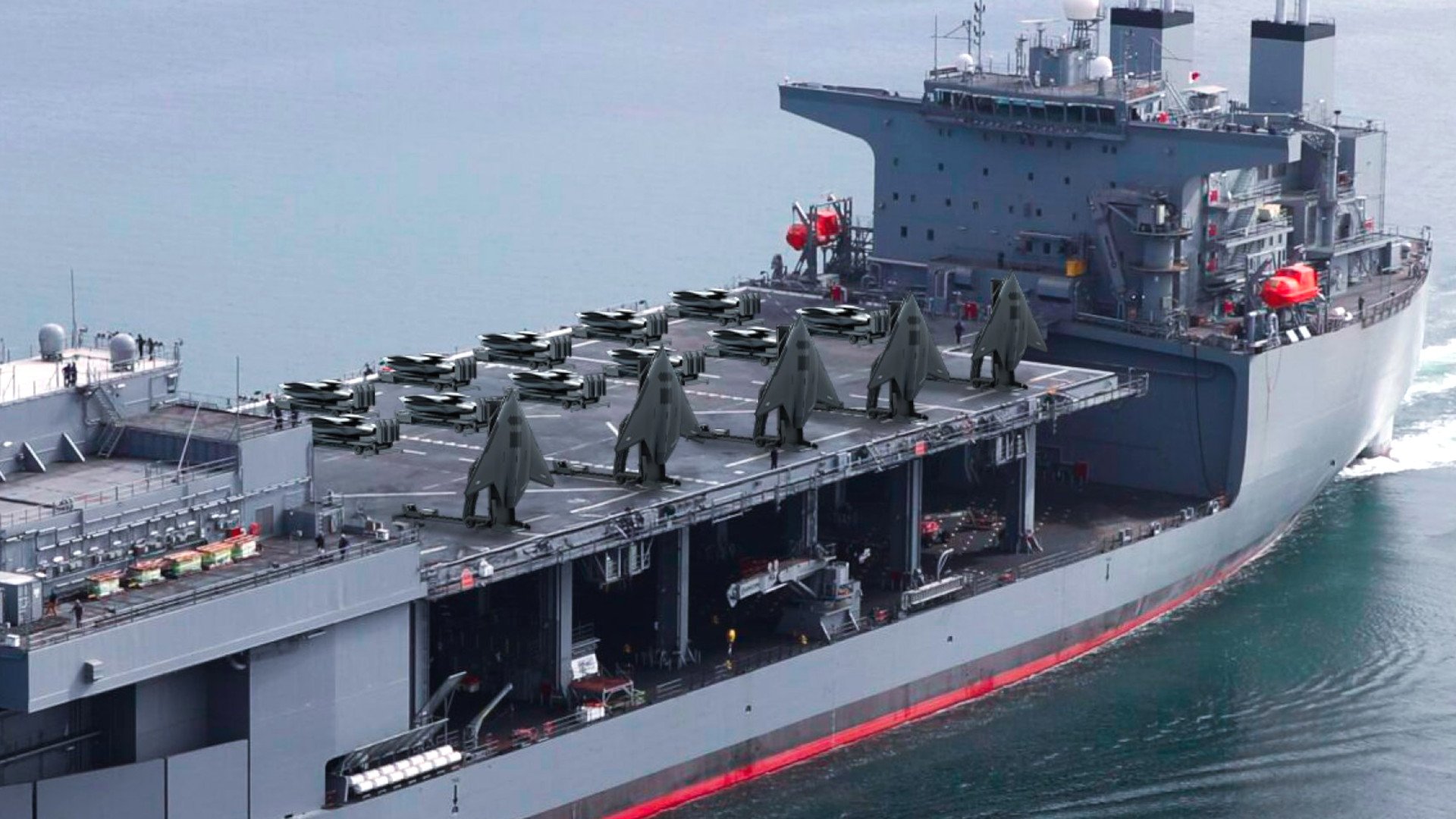
The U.S. Navy has committed another $150 million to Shield AI’s development of its X-BAT vertical takeoff and landing drone, as the company works toward flight testing this year and an early operational capability in 2029. The new funding comes through the Office of the Under Secretary of War for Acquisition and Sustainment’s Defense Exportability Features program, via the Navy. Combined with a $50 million Navy investment made earlier this year with the Pentagon’s Defense Innovation Unit through the Runway Independent Maritime Expeditionary Strike program, and an equivalent amount committed by Shield AI, the total funding stands at $400 million.
Shield AI says it is on schedule to complete the first full-scale prototype by the end of October. The jet-powered, stealth-designed aircraft is intended to take off and land vertically while balanced on its tail, without a runway. Flight testing remains planned for before the end of 2026, with the company’s schedule targeting a fully missionized aircraft in 2028 and the start of series production in 2029.
Armor Harris, Shield AI’s senior vice-president and general manager of the company’s aircraft division, described the preceding year as a period of joint technical work with the Navy. “In broad strokes, the last year has been a bunch of collaborative risk reduction with the Navy. So, wind tunnel testing, engine testing, thermal testing, all kinds of stuff to basically take the major risks in the program, [and] burn them down, so we can move confidently into the production design,” he said. “The last culmination of the risk reduction is the flight testing of the two full-scale prototypes. The first one of those will be done at the end of October.”
Harris said the prototype will include the aircraft’s full exterior shape and propulsion system. “That’s a full-scale vehicle,” he said. “It’s got the outer mold line, it’s got the F110 engine, the full propulsion path, everything in it.” The company has so far shown models of X-BAT publicly, rather than a completed aircraft.
The design shown at the Navy League’s Sea-Air-Space 2026 exposition in April differed substantially from the concept presented earlier. Its planform changed from a cranked-kite arrangement to a more pronounced arrowhead shape, with a straight leading edge and greater sweep. Shield AI has also previously discussed adding more low-observable features around the exhaust in a later design iteration.
The aircraft’s vertical flight system centres on a General Electric F110 engine paired with an Axisymmetric Vectoring Exhaust Nozzle, or AVEN. Ground testing of the propulsion path has already taken place. The AVEN was first developed in the 1990s for an experimental thrust-vectoring F-16 and had been stored for decades before Shield AI brought it into the X-BAT effort.
The nozzle is intended to provide pitch and yaw control. Roll control is to come from bleed air routed through thrusters in the wings. On July 20, 2026, Shield AI said it and GE Aerospace had completed engine light-off testing of the AVEN, describing the work as clearing a critical path toward vertical flight. Engineers from both companies integrated the nozzle into GE Aerospace’s engine setup for the test.
Shield AI has described X-BAT as roughly fighter-sized, with a maximum range of 2,000 nautical miles and a service ceiling of about 50,000 feet. The company has previously set an effective combat radius target roughly twice that of the F-35, or about 1,340 nautical miles, while also saying the figure could be closer to 1,000 nautical miles. The design leaves space for a possible in-flight refuelling system, though work to integrate that capability has not begun.
The planned payload includes internal weapons bays approximately the size of those on an F-35, plus two external hardpoints under the wings. The hardpoints have plumbing for equipment such as range-extending drop tanks or buddy-refuelling stores, which could let the drone serve as a tanker. A Shield AI rendering depicts two AGM-154 Joint Stand-Off Weapon glide bombs in the internal bays and an AGM-158C Long Range Anti-Ship Missile under a wing.
The company says modular construction and open-architecture mission systems are meant to make it easier to add sensors, data links and other capabilities. Harris said the aircraft is intended to perform more than one role. “X-BAT’s really designed to be a multi-role capability, and, if you look out at the 10-20 year time horizon, it’s hard to predict what the future fight is going to look like,” he said. “We fundamentally believe that multi-role capabilities are critically important. And, so, X-BAT, the reason why it’s sized to where it is is [sic] to be able to carry serious strike weapons internally and externally, in addition to being able to do air-to-air [combat], electronic warfare, and other mission sets.”
Harris compared the relationship between the initial prototypes and the future production aircraft to the difference between Lockheed Martin’s X-35 demonstrators and the eventual Joint Strike Fighter variants. “You could think of it as like X-35 versus F-35,” he said. The X-35 demonstrators were broadly similar to, but distinct from, the production aircraft that followed.
The flight campaign will proceed in stages, Harris said. First, the aircraft will sit horizontally on its launch and recovery vehicle, a trailer that carries it for launch and landing, while the engine runs. The team will then raise it vertically and operate it in that position to develop and demonstrate the vertical takeoff and landing technology.
“Then we have one of the biggest cranes in the world that’s getting set up at our test site in Kansas right now, and we hang the vehicle suspended from that crane and do a bunch of testing while it’s hanging from the crane in free flight,” Harris said. “Then we take the crane away, and then we do the actual untethered flights.” He added: “Then we’ll get into flight testing around the end of this year. We’ll be doing vertical takeoff and landing testing with that [the initial prototypes] to actually prove out and develop the VTOL [vertical takeoff and landing] technology for X-BAT.”
Shield AI’s X-Forge 2 facility at Newton City-County Airport in Kansas is expected to serve as the primary flight-test location and a hub for sustaining the aircraft. A production site, X-Forge 3, is being built in Des Moines, Washington. The company’s original facility, X-Forge 1, is in Frisco, Texas. A rendering of X-Forge 2 has been released, as has one of the X-Forge 3 site under construction.
The launch and recovery system is also central to the operating concept. Harris said Shield AI has tested the mechanisms used to “latch and unlatch” the aircraft using an unpowered “battleship” test article. The system has evolved from a towed trailer design and is now self-propelled to some degree.
“The launch and recovery vehicle is actually critical to the operation of the X-BAT weapon system because it enables survivability on the ground. So when you’re operating in a land-based environment, it enables basically shoot-and-scoot tactics,” Harris said. “Enemy transporter-erector-launchers [for missiles] are like pretty hard to find because they’re constantly moving around. Just like X-BAT, when it’s mated onto the launch and recovery vehicle, [it] is always moving around, makes it hard to track, hard to find, hard to destroy.”
Shield AI intends to build one launch and recovery vehicle for each aircraft, with the aircraft remaining on its trailer rather than being removed. “The plan now is to ‘build the one-to-one launch and recovery vehicles to air vehicles. So the air vehicle is always on the trailer. It never comes off of it,” Harris said. “Even maintenance to the air vehicle is done while it’s sitting on that launch and recovery vehicle.” The company plans to build more launch and recovery vehicles than aircraft, allowing them to be positioned around different islands and elsewhere in a theatre so aircraft can use multiple sites as “lily pads.” Harris said the plan does not involve placing multiple aircraft on one launcher.
“When you typically operate a jet, there’s a whole bunch of ground carts and stuff that you bring, like the ground power cart, the ground cooling cart, the air start cart, etc,” Harris said. “So we’ve moved a lot of those systems onto [the] launch and recovery vehicles, so you don’t have all these separate carts, which is pretty critical when you’re trying to do expedit” The available source text ends during this quotation.
Harris said the RIMES program’s end goal is to reach early operational capability in 2029. Asked whether the program aims for an operationalized capability rather than a demonstration, he replied, “correct.” That target would put the effort on an aggressive schedule, with the first prototypes due this October, flight tests planned by year-end, a fully missionized aircraft targeted for 2028 and series production expected to start in 2029.