
The War Zone has reported:
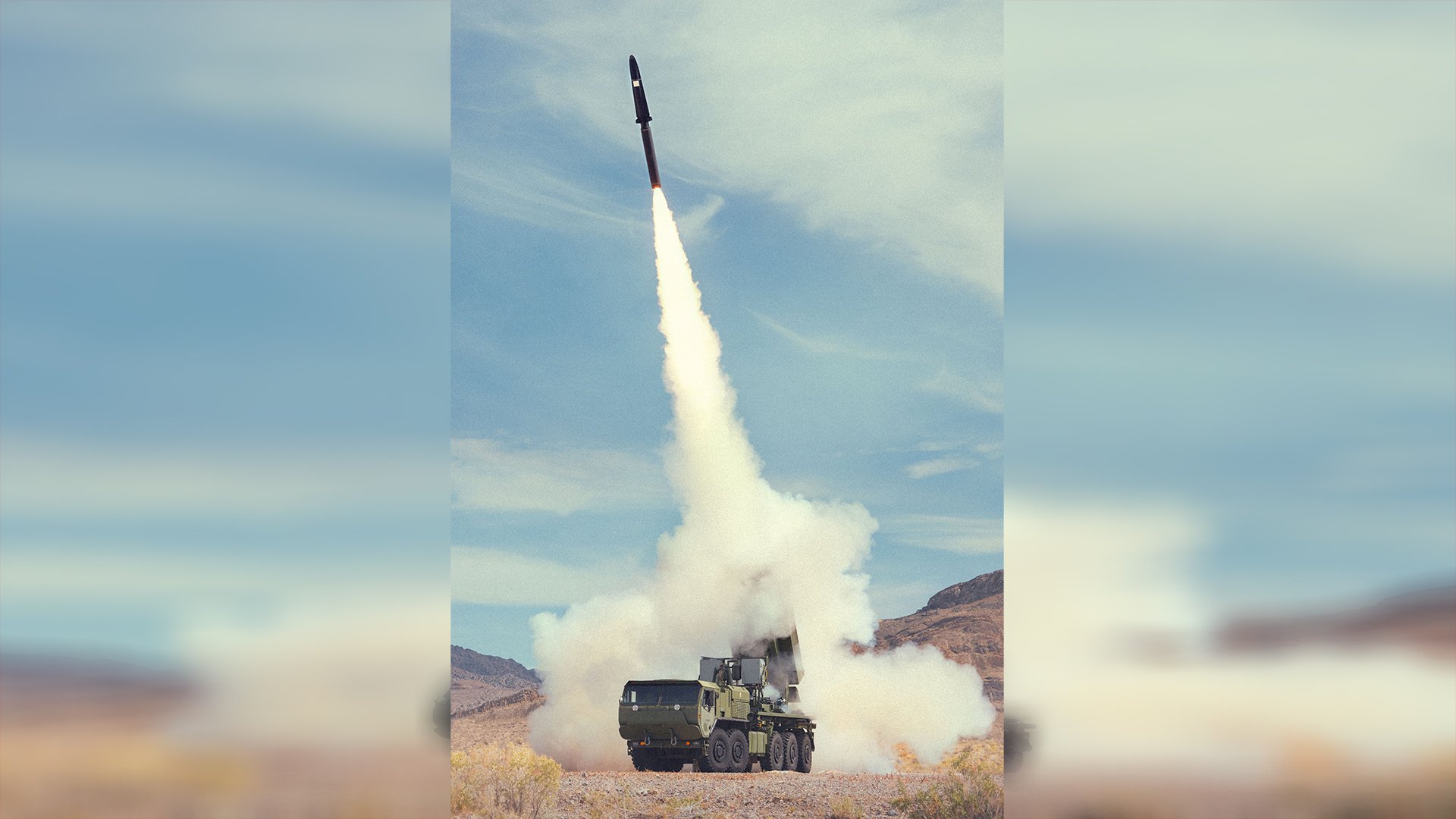
Castelion has released what appears to be the first public image of its Blackbeard hypersonic missile firing from a ground launcher, showing a containerized system mounted on a high-mobility truck chassis. The photograph, posted on X on October 8, 2026, offers a view of the ground-launched version, known as Blackbeard GL, being developed for the U.S. Army.
The company captioned the image, “Container-compatible Blackbeard. Built to move with the fight.” The missile itself has appeared in earlier imagery, but the new photograph provides a look at how Castelion is packaging and operating the ground-launched weapon. The launcher appears to use a compact enclosed container.
The Army’s earlier plans call for an initial ground-launch demonstration using a modified Multiple Launch Rocket System Family of Munitions, or MFOM, pod. That step is to be followed by Blackbeard GL prototypes and development of a dedicated launcher pod. The service ultimately intends to conduct a minimum viable product flight test using the M142 High Mobility Artillery Rocket System’s, or HIMARS, fire-control system.
Castelion posted a separate message on August 3, 2026, with the caption, “Blackbeard for HIMARS.” The company has not established whether the launcher in the October image matches the final production Blackbeard GL pod. It has said previously that test hardware is designed to support rapid development cycles and should not necessarily be taken as representative of the final weapon system.
The Army’s fiscal year 2027 budget documents point to progress toward hardware that more closely represents the planned system. Among the milestones listed for FY2027 is a live-fire launch of a “production representative” Blackbeard GL and launcher pod. That test is the next major Army milestone identified for the programme.
The new photograph appears to show a vehicle Castelion has used in earlier Blackbeard-related testing. The company previously displayed test articles alongside palletized launch equipment, including hardware mounted on an Oshkosh MKR18 Logistics Vehicle System Replacement truck. Castelion has also said it was converting such a vehicle into a launcher for flight testing.
The photograph does not reveal how many missiles one launcher can carry. Based on the apparent dimensions, at least two and possibly as many as four could fit, although that remains an estimate. The image also does not disclose the system’s precise launcher configuration or establish the final missile load.
Castelion has released extensive imagery of Blackbeard test vehicles and formally unveiled the weapon’s current external configuration earlier in 2026. The missile appears to have two stages: a booster and an upper vehicle with features consistent with a hypersonic glide or manoeuvring payload. Compared with the air-launched version, the ground-launch model lacks cruciform tailfins at the rear of its lower stage, while otherwise appearing similar.
The weapon’s production propulsion system and flight profile have not been disclosed, and little is known about its performance. Castelion has previously suggested the missile might reach targets at distances just under 500 miles. Its range would likely be shorter from a ground launch because it would not receive the altitude and speed provided by an aircraft launch platform.
The Army’s interest in Blackbeard GL reflects cost as well as performance. The service has described it as an affordable, mass-produced hypersonic precision-fire capability for engaging moving and hardened targets that are time-sensitive. Its stated goal is to obtain roughly 80 per cent of the capability of the planned Precision Strike Missile Increment 4, or PrSM Increment 4, at a substantially lower cost per round.
The Army’s Dark Eagle Long Range Hypersonic Weapon is an existing U.S. hypersonic system that uses large, highly specialized launch equipment. Blackbeard is being developed around a different approach: a weapon compact and inexpensive enough to manufacture at scale and treat more like a conventional tactical munition. A containerized launcher compatible with the Army’s existing mobile fires systems could let the service field a hypersonic capability without setting up a separate launcher, crew, transport and reload architecture.
The Army has previously shown interest in using the existing MFOM ecosystem and, eventually, HIMARS for Blackbeard GL. The new photograph is consistent with that interest, but does not by itself confirm how the pictured equipment would fit into an eventual operational system. Castelion’s earlier warning about its test hardware also leaves the final pod design uncertain.
Blackbeard GL is one part of Castelion’s wider effort. The company is also working with the Navy to integrate the missile onto the F/A-18E/F Super Hornet. In April 2026, Castelion received a $105 million Navy contract to support integration and transition toward an early operational capability.
A later Navy order worth $23.4 million covered 50 pre-production missiles for early operational capability, along with associated storage and shipping containers. A pair of Blackbeard missiles was shown mounted on a Super Hornet during a developmental test flight on September 18, 2026. The Navy has since moved into additional procurement, as Castelion seeks to establish production at the quantities required.
The missile could also be considered for Navy ships and submarines, as well as ground-based launchers. The source materials do not specify a schedule or configuration for those potential platforms. The Army’s immediate next milestone remains the planned live-fire test of a production-representative Blackbeard GL and launcher pod.
In May 2026, the Pentagon described a possible procurement arrangement tied to successful testing and validation. “Once Castelion achieves testing and validation, the Department will award a two-year multi-year procurement contract for a minimum of 500 Blackbeard missiles annually, with options to extend for up to five years,” the department announced.
The Pentagon also said: “To further encourage Castelion’s self-funded facility expansion, the Department is actively seeking the necessary authorizations and appropriations to purchase over 12,000 Blackbeard missiles over five years.” The proposed quantities reflect a broader U.S. military push to build up stocks of lower-cost precision weapons that can be manufactured simply and at scale, with growing participation from non-traditional defence contractors.
That effort is aimed at building large stockpiles affordably before a major contingency, particularly a potential large-scale conflict with China in the Pacific, and sustaining production during a prolonged war. The October image shows Blackbeard firing from a ground launcher in its initial form, while the Army’s budget documents set out the next test step toward a more representative system.