
The War Zone has reported:
Sikorsky is advancing a package of upgrades intended to keep the UH-60 Black Hawk useful through 2070, including a new digital backbone, more power and payload capacity, autonomy systems and an uncrewed cargo version called the U-Hawk. The company plans to fly the U-Hawk later this year. The Black Hawk has served as a mainstay of U.S. Army aviation for nearly 50 years, and about 4,000 are in service with 36 nations worldwide.
Many existing helicopters, along with new aircraft leaving the production line, are expected to remain in service for decades. Sikorsky’s modernization work is aimed at supporting rapid technology additions and adapting aircraft to future missions. The program includes launched effects, or small drones carried and deployed by helicopters, and systems that provide more electrical power for heavier payloads.
“As part of an overall “Black Hawk 2070” modernization effort we’re developing a number of complementary capabilities, including our U-Hawk uncrewed cargo variant, which we plan to fly later this year,” Jason Wrigley, Sikorsky’s director of business development for Black Hawk, told The War Zone at the company’s Stratford plant in Connecticut.
A central part of the effort is a digital backbone that Sikorsky says is at an advanced design stage in its laboratories. It is intended to provide aircraft-wide interfaces for power, data, networking and cooling, along with open architecture that allows equipment such as sensors to be integrated more easily. The company views it as a core building block for the next generation of Black Hawks, together with new engines and other airframe improvements.
The software-driven approach is designed to align with the U.S. Army’s Modular Open Systems Approach, which supports adding technology at lower cost and with less time and difficulty. Sikorsky says customers could tailor the aircraft as requirements emerge, potentially changing its configuration for individual missions. The company is also developing a modular nose for the H-60 family to hold more sensors and electronics.
“There’s a big focus on open architecture and that ability to quickly plug-and-play,” Wrigley said. “The new modular nose will change the look of the Black Hawk up front to provide even more space for equipment that will work directly with the new digital architecture.”
The replacement nose is designed to provide more than twice the internal volume of the original section. It will include space for internal electronics and an integrated mount for external sensor pods. Sikorsky says the additional capacity could support search-and-rescue operations, control of drones and flight in degraded environments, as well as equipment needed as the Black Hawk’s autonomous functions expand.
Joshua Powers, who spent 22 years as an Army Aviation officer flying Black Hawks, now handles business development for rapid capabilities insertions at Sikorsky. He said the company’s approach is intended to add capability while limiting changes to the way units sustain, train with and operate the helicopters.
“Army units know the Black Hawk inside out; how to fly it, maintain it, and use it to maximum effect. The upgrades we are developing will bring new capabilities faster, without time-consuming and complex changes to sustainment, training, and operations, plus we are adding more range, more payload, and more power to meet the demands of the Indo-Pacific region,” Powers said.
He said the aircraft’s rugged design can be paired with new technology to address a changing battlefield. “I find it amazing to pair new technology with a rugged platform like the Black Hawk. These new innovations are needed to meet the needs of the new complex battlefield. The fight I fought in Iraq is very different from the current operating environment and what future warriors are going to go up against, and what we’re asking them to do is very different from what came before.”
Autonomy is another major part of Sikorsky’s plans. The company’s MATRIX software is being developed on a UH-60M variant. Sikorsky says it is not necessarily intended to remove pilots from every mission, but could take on parts of their workload as missions become more complex and dangerous. Pilots directing collaborative drones, for example, could focus on the drone task while the system helps manage aircraft functions, Wrigley said.
“The standard Black Hawk crew operates with two pilots. Adding our MATRIX autonomy system gives the operator options - a single pilot could fly without an unbearable workload and still fulfil a mission commander role, for example. The Army could then operate the Black Hawk with no pilots at all when that’s the appropriate option,” Wrigley said.
MATRIX was developed on Sikorsky’s UH-60A fly-by-wire Optionally Piloted Black Hawk and has been tested by company and Army aviators. The software has logged more than 1,000 flight hours over 500 tests and demonstrations. It has also been integrated on more than 20 platforms, including Black Hawks used in exercises by the Defense Advanced Research Projects Agency and the U.S. Army.
The Army received its first UH-60MX Optionally Piloted Vehicle on March 20, 2026, according to the source account. Wrigley said the aircraft was delivered earlier in the year and marked the first full-authority fly-by-wire and optionally piloted UH-60 in the Army fleet. Soldiers are using it for testing and to provide feedback as the Army develops tactics, techniques and procedures for autonomous Black Hawks. Sikorsky has since received a contract to deliver three more MX aircraft.
Autonomy kits have been installed on all three U.S. Army Black Hawk models: the UH-60A, UH-60L and UH-60M. Sikorsky plans to offer autonomy options on new Black Hawks as they are built and says MATRIX can also be retrofitted to aircraft already in service.
Powers described potential benefits in both combat and routine operations, including situations where fatigue or poor visibility creates risk. “Flying at night and seeing the tracer fire coming up at you, things like that, I honestly feel that’s not the big threat. It’s when you’re going to land and there’s just a big dust cloud. When you’re tired, you aren’t as focused. Having MATRIX, whether that’s with one, two, or no pilots, it’s about that reduced workload on the mission. Pilots won’t be as fatigued, plus they have the safety net of a fully autonomous aircraft that can, if needed, land in all of those difficult environments. It will give commanders more operational flexibility and the ability to mitigate risk in less-than-ideal conditions dictated by the enemy or weather.”
He said the technology is meant to support the entire four-person crew, not only the pilots. Crewmembers in the cabin help pilots judge the aircraft’s position and direction, while MATRIX draws on sensors and flight information. “The Black Hawk operation isn’t just about pilots, it’s also that integrated four-person crew. As a pilot, you’re relying on your senses and also on the guys in the back to watch out and tell you where you’re going. MATRIX is just going to help that team effort and put you in a better position to bring the crew back safely. It integrates all the systems and sensors and uses altitude, airspeed, radar altimeter, drift indications, and puts the fly-by-wire technology to where it can make rapid adjustments and changes based on what it’s seeing with the sensors.”
Sikorsky’s U-Hawk is a further application of the autonomy work. Unveiled in 2025, the S-70UAS removes the Black Hawk cockpit and related equipment, replacing the front end with clamshell cargo doors to create a large internal space. The first aircraft is based on a used UH-60L acquired by Sikorsky as a conversion template. That aircraft was displayed at the Association of the United States Army exhibition last year, Wrigley said.
“Since then we’ve been adding the fly-by-wire and integrating the MATRIX autonomy. It’s currently in our innovations hangar in Bridgeport, Connecticut, getting the final work done and it will make its first flight as a U-Hawk later this year,” Wrigley said.
Sikorsky sees the aircraft as a way to move supplies in contested logistics missions where the threat level makes an uncrewed platform preferable. The company also sees it carrying large numbers of launched effects. Wrigley said Black Hawks being divested from service could be converted to the U-Hawk configuration as a lower-cost way to bring the capability to market.
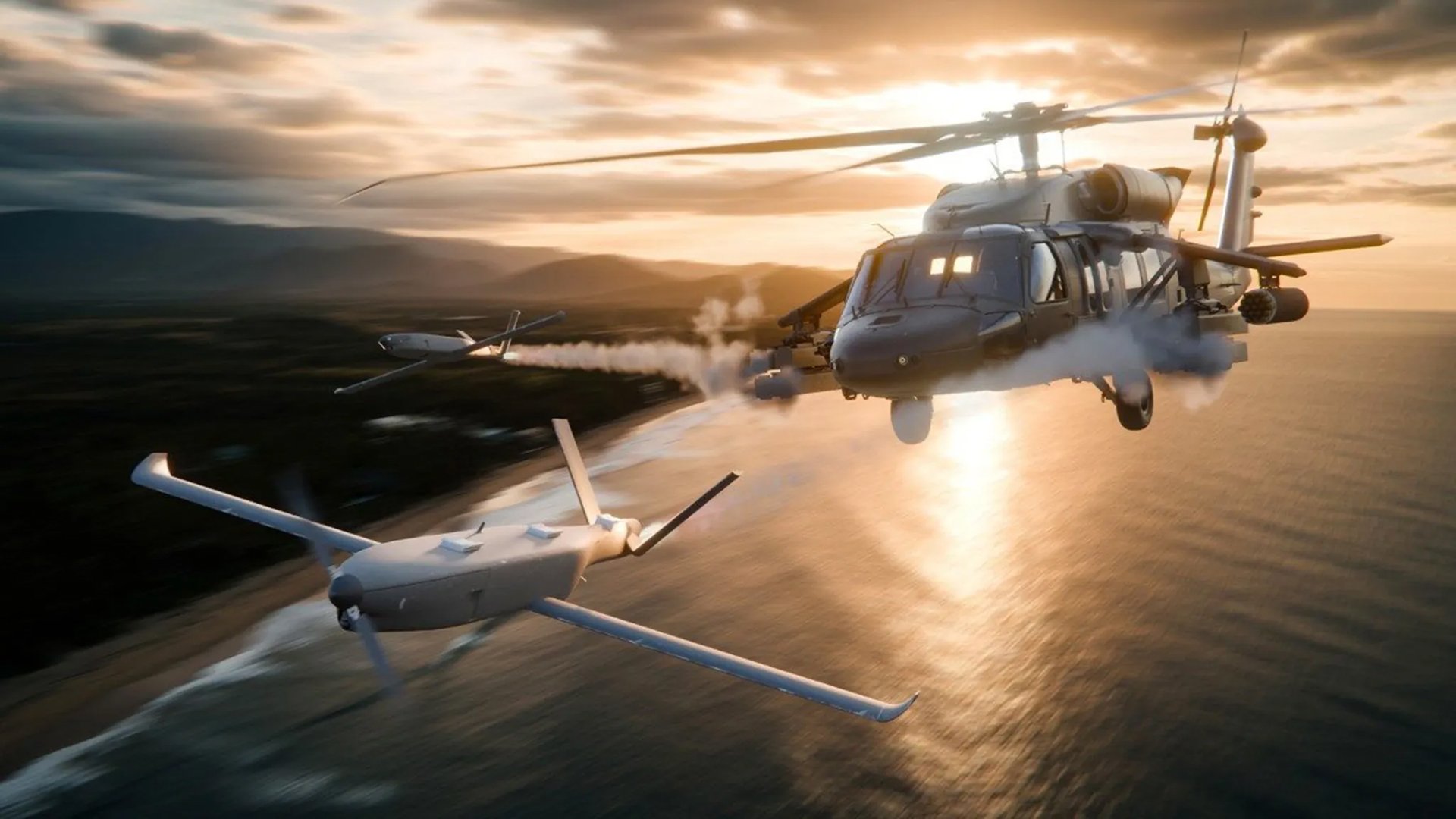
The Army’s interest in launched effects reflects their potential battlefield uses: gathering intelligence for commanders, relaying communications, jamming or distracting enemy emitters, and serving as loitering munitions. Smaller air-launched drones could be carried and fired from launchers mounted on stub wings, while other concepts would carry larger quantities inside the cabin as a “mega-pack.” Sikorsky considers both approaches suitable for the Black Hawk and U-Hawk.
The digital backbone is designed to support plug-and-play drone command equipment, potentially letting a Black Hawk serve as a mothership that launches, assigns tasks to and commands groups of multi-mission drones. A Launched Effect-Medium Range drone was fired from a UH-60M during Project Convergence-Capstone 6 in July 2026, according to the source account. Sikorsky’s wider modernization effort combines these potential new roles with added range, payload and power, while keeping the Black Hawk platform in service for future decades.